Modern Zoo Exhibit Design Trends: The current era of zoo architecture is defined by Landscape Immersion, a philosophy that removes visual barriers to make guests feel they are entering the animal’s world. Key trends for 2026 include Multi-Species Habitats that mimic natural ecosystems, Verticality-First Enclosures for arboreal species, and the use of Stainless Steel Rope Mesh to provide 90% transparency without compromising safety. These designs prioritize “Choice and Control” for the animals, ensuring welfare and conservation remain at the heart of the visitor experience.
1. Landscape Immersion: The Death of the “Cage” Look
In the world of modern zoology, the era of “viewing animals in boxes” is officially over. The leading zoo exhibit design trend for 2026 is Landscape Immersion—a sophisticated architectural philosophy where the boundaries between the human world and the animal habitat are intentionally blurred. This shift represents a move from the 20th-century “Menagerie” style toward truly Biocentric Habitats.
From “Menageries” to “Biocentric Habitats”
Historically, zoo enclosures were designed for human convenience: easy to clean, easy to view, and heavily barred. A “Biocentric” approach flips the script, designing the space primarily for the animal’s biological and psychological needs.
- The Goal: To recreate a specific ecosystem (like a Congolese rainforest or an Indonesian canopy) so accurately that the animal exhibits a full range of natural behaviors.
- The Result: Guests no longer feel like they are looking at an exhibit; they feel like they have stepped into the wild.
Creating “Boundary-Less” Vistas with Hebmetalmesh
To achieve immersion, designers must eliminate the visual “stutter” caused by traditional fencing. This is where hebmetalmesh becomes the architect’s most valuable tool.
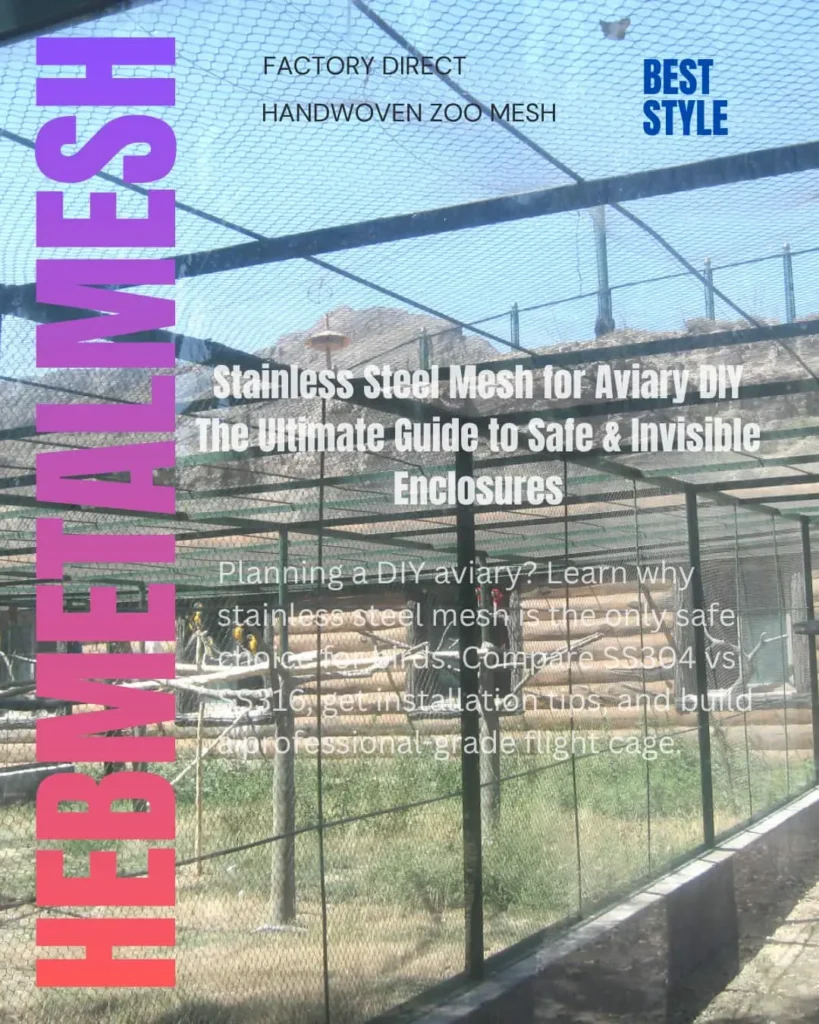
- The “Vanishing” Effect: By using ultra-thin, high-tensile stainless steel rope mesh—specifically with a Black Oxide finish—designers can create massive spans of “invisible” walling.
- Seamless Transitions: Unlike glass, which can reflect the visitor and create a physical “wall” of glare, bird netting fence allows air, sound, and scent to pass through. This sensory connection is vital for an immersive experience, making the barrier feel like a suggestion rather than a cage.
The Psychology of Empathy and Engagement
The removal of vertical bars has a profound psychological effect on the visitor.
- Breaking the “Prison” Stigma: Heavy bars subconsciously signal to the brain that the animal is a prisoner or a threat. This creates a psychological distance that hinders conservation messages.
- Fostering Connection: When the bars are replaced with nearly transparent Parrot and Macaw enclosure mesh, the visitor’s brain “ignores” the barrier. This lack of visual interference increases empathy, making the guest feel like a guest in the animal’s home.
- Increased Conservation Action: Data shows that visitors spend more time observing animals in immersive habitats and are significantly more likely to donate to conservation efforts when they feel a direct, unobstructed connection to the species.
2. Multi-Species Habitats: Engineering Social Complexity
The second major zoo exhibit design trend for 2026 is the move away from monoculture toward complex, multi-species ecosystems. By grouping animals that naturally coexist in the wild, zoos can stimulate natural social behaviors, reduce boredom, and provide a much richer educational narrative for visitors. However, mixing species creates a unique set of engineering puzzles that only high-performance materials can solve.
The Rise of the “African Savanna” Model
The “African Savanna” or “South American Rainforest” models are the gold standard for modern immersion. Instead of seeing a giraffe in one pen and an ostrich in another, guests see them interacting in a single, massive footprint.
- Simulating Natural Life: These habitats allow for inter-species dynamics—zebras grazing near giraffes while hornbills fly overhead.
- Spatial Efficiency: By combining footprints, zoos can dedicate more square footage to a single, high-quality environment rather than several small, cramped ones.
Integrating Specialized Mesh for Avian Residents
One of the biggest challenges in a multi-species habitat is containing birds within a space designed for large mammals. This is where Peacock enclosure mesh and large-scale perimeter barriers must work in tandem.
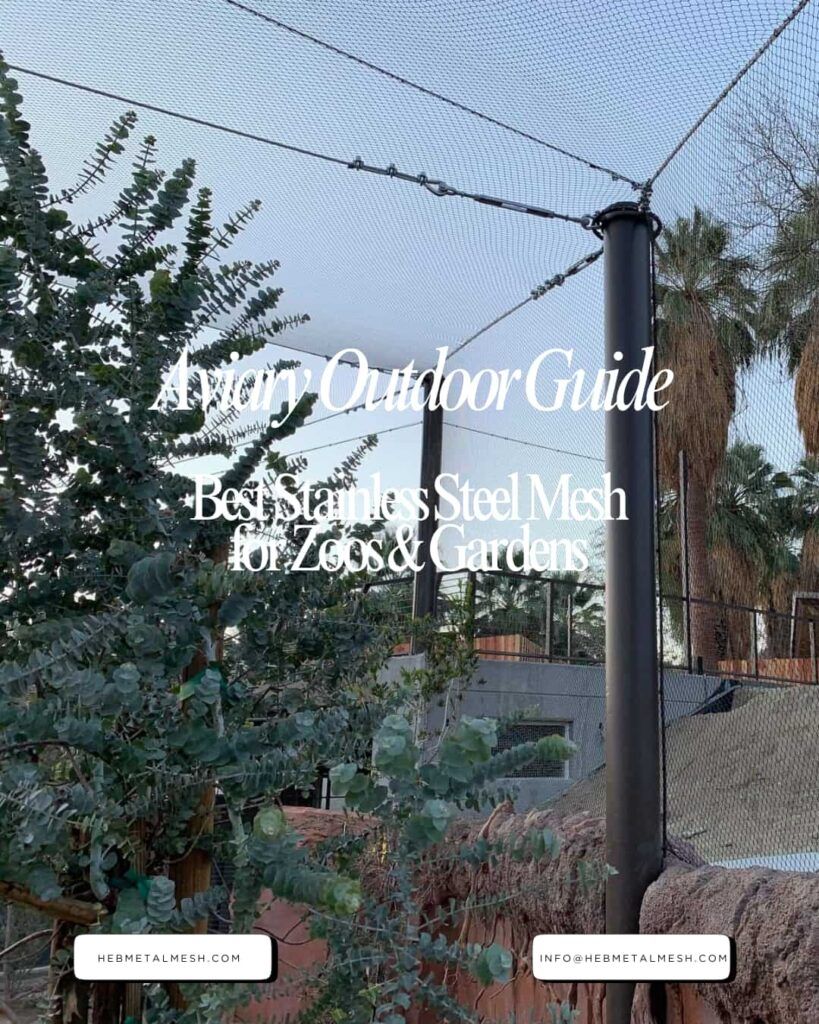
- The “Invisible” Ceiling: Designers often use a massive “tent” of stainless steel bird netting that spans the entire multi-species area.
- Zoned Protection: While a giraffe won’t challenge a mesh wall, a smaller bird might try to find a gap. The mesh must be fine enough to keep small birds in (25mm to 38mm aperture) while being strong enough to withstand the tension of a 100-foot span.
The Engineering Challenge: Strength vs. Scale
How do you build a fence that is light enough for a bird but strong enough for a startled zebra?
- Variable Tensile Loads: In a multi-species habitat, the hebmetalmesh must be specced for the “strongest potential impact.” If a large mammal accidentally bumps into a perimeter wall, the mesh needs to be flexible enough to absorb the kinetic energy without snapping.
- Hybrid Mesh Zones: Architects often use Variable Diameter Mesh. They might install a 2.0mm or 3.2mm wire rope near the ground level (where mammals are active) and transition to a lighter 1.2mm or 1.6mm Parrot and Macaw enclosure mesh for the upper canopy.
- The “Universal” Safety Net: By using 316-grade stainless steel, engineers ensure that the habitat is safe for everyone—from the delicate beak of a tropical bird to the powerful hooves of a savanna dweller.
3. “Choice and Control”: Designing for Animal Agency
The most significant ethical shift in zoo exhibit design trends for 2026 is the move toward “Animal Agency.” In the past, enclosures were designed to keep animals on display at all times. Today, modern zoology prioritizes the animal’s right to choose where they are, who they are with, and whether they want to be seen. This welfare-led design transforms the habitat from a “stage” into a functional living space.
Welfare-Led Design: The Right to Retreat
Modern habitats now incorporate “retreat zones”—areas where animals can move out of the public eye to rest, socialize, or avoid weather.
- Off-View Holding Areas: By using hebmetalmesh to create “soft” boundaries between public and private zones, keepers can manage animal movement without the stress of solid steel doors.
- Visual Privacy: Designers often use dense plantings against the mesh to create “pocket” habitats. From the animal’s perspective, they feel hidden; from the guest’s perspective, they get a rare, “peek-a-boo” glimpse of a natural behavior.
Facilitating Natural Behaviors: Mesh as a Tool
Stainless steel rope mesh isn’t just a barrier; it’s an enrichment tool. Unlike glass or solid walls, stainless steel bird netting allows animals to interact with their environment in 3D.
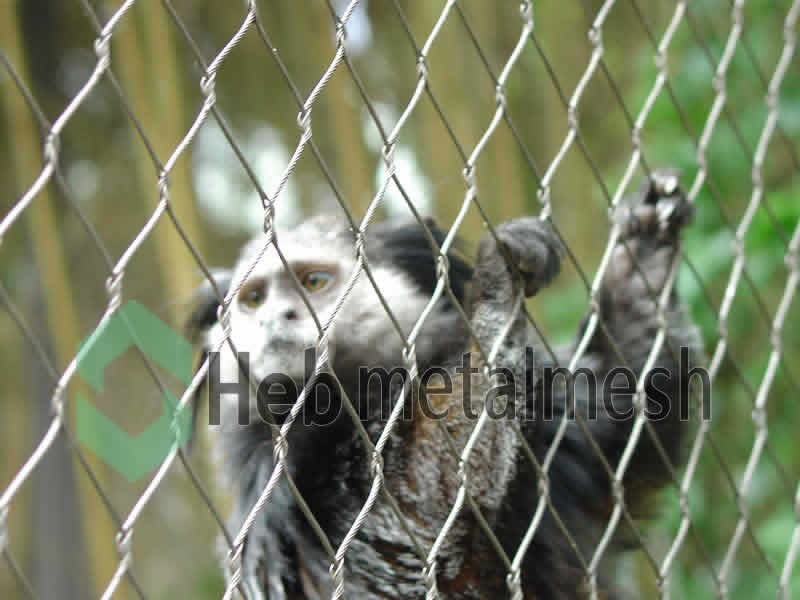
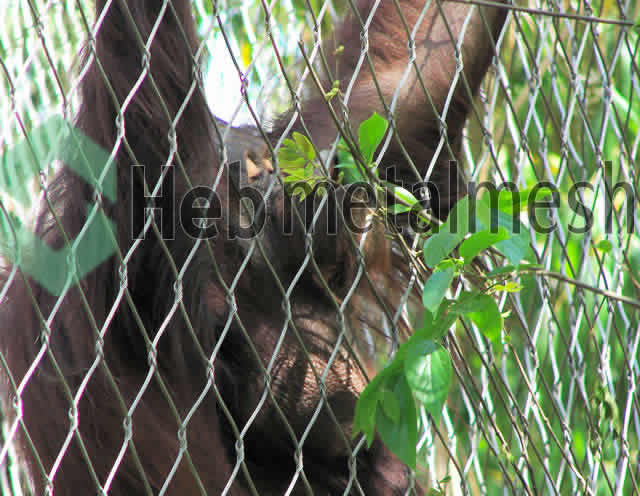
- Climbing and Brachiating: For primates and small mammals, the hand-woven diamond pattern of the mesh acts as a giant climbing wall. The mesh provides the necessary grip for natural movement without the risk of splintering or tearing.
- Nesting and Foraging: Birds and small mammals can cling to the mesh to reach “hanging” enrichment items or nesting materials placed high in the canopy. This encourages the vertical use of space, which is critical for physical health and mental stimulation.
Case Study: Parrot and Macaw “High-Impact” Welfare
Large psittacines present a unique challenge for agency-led design because they are both highly destructive and high-energy flyers.
- Beak-Strength Enrichment: A Macaw’s primary way of interacting with the world is through its beak. Parrot and Macaw enclosure mesh must be able to withstand constant “testing” and chewing without fraying or releasing toxic coatings.
- High-Impact Flight: In large-scale immersion aviaries, birds can reach significant speeds. The mesh must have enough “give” (elasticity) to catch a bird in mid-flight without causing injury, yet be strong enough to snap back into a taut, invisible plane immediately after.
- The Verdict: By using zoo-grade 316 stainless steel, designers provide these birds with a space where they can be “wild” without the constraints of a traditional, restrictive cage.
4. Verticality and Over-Path Travel
Perhaps the most visually stunning zoo exhibit design trend of 2026 is the expansion of the habitat into the “Z-axis.” For over a century, animals and guests were separated by a horizontal plane—the animal stayed on their side, the human on theirs. Today, architects are breaking that plane, allowing animals to travel above, around, and even through the visitor space via elevated transit systems.
The “O-Line” and the Animal Bridge Concept
The “O-Line” (Orangutan Line) or animal bridge is a revolutionary concept that allows arboreal species to move between primary habitats across the zoo.
- Guest Immersion: Imagine walking down a garden path while a troupe of monkeys or a pair of Red Pandas travels 20 feet directly above your head.
- Psychological Stimulation: For the animals, this mimics the “highways” of the rainforest canopy. It provides varied sensory input and a sense of territorial expansion that a static, four-walled enclosure simply cannot offer.
Safety Requirements for Overhead Tunnels and Chutes
Moving animals over guest pathways requires zero-fail engineering. This is where the structural integrity of hebmetalmesh is non-negotiable.
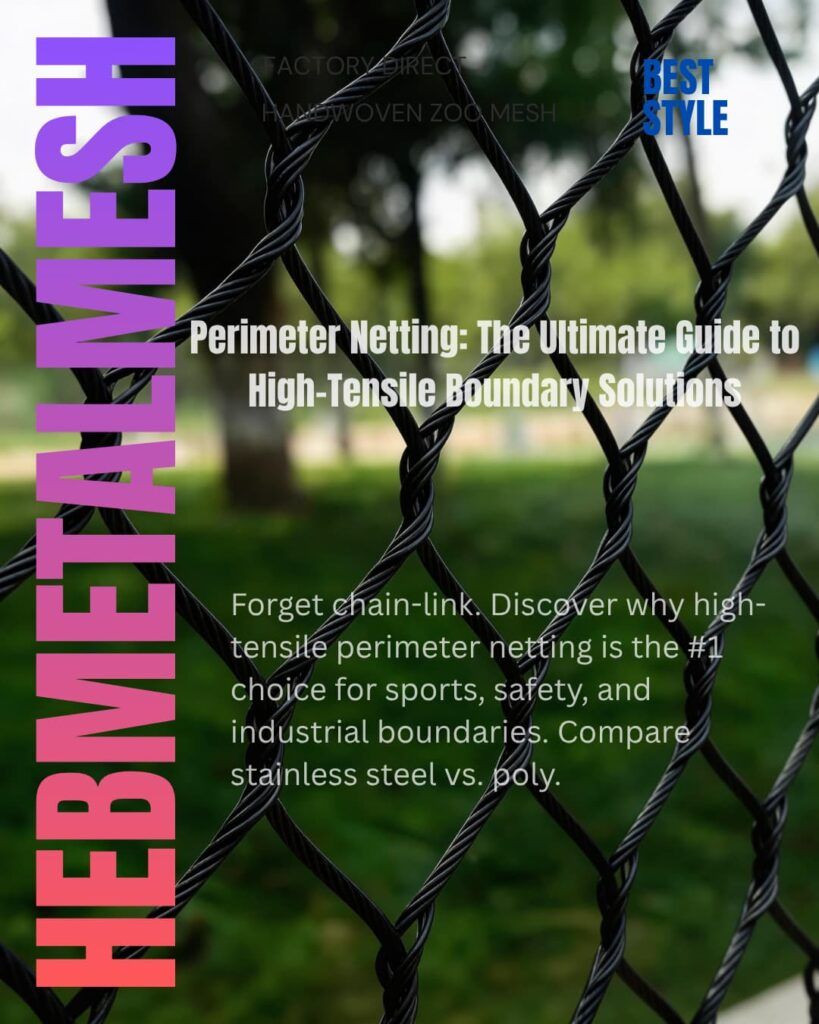
- 360-Degree Containment: Overhead “chutes” are typically constructed as cylindrical tubes made of high-tensile stainless steel rope mesh.
- Load-Bearing Capacity: These tunnels must be able to support the full weight of the animal (and potentially multiple animals) as they jump or climb. Using a 2.0mm to 3.2mm wire rope ensures that even if an animal thrangs against the side, the mesh maintains its shape and tension.
- Debris Protection: Specialized stainless steel bird netting is often layered over the base of these tunnels to prevent food or waste from falling onto guest walkways, maintaining a hygienic environment for everyone below.
Maximizing Small Footprints in Urban Zoos
As urban zoos face space constraints, they are looking “up” to increase animal welfare. By utilizing 3D Vertical Design, a small footprint can be transformed into a massive, multi-level territory.
- The “Lego” Approach: Stacked habitats allow different species to occupy different “altitudes.” You might have a ground-dwelling tapir exhibit on the floor, with a Parrot and Macaw enclosure mesh canopy overhead.
- Tower Habitats: For climbing species, designers are creating tall “mesh towers” that allow for hundreds of feet of vertical climbing. These towers provide animals with a high-ground “sentinel” view of the surrounding zoo—a natural behavior that significantly reduces stress in captive environments.
By embracing verticality, zoo architects aren’t just saving space; they are giving animals back their right to the sky.
5. Sustainability & Material Science in 2026
In 2026, a “beautiful” exhibit is no longer enough; it must also be sustainable. Modern zoo exhibit design trends are heavily influenced by the global push for carbon neutrality and bird-safe architecture. As zoos lead the charge in conservation, their physical structures must reflect those same values.
The “Green” Choice: 316-Grade Stainless Steel
When evaluating the life-cycle of exhibit materials, 316-grade stainless steel is the undisputed champion of sustainability.
- Longevity over Replacement: Unlike plastic netting that micro-shreds into the environment or galvanized steel that requires toxic anti-rust coatings, stainless steel lasts 30+ years. This “set it and forget it” durability drastically reduces the carbon footprint associated with frequent teardowns and reconstructions.
- 100% Recyclability: At the end of its multi-decade lifespan, stainless steel rope mesh is fully recyclable, fitting perfectly into the “circular economy” model that modern zoos strive to achieve.
Bird-Friendly Architecture: Mesh vs. Glass
Avian collisions are a major concern in zoo design. While large glass viewing panels are popular, they can be deadly “invisible” traps for birds.
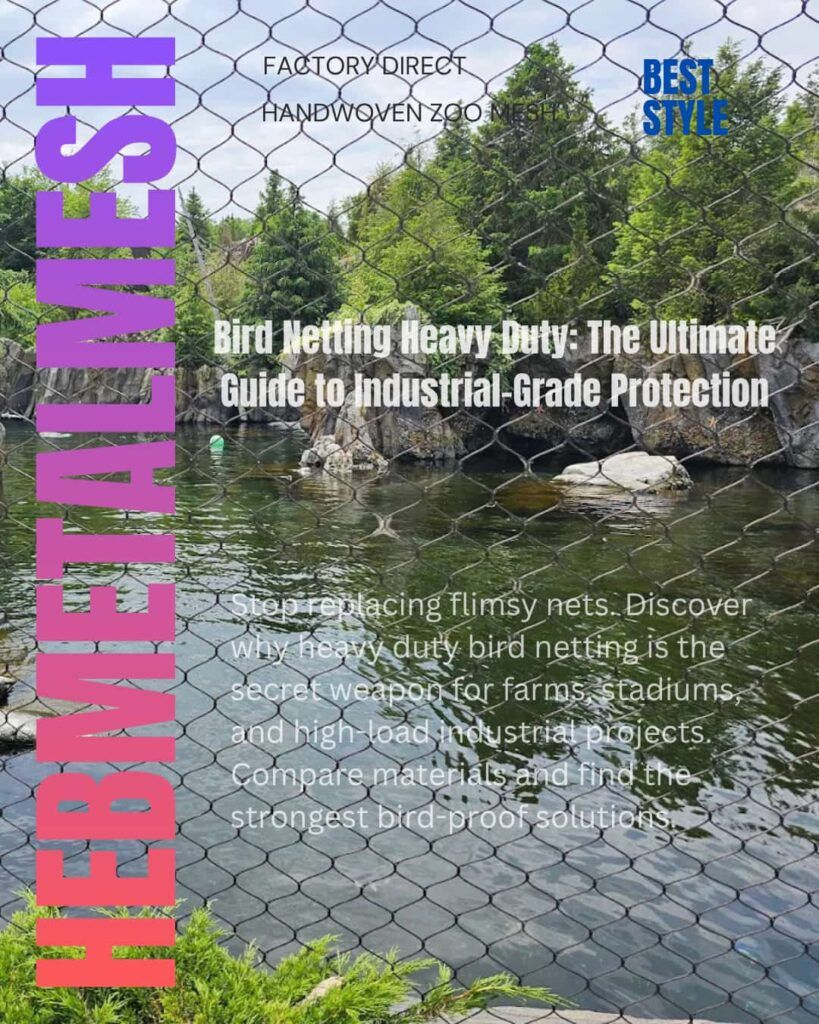
- The Mesh Advantage: High-transparency stainless steel bird netting provides a physical and visual cue to birds, preventing high-speed collisions while maintaining a clear view for visitors.
- Non-Toxic Environment: Many older fencing materials used lead or zinc coatings that could be ingested by curious animals. Hebmetalmesh’s stainless steel is inert and non-toxic, ensuring a “clean” habitat from day one.
6. The “Aha!” Moment: Zoo-Grade Tech for Private Sanctuaries
One of the most exciting trends we’ve seen at Hebmetalmesh is the “Trickle-Down” effect. Professional zoo exhibit design trends are no longer reserved for major metropolitan institutions. High-end private estates and wildlife rehabilitators are now adopting these same professional standards.
Professional Standards for Private Estates
Wealthy conservationists are moving away from “bird cages” and toward “private immersions.”
- Scaling the Tech: Using the same Parrot and Macaw enclosure mesh found in top-tier bird parks, private owners are building walk-in sanctuaries that rival professional exhibits.
- Aesthetic Value: Property owners want the security of a zoo-grade Eagle enclosure but the beauty of a garden feature. The “Invisible Fencing” techniques used by architects are perfectly suited for luxury residential landscapes.
The Future is Transparent
Whether it’s a multi-million dollar “O-Line” for orangutans or a private backyard sanctuary, the goal for 2026 is clear: Transparency, Agency, and Sustainability. By choosing materials that prioritize the animal’s welfare and the visitor’s immersion, we aren’t just building fences—we are building a future where humans and wildlife coexist without barriers.
Designing the Next Generation of Wildlife Habitats?
Hebmetalmesh provides zoo-grade stainless steel rope mesh for world-class exhibits. From landscape immersion projects to high-security raptor centers, we help architects turn vision into reality.
- Unmatched Transparency: Over 90% open area for immersive viewing.
- Extreme Durability: 316-grade steel for 30+ years of maintenance-free service.
- Custom Engineering: Apertures and wire diameters tailored to your species.
Frequently Asked Questions: 2026 Zoo Exhibit Design
Landscape immersion reduces the psychological stress of “enclosure awareness.” By using nearly invisible hebmetalmesh and naturalistic rockwork, animals are encouraged to occupy the entirety of their habitat, including perimeter areas they might otherwise avoid. This leads to increased natural movement, lower cortisol levels, and higher rates of successful breeding in sensitive species.
Yes, it is the safest material available for over-path travel. Unlike rigid panels, hand-woven stainless steel bird netting is flexible and absorbs the kinetic energy of a jumping primate or large cat. Our 316-grade mesh is engineered to support the static weight of the animals and the dynamic forces of their movement, ensuring 100% public safety.
For species with high bite force, we recommend a minimum wire diameter of 2.0mm to 3.2mm. Our Parrot and Macaw enclosure mesh is made of high-tensile 316 stainless steel, which is significantly harder than the beaks or teeth of the animals. It does not fray or release metal shards, preventing ingestion injuries common with lower-quality fencing.
Absolutely. Unlike traditional painting or PVC coating, our Black Oxide process is a chemical conversion of the steel’s surface. It does not “off-gas,” it won’t flake into the soil or water, and it is completely non-toxic to animals. It also significantly extends the life of the mesh by adding an extra layer of corrosion resistance, meeting the highest LEED and green-building criteria.
Yes. Many high-end private estates now utilize “Zoo-Grade” technology to create immersive backyard aviaries. By using the same Peacock enclosure mesh and tension-cable engineering found in professional exhibits, private owners can achieve that “invisible” look while ensuring their birds are protected by professional-level security.