1. Executive Summary & Introduction
Choosing the right outdoor netting material is a critical decision that balances project safety with long-term maintenance costs. For maximum durability in demanding environments, engineers must specify AISI 316 or 316L stainless steel cable mesh. This guide clarifies how to select the correct grade, understand wire construction, and avoid common failure points like poor coating adhesion or incorrect tensioning, ensuring your enclosure remains secure, aesthetically pleasing, and corrosion-resistant for decades.
The Challenge of Outdoor Durability
In outdoor settings, netting is not merely a partition; it is a structural component exposed to constant environmental stressors. UV radiation, fluctuating thermal loads, and corrosive agents—ranging from salt spray to acidic bird droppings—work to degrade subpar materials rapidly. Many projects fail within years because they treat netting as a decorative afterthought rather than an engineered barrier. When you overlook material science, you aren’t just risking aesthetic decay; you are inviting structural failure, costly replacement cycles, and potential safety liabilities in environments like zoo habitats or public safety barriers.
The Factory Perspective
From a professional China stainless steel cable mesh factory with 10+ years export experience, we have observed firsthand the catastrophic results of choosing the wrong specifications. Our expertise is built on thousands of successful international projects where we have provided custom material solutions that meet rigorous ASTM and EN standards. By moving beyond “standard” options and analyzing specific site conditions, we help procurement managers and designers secure their projects with material that is proven to withstand the test of time.
2. Metallurgical Foundations: 304 vs. 316 and Beyond
Understanding the chemical composition of your mesh is the difference between a product that lasts 25 years and one that begins showing “tea-staining” or pitting within five. Stainless steel relies on a passive chromium-oxide layer to resist corrosion; however, this layer can be compromised by chlorides and environmental pollutants.
The Chemistry of Corrosion
The secret to corrosion resistance lies in the alloying elements. While all stainless steel contains Chromium (Cr) to provide basic protection, the addition of Molybdenum (Mo) is what creates a robust defense against pitting.
- Grade 304: Typically contains 18% Chromium and 8% Nickel. It is an excellent general-purpose material but lacks the molybdenum necessary to fight aggressive chloride attacks.
- Grade 316: Adds 2–3% Molybdenum. This acts as a chemical “shield,” significantly increasing resistance to salt spray and industrial chemical exposure.
- Grade 316L: The “L” stands for Low Carbon. By keeping carbon levels below 0.03%, this grade prevents carbide precipitation during welding, ensuring the mesh remains corrosion-resistant even at the structural joints.
304 vs. 316/316L: Strategic Selection
- Use 304 (Inland): If your project is located far from the coast, in a dry climate, and away from significant industrial pollution, 304 provides the necessary strength and aesthetic at a lower cost.
- Use 316/316L (Coastal/High-Humidity): For any project within 5–10 miles of the coast or in high-humidity regions, 316 is the minimum requirement. The molybdenum content prevents the “pitting” that destroys the mesh integrity in salty air.
Beyond 316: The Duplex Advantage
In extreme environments—such as direct contact with saltwater, heavy industrial chemical plants, or regions with extreme acid rain—even 316 can eventually succumb to stress corrosion cracking. In these cases, we recommend Duplex Stainless Steel (Grade 1.4462). With a microstructure consisting of both austenite and ferrite, Duplex steel offers significantly higher tensile strength and superior resistance to chloride-induced stress corrosion compared to standard 316.
Material Comparison Chart
| Steel Grade | Chromium (Cr) | Molybdenum (Mo) | Corrosion Resistance | Primary Use Case |
|---|---|---|---|---|
| 304 | ~18% | 0% | Moderate | Inland, low-corrosion areas |
| 316 | ~16% | 2% – 3% | High | Coastal, marine, general outdoor |
| 316L | ~16% | 2% – 3% | High | Welded structures, high humidity |
| Duplex (1.4462) | ~22% | 3% | Extreme | Saltwater contact, industrial sites |
3. Wire Rope Architecture: Technical Performance Specs
The structural backbone of any high-quality outdoor netting material is the wire rope construction. It is not enough to simply choose a diameter; you must understand the interplay between strand configuration and mechanical performance.
Strand Breakdown: 7×7 vs. 7×19
The nomenclature “7×7” or “7×19” refers to how the wire rope is bundled. A 7×7 construction consists of seven bundles, each containing seven individual wires. This configuration creates a relatively stiff, robust cable with high dimensional stability, making it the preferred choice for structural fencing where minimal stretch is required.
In contrast, a 7×19 construction—seven bundles of 19 wires each—is significantly more flexible. The higher wire count allows the cable to bend around tighter radii without fatigue, which is ideal for complex, contoured architectural shapes or intricate aviaries. However, increased flexibility often comes with a higher degree of initial elongation, which must be accounted for during the design phase.
Tensile Strength & Load Capacity
To ensure an enclosure can withstand environmental loads (such as snow accumulation or wind pressure) or animal impact, you must review the Minimum Breaking Load (MBL). High-quality stainless steel cable must comply with international standards, such as ASTM A580/A580M-06, which defines the material specifications for stainless steel wire.
As a professional manufacturer, we stress that load capacity is not a suggestion; it is a safety requirement. Engineers should calculate the peak potential force—factoring in animal weight and momentum—and compare it against the MBL charts provided for your specific wire diameter.
Engineering Documentation: The 3.1 Mill Certificate
Never accept a bulk supply of netting without proper documentation. You should always request an EN 10204 3.1 mill test certificate. This document serves as a “birth certificate” for your steel, certifying that the chemical composition and mechanical properties have been verified through batch testing. It is your only guarantee that the material on your job site matches the specifications you paid for.
For a full technical breakdown of our available wire rope constructions and load-bearing data, please visit our comprehensive product page.
4. Critical Finishing Processes: The “Why” Behind Coating
Aesthetics often drive the design of modern enclosures, but finishing processes are about far more than color. They determine the surface longevity of your mesh.
Black Oxide & Powder Coating: The Pre-Weave Rule
We often receive inquiries regarding post-production coating. Our advice is firm: If your project requires a black oxide or powder-coated finish, it must be applied before the wire is woven into a mesh.
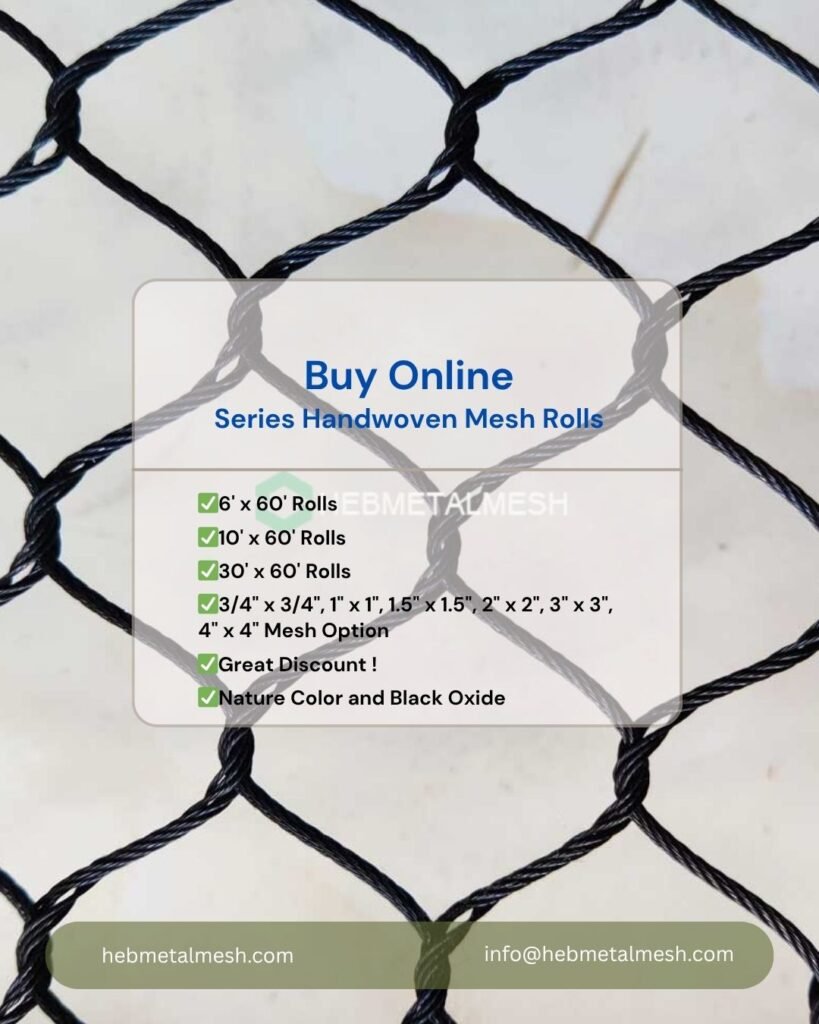
When you coat a finished mesh panel, the process inevitably fails at the “crossover” points where the cables are ferrules or knotted. Because these points are tight, the coating cannot penetrate the gap, leaving raw, exposed metal. This creates a “corrosion bridge” where moisture collects, leading to premature rusting. Pre-weaving the wire ensures the entire surface area is encapsulated, providing uniform protection and a superior aesthetic finish. To see this in action for high-end zoo projects, explore our black oxide zoo mesh ordering guide.
Electrolytic vs. Mechanical Polishing
The final surface finish of your stainless steel significantly impacts maintenance:
- Electrolytic Polishing: This electrochemical process removes a microscopic layer of surface metal, “smoothing” the peaks and valleys on a molecular level. It creates an exceptionally bright, clean surface that is highly resistant to bacterial growth and environmental pollutants. It is the gold standard for high-visibility architectural or marine applications.
- Mechanical Polishing: This involves abrasive grinding. While it provides a sleek look, it can leave tiny directional scratches that may act as sites for “tea-staining” in harsh, salty environments.
For most outdoor netting applications, electrolytic polishing is superior as it enhances the stainless steel’s natural ability to form its protective chromium-oxide layer, ensuring the mesh remains pristine for years with minimal cleaning.
5. Installation Intelligence: Fixing & Tensioning
The long-term performance of your outdoor netting material is dictated by the quality of the installation. Even the highest-grade 316 stainless steel will fail prematurely if the structural frame or fixing method introduces unnecessary stress points.
The 3 Core Fixing Methods
- Sleeve (Ferrule) Fixing: This is the industry standard for high-strength applications. Using hydraulic presses, stainless steel ferrules are crimped onto the cable, locking the mesh geometry. This method provides the highest structural integrity, making it the top choice for tiger enclosures and large-animal barriers.
- Buckle/Clasp System: A cleaner, more aesthetic alternative. While it offers slightly less load-bearing capacity than ferrules, it is perfectly suited for tension-curtain systems where a more “invisible” look is required.
- Winding (Lacing) Method: In this technique, a continuous lacing wire is threaded through the mesh perimeter and the structural frame. This is the preferred method for irregular, organic-shaped frames often found in modern zoos, as it allows for precise tension adjustment across non-linear edges.
Custom Panel Strategy
When ordering, balancing panel size is critical. While it is tempting to request massive, seamless panels (e.g., 30′ x 60′), they are difficult to transport and install without damaging the mesh geometry. We recommend designing panels in manageable dimensions and treating the seams as structural joints. When joining panels, always use high-tensile lacing wire that matches the base material’s grade, ensuring the seam is just as strong as the factory-produced mesh.
On-Site Tensioning
To prevent “sagging”—the most common aesthetic and structural failure—you must plan your tensioning system during the design phase.
- Turnbuckle Systems: These allow for mechanical adjustment, making it easy to tighten the mesh as the project settles over time.
- Turnbuckle-less Systems: These rely on calculated initial tensioning during installation. While cleaner, they offer no room for adjustment.
Regardless of the method, tension must be applied incrementally. For a deep dive into successful project execution, read our full outdoor netting installation guide.
6. Applications: Species, Habitat, and Security
Choosing the correct mesh is a balance between containment and transparency. Your goal is to maximize visibility for guests while ensuring the safety and health of the inhabitants.
Aviary Design: The Aperture Rule
Aperture size—the opening between the cables—is the single most important factor in bird containment. Small parrots require tight apertures to prevent them from getting their heads stuck or chewing through the wires. As a general rule, your aperture should be no larger than 75% of the bird’s head width. Utilizing our specialized bird netting guide will help you calculate the exact aperture needed for your species.
Predator-Proofing and Zoo Enclosures
For large predators, the focus shifts to impact resistance. It is not just about keeping the animal in; it is about preventing the mesh from deforming under pressure. Using a 7×7 wire construction with a diameter of 2.0mm to 4.0mm provides the tensile strength required for animal containment.
Biodiversity & Safety
Well-designed mesh supports biodiversity by allowing sunlight, moisture, and airflow into an enclosure, mimicking a natural environment. When netting is correctly tensioned and properly finished (e.g., black oxide), it effectively “disappears” to the human eye, providing a superior viewing experience for visitors while keeping the animal habitat secure. By prioritizing high-quality material, you protect the enclosure’s long-term health and the biodiversity within it. For deeper insights on how these enclosures interact with the surrounding environment, explore our resources on bird habitat and its role in biodiversity.
7. Export Logistics & Pre-Installation Protocols
International projects demand more than just premium materials; they require a robust logistics chain that ensures the mesh arrives at the job site exactly as it left the factory.
Factory-Floor Quality Control
Before any shipment leaves our facility, we conduct a multi-point inspection. This includes verifying that every ferrule is hydraulically crimped to the correct pressure—an essential check to prevent “slippage” under load. We also inspect the mesh apertures for uniform alignment and check the edges for any burrs or fraying. For projects requiring high-precision installation, we conduct a pre-shipment tension test to ensure the panel dimensions meet the tight tolerances requested by your site engineers.
Packaging Standards
We treat your investment with extreme care to prevent surface contamination. Every panel is first wrapped in protective, moisture-resistant film to prevent oxidation during sea transit. We then secure the material on ISPM 15 compliant fumigated pallets. This certification is vital for our international clients, as it guarantees the wood packaging meets global phytosanitary standards, preventing customs delays and ensuring your material arrives ready for immediate installation.
8. Frequently Asked Questions (FAQ)
When using 316-grade stainless steel, your netting can easily last over 20–25 years. In standard environments, the material maintains its structural integrity and aesthetic appeal with virtually zero maintenance, provided the mesh was correctly tensioned at installation.
Yes, if the material is low-grade. Bird droppings are acidic and can cause localized pitting on 304 stainless steel. However, our 316 and Duplex grade materials are chemically formulated to resist this acidity, ensuring the mesh remains corrosion-free even in high-traffic bird habitats.
Costs are primarily driven by wire diameter, aperture size (smaller apertures require more material and labor), and the type of finish (black oxide or specialized coatings). Choosing pre-fabricated custom panels—rather than raw rolls—also affects pricing, but significantly lowers your on-site labor and installation risks.
We recommend using high-quality hydraulic cable cutters specifically designed for stainless steel wire. To prevent fraying, apply a small amount of specialized metal adhesive or bind the area with wire tape before making the cut. Ideally, specify your dimensions during the ordering phase so we can provide factory-finished, non-fray edges.
The most effective way to prevent long-term sagging is to use a perimeter tensioning system that incorporates heavy-duty turnbuckles. By tensioning the outer boundary cable rather than the mesh itself, you distribute the load evenly. For very large spans, intermediate support posts may be necessary to maintain structural tension.
9. Key Takeaways & Conclusion
Selecting the right outdoor netting material is an engineering commitment that pays dividends in safety, aesthetics, and longevity. To ensure your project remains a success for decades, keep these core principles in mind:
- Specify by Grade: Always prioritize AISI 316 or 316L for outdoor use. For coastal or highly industrial environments, consider Duplex (1.4462) to mitigate the risk of chloride-induced stress corrosion.
- Finish Before Weaving: To ensure long-term coating integrity for black oxide or powder-coated meshes, specify that the finish must be applied before the weaving process.
- Demand Certification: Never accept material without an EN 10204 3.1 mill test certificate. This is your professional guarantee of the steel’s chemical composition and tensile strength.
- Invest in Professional Installation: Proper tensioning is not an aesthetic choice; it is a structural requirement. Use perimeter cable systems and high-quality hardware to prevent sagging and ensure a clean, modern look.
- Factory-Direct Value: Working with an experienced factory allows you to optimize panel sizes, reduce on-site labor costs, and receive technical support during the design phase.
By moving beyond generic material descriptions and focusing on these technical specifications, you position your project for durability and excellence. If you are ready to move from planning to procurement, our team is here to provide the engineering data and custom panels your site requires.
10. CTAs
Need Technical Specs for Your Project?
Get instant access to our Material Technical Data Sheets, breaking load charts, and EN 10204 3.1 mill test certificates. Don’t leave your structural integrity to chance—let our engineering team verify the perfect mesh specs for your specific environment.
Request Technical Specs & QuoteProfessional support from our China-based factory with 10+ years of export expertise.