1. Introduction
The Power of Precision: Why Custom-Made Stainless Steel Netting is the Future of Containment
In the construction and zoo-design industries, “standard” is often a synonym for “compromise.” For decades, project managers were forced to buy standard-sized wire rolls, leading to hours of on-site cutting, significant material waste, and unsightly seams that weakened the overall structure. Today, the shift toward custom-made stainless steel netting has revolutionized how we build.
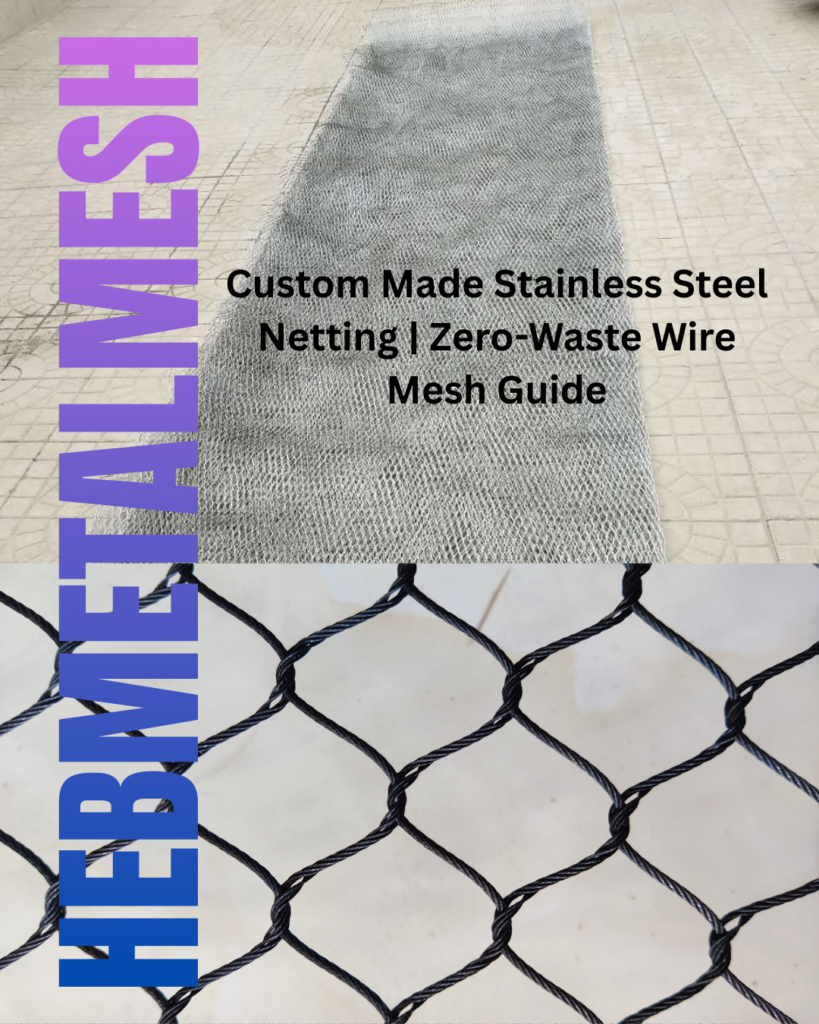
At Hebmetalmesh, we don’t just sell rolls of wire; we provide engineered solutions. By weaving mesh to the exact dimensions of your frame—whether it’s a standard rectangle or a complex, three-dimensional geometric shape—we eliminate the “hidden costs” of traditional fencing.
Article Key Takeaways
- Cost Efficiency: Custom panels eliminate on-site fabrication labor and material scrap.
- Superior Strength: Single-piece construction (up to 30′ x 60′) removes weak joints and seams.
- Zero-Cost Tailoring: Hebmetalmesh offers custom weaving at factory-direct prices with no “cutting surcharges.”
- Perfect Fit: Ideal for irregular architectural shapes, bridge balustrades, and organic-shaped animal exhibits.
2. The Structural Benefits of “Seamless” Design
When you connect multiple small mesh panels to cover a large area, you create a “seam.” In the world of high-tension stainless steel rope mesh, a seam is a liability.
Eliminating Points of Failure
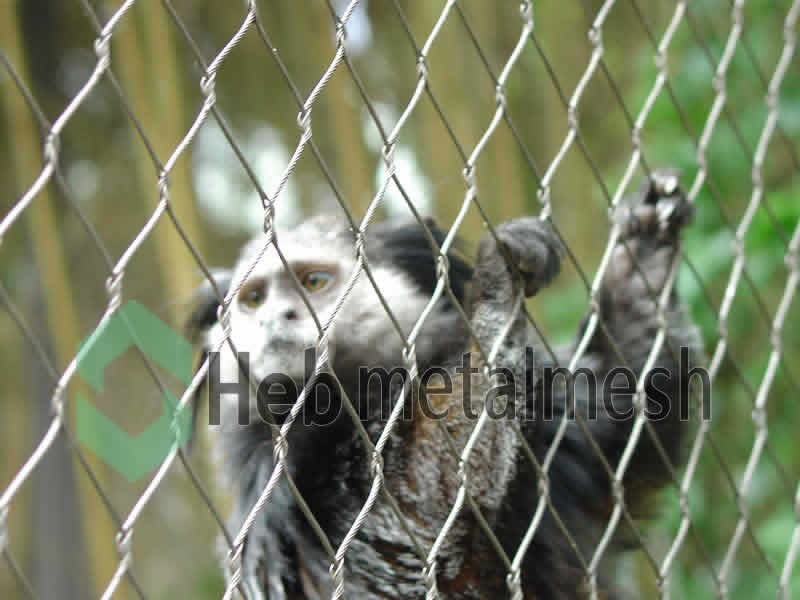
Every time you lace two panels together, you introduce a secondary component (the lacing wire). While lacing is secure, it can never match the structural uniformity of a continuous weave. Custom-made netting ensures that every diamond in the mesh shares the load equally. This is particularly vital in Tiger Enclosure Mesh, where a localized impact must be dissipated across the entire surface area.

Visual Elegance
In architectural applications, such as staircase safety nets, seams are an eyesore. A custom-made panel allows the mesh to flow perfectly from the top rail to the floor, maintaining the “invisible” aesthetic that makes stainless steel mesh a favorite for modern designers.
Technical Comparison: Standard vs. Custom
| Feature | Standard Rolls (Off-the-shelf) | Custom-Made (Hebmetalmesh) |
| On-site Cutting | Required (Labor Intensive) | None (Ready to Install) |
| Material Waste | 10% – 20% scrap average | 0% Waste |
| Joints/Seams | Multiple (Weak Points) | Seamless (Maximum Strength) |
| Max Panel Size | Usually 6′ – 10′ wide | Up to 30′ x 60′ |
| Lead Time | Instant (but high labor later) | 7-14 Days (but fast install) |
3. The Economic Case: Saving 30% on Total Project Costs
Many buyers make the mistake of comparing “Price per Square Meter” between standard rolls and custom panels. However, the raw material cost is only a fraction of a project’s total budget. When you account for labor, waste, and specialized tools, custom-made mesh becomes the more economical choice.
3.1 The Labor Math: Manual Lacing vs. Single-Panel Installation
In traditional fencing, if you have a 30-foot high wall and use 5-foot wide standard rolls, your crew must “sew” or lace six panels together vertically.
- The Standard Cost: This requires hundreds of man-hours spent on ladders or scaffolding, manually threading lacing wire through thousands of diamond openings.
- The Custom Saving: With a custom-made 30’ x 60’ panel, you hoist one single sheet. The labor is reduced from days to hours. In regions with high labor costs, this alone can save thousands of dollars.
3.2 The “Invisible” Cost of Material Waste
When you buy standard rolls, you are almost always buying more than you need.
- If your enclosure is 8.5 feet tall and you buy a 10-foot roll, you are paying for 15% more material that will eventually be cut off and thrown into a scrap bin.
- Hebmetalmesh’s Zero-Waste Policy: Because we weave to your exact height (e.g., exactly 8.5 feet), you pay only for the functional mesh. You are not paying for “the floor sweepings.”
4. Technical Customization: Engineering for Environment and Species
Customization isn’t just about size; it’s about “tuning” the mesh to the specific environmental and safety stresses of your site.
4.1 Material Grade Pairing
The most basic customization starts with the alloy.
- Grade 304: Best for interior architectural projects or inland zoo exhibits with low humidity.
- Grade 316: Mandatory for coastal regions. The addition of Molybdenum prevents the “pitting” that salt air causes in standard steel. Customizing the grade ensures you don’t overpay for 316 where it isn’t needed, or risk failure by using 304 where 316 is required.
4.2 Custom Aperture and Wire Diameter Combinations
While we have standard specs for tigers and aviaries, unique projects often require a “hybrid” approach.
- Impact Resistance vs. Visibility: You might choose a thinner wire (e.g., 3/32″) but a smaller aperture (e.g., 1.5″ x 1.5″) to maintain high visibility while preventing small primates from reaching through.
- Hebmetalmesh allows you to mix and match wire diameters (1.2mm to 3.2mm) with apertures ranging from $20mm$ to $200mm$.
4.3 Edge Treatments and Perimeter Customization
Standard mesh rolls often have “raw” edges that are difficult to manage. Custom-made netting allows for specific edge treatments:
- Eyelet Ends: For easy bolting to steel frames.
- Integrated Border Cables: Where the perimeter cable is woven directly into the mesh at the factory.
- Closed Loops: For a cleaner aesthetic in architectural handrails.
5. The “Maxi-Panel” Advantage: 30′ x 60′ Engineering
One of the most frequent questions we receive is: “How do you ship a 30′ x 60′ (1,800 square foot) metal panel?”
The beauty of handwoven rope mesh is its “accordion” property. A massive panel can be compressed into a remarkably small volume.
- Compression: The mesh is folded along its diamond axis, reducing its width significantly.
- Packaging: It is packed into high-strength wooden crates or reinforced bags.
- Expansion: Once on-site, the panel is unrolled and expanded back to its full 30′ x 60′ dimensions.
By shipping one large panel instead of 10 small ones, you reduce the risk of lost packages, simplify your inventory on-site, and ensure that the “dye lot” or finish of the stainless steel is perfectly consistent across the entire project. Consistency is key in architectural facades where variations in steel reflection can be highly visible.
6. Quality Control: The Science Behind the Weave
A custom-made stainless steel netting panel is only as good as the hands that weave it. Unlike machine-made chain link, every knot in a Hebmetalmesh panel is inspected for uniformity.
6.1 Tensile Strength Testing
Before a custom order is finalized, we perform batch testing on the wire rope. This ensures that the Grade 316 or 304 stainless steel meets international standards for breaking loads. For a tiger enclosure or a bridge safety net, there is zero room for error. We provide material test certificates (MTC) to ensure your engineering team has the data they need for safety compliance.
6.2 Precision Dimensional Checks
One of the biggest fears in custom ordering is receiving a panel that doesn’t fit the frame. Our weavers use specialized tensioning tables where the mesh is stretched to its designed 60° angle.
- The “Tolerance” Standard: We maintain a strict dimensional tolerance. Because the mesh is flexible, we engineer it to be slightly “active,” meaning it will reach its perfect dimensions only when the final tensioning is applied on-site.
7. Factory-Direct Ethics: Transparency and Value
When you search for “fence enclosures” or “custom netting,” you will find many middleman distributors. Buying factory-direct from Hebmetalmesh provides three distinct advantages:
- Direct Communication: When you have a complex architectural shape, you speak directly to the engineers who will weave it. No information is lost in translation between a salesperson and a factory.
- Zero “Middleman” Markup: Customization is often where distributors add their highest profit margins. By going to the source, you get custom sizing at the price of standard rolls.
- Sustainable Production: Because we weave to your exact size, we reduce the carbon footprint of your project. We don’t ship “scrap” metal that will just end up in a landfill on your job site; we ship only what you need.
8. Custom Netting FAQ: Everything You Need to Know
A: Surprisingly, no. Because we weave every order to order, it takes roughly the same amount of time to weave a 10’x20’ panel as it does to weave a custom 8.4’x19.2’ panel. Most orders are ready for shipping within 7–14 days.
A: Yes. We specialize in non-rectangular shapes. These are common for bridge gussets or modern “zoogeometry” exhibits. Simply send us a CAD file or a PDF drawing with your dimensions.
A: While we handle massive industrial projects, we also provide custom solutions for smaller residential projects, such as deck railing infills. Contact us with your dimensions for a specific quote.
A: You don’t have to! Just give us the Inside Dimensions of your frame. Our engineering team calculates the “Diamond Contraction” (the way the mesh pulls in when stretched) so that the finished product fits your frame perfectly.
Conclusion: Designing Without Limits
The era of “making it work” with standard fencing is over. Custom-made stainless steel netting allows architects, zoo directors, and safety engineers to design without limits. You no longer have to build your frame to match the mesh; we build the mesh to match your vision.
By choosing custom panels from Hebmetalmesh, you are choosing a faster installation, a stronger structure, and a significantly lower total project cost. From the 30′ x 60′ “Maxi-Panels” to intricate architectural details, precision is our standard.
Ready to start your custom project?
Visit our Custom Product Page or use our Store to see our most popular specifications.