
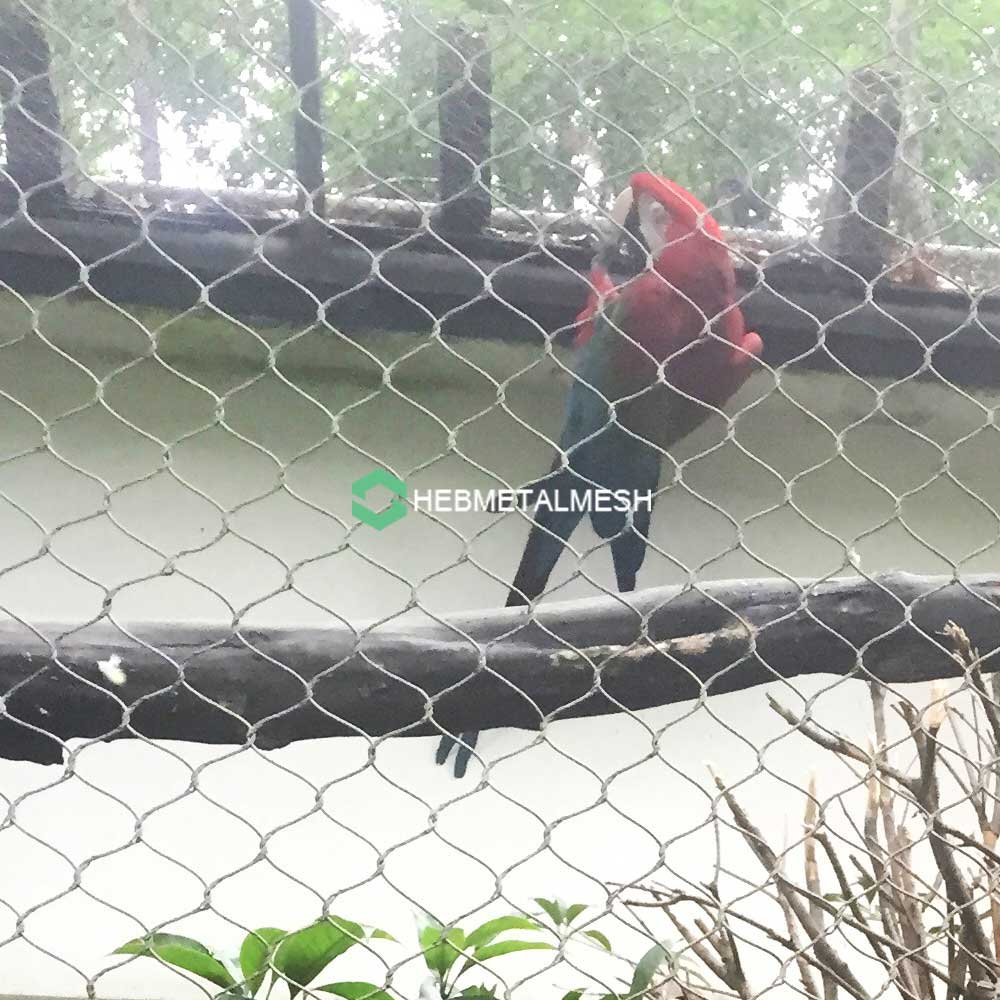
A keeper at a small bird park found a finch hanging by one leg from a nylon net last spring. The net had been sold as humane. It was black, knotted and cheap, and the bird had pushed its head through a diamond wider than its own skull. The gap between the mesh and the frame did more damage that week than any trap the park had ever used.
Non-lethal bird control netting for aviaries only earns the word humane when the mesh, the tension and the fixing detail all agree with the birds inside. A net that stops a bird and mangles it on contact is a lethal method with better marketing. This article sets out the specification that holds a resident flock in, keeps wild birds out, and leaves both of them whole.
Executive Summary
The non-lethal claim belongs to the design, not the material. Three numbers decide whether aviary netting protects birds or injures them: the aperture the smallest resident cannot pass, the cable diameter the largest beak cannot deform, and the tension that removes the slack a bird can wedge itself into.
Get those three right and netting becomes the safest method on the table for a mixed collection. Get them wrong and the net itself becomes the hazard. This guide covers the failure modes, the choice between nylon and 316 stainless, the separation detail on a walk-through aviary, the evidence an inspector will ask for, and the repair routine that keeps a panel safe after a storm.
Send the Species List, Get a Welfare-Safe Spec
Tell us the smallest and heaviest birds in the collection, the enclosure shape and the fixing method. We return aperture, cable diameter, panel sizes and tension figures, with a cut-to-size quote and a lead time.
Request a Welfare SpecQuick Answer
Non-lethal bird control netting for aviaries works when the aperture is smaller than the smallest resident’s skull and the panel stays tight enough that no bird can push a wing through. Stainless rope mesh with a smooth knotless surface, set on a tensioned perimeter cable, keeps birds contained without the abrasion and entanglement that knotted nylon causes.
Key Takeaways
- Aperture is a skull measurement, not a bird-size guess.
- Slack panels injure more birds than wide apertures do.
- Knotless stainless removes the abrasion point that damages feathers and feet.
- Tension has to survive wind load, so the frame matters as much as the mesh.
- An inspector wants the method rationale in writing, not just a purchase invoice.
- Storm damage rarely breaks the mesh; it pulls the fixings and leaves slack.
Why the Method Decision Comes Before the Mesh
Most bird problems in a collection get blamed on the net. The real fault usually sits one step earlier, in the method choice. Someone reached for a deterrent, a trap or a cull because it was cheaper that week, and the net came later as a patch.
Replacing traps with netting in a bird park changes the job from removal to exclusion. Removal treats a symptom and leaves the opening. Exclusion closes the opening and stops the argument. Deterrents versus netting for a resident flock settles the same way, because a resident flock learns a deterrent and never learns a wall. That shift is why inspectors now ask for a method rationale rather than a body count, and why a netting plan for a bird park now starts with the species list instead of the hardware catalog.
Where traps and deterrents break down
Traps catch individuals and miss the reason they arrived. Deterrents work on surprise, and resident birds learn fast. A flock that sees the same plastic owl for three weeks treats it as furniture.
Both methods also carry a hidden cost. Traps need daily checking, a holding protocol and a release site. Deterrents need constant rotation. Netting needs one correct installation and then inspection.
What “non-lethal” actually means in a specification
The word describes an outcome, so write it as one. A panel qualifies when a bird cannot pass through it, cannot become trapped in it, and cannot cut or abrade itself on it. Those three conditions translate directly into aperture, tension and surface finish.
That is the whole test, and it scales from a single pair up to a mixed collection. Humane bird exclusion for a mixed species aviary runs on the smallest bird in the house, not the average. If a supplier cannot answer those three points with numbers, the humane claim is a slogan, so check whether the aviary netting and bird mesh range publishes them per cable diameter.
Four Ways Aviary Netting Injures Birds Anyway
A wide aperture gets the blame for most escapes. The injury cases usually trace back to something else, and the pattern repeats across collections of every size.
| Failure mode | What actually causes it | Specification fix |
|---|---|---|
| Leg or wing caught | Slack panel with a fold the bird can enter | Tension to design load, tensioned perimeter cable |
| Feather wear on the crown | Knotted nylon rubbing at a repeat flight line | Smooth knotless wire rope mesh |
| Head through, body stuck | Aperture sized to body width instead of skull | Aperture under the smallest resident’s skull width |
| Gap at the post | Mesh tied to the frame without a return or clamp | Fixed edge detail with no finger-width opening |
An Aperture That Stops a Bird Without Trapping It
Measure the skull, not the body. A bird that can pass its head through a mesh will follow with the shoulders, and the shoulders are what jam. The aperture has to sit below the skull width of the smallest resident, with a margin for a juvenile.
Most collections settle between 25 mm and 50 mm. A finch or waxbill collection needs the tight end. A hornbill or toucan house can run wider because the skull is the widest part of the bird. The bird netting fence specification page sets out the options per species group, so start with the smallest resident and work upward.
Netting Tension That Prevents Entanglement
A tight panel deflects. A loose panel swallows. Netting tension that prevents entanglement is not about strength; it is about removing the pocket a bird can enter and then cannot reverse out of.
Set tension against wind load rather than by feel. A panel that drums in a gust will fatigue at the clamps, and fatigue shows up as sag long before it shows up as a break. Our aviary netting and bird mesh range lists the load figures that correspond to each cable diameter, so the frame can be sized to match.
Choosing Material for a Resident Flock
Two materials dominate the market, and the gap between them is wider than the price difference suggests.
- Knotted nylon. Light, cheap, easy to cut. It stretches, degrades under UV, and holds water. The knots create hard points that abrade skin and feathers.
- Welded galvanized wire. Rigid and inexpensive. It rusts at every weld in a wet climate, and the coating fails first at the cut edges.
- 316 stainless steel wire rope mesh. Flexible, corrosion resistant, and smooth at the strand. It holds tension for decades and does not shed coating into the enclosure.
The material decision drives the maintenance budget more than anything else on the enclosure. A nylon panel that needs replacing every four years costs more than a stainless panel that outlasts the frame. It also sets the bird welfare ceiling, because the polymer is rarely the problem. Ask why birds get injured in nylon netting and the honest answer is the knot, not the plastic: a hard point at every crossing, sitting exactly at head height on a repeat flight line.
Glare is the other material question, and it decides whether birds fly into a panel they cannot read. The light and glare behavior of stainless rope mesh makes a visible grid at the angle a bird approaches it, which is what stops the strike before it happens.
Smooth Knotless Netting and Feather Damage
Feather condition is the quiet welfare indicator. A bird that keeps clipping its crown on a knot looks fine at a distance and fails a close inspection.
Smooth knotless netting and feather damage rarely appear in the same sentence, because the strand has no proud surface. The wire crosses without a knot, so a bird brushing past meets a rounded profile. Flighted species in a long enclosure notice this most, since they cross the same panel line hundreds of times a day.
Welfare standards for collections are published and testable. The WAZA animal welfare standards set out how a barrier should be assessed against the animal it holds, and that framework is what most inspectors work from.
Specifying a Walk-Through Aviary So Visitors and Birds Stay Apart
Stopping birds entering a walk-through aviary is one problem. Keeping a visitor from walking into a nesting bird is the other, and the second one drives the layout.
- Fix the visitor route first, then draw the mesh line around it.
- Keep a double-door airlock at every entry, with a minimum gap of two meters.
- Set the mesh back from the path where vegetation screening is possible.
- Place any feed or nest station outside arm’s reach of the handrail.
- Run the roof mesh continuously over the path, with no seam above head height.
Keeping visitors and birds apart without bars comes down to distance and sight lines. A guest who can see the whole flight enclosure behaves differently from one who can see only a wall of mesh. Wild birds are the non-target species in that calculation, and they need a reason to stay outside, so the roof line and the side panels have to close the same gaps. Confirm the panel and fixing pair before the frame goes up, because the roof run above a path is the hardest line to redo later.
Proving Humane Practice at Inspection
Humane bird control evidence for a zoo inspection is a document problem before it is a hardware problem. Inspectors rarely argue with a stainless panel. They ask why the panel was chosen.
Keep four items on file. A species list with the smallest bird marked. The aperture calculation derived from that bird. The tension figure and the frame design load. The inspection and repair log with dates.
Netting instead of culling for nuisance birds also needs a short written justification, because the decision removes a method the inspector may expect to see. One paragraph explaining exclusion over removal is usually enough.
Non-lethal bird control for zoo bird collections increasingly appears in accreditation criteria, and the paper trail is what auditors sample. Photograph the finished panel before birds go in, and keep the image with the spec sheet.
Maintenance and Storm Repair
Storm damage repair on aviary netting is mostly about the frame. The mesh survives the gust; the clamps and the perimeter cable take the load and move. Framing and border cable details decide how that load travels, which is why a failed clamp shows up as a sagging panel a week later.
- Walk the perimeter after any event above the local design wind speed.
- Check clamp torque at every corner and every cable termination.
- Look for a sag pocket before looking for a broken strand.
- Re-tension the panel rather than patching a slack section.
- Replace any cable with a visible bird-strike kink at the strand level.
Release aviary netting for rehabilitated birds needs a shorter inspection interval, because those panels take repeated impact from birds that have not flown in months. Check them monthly through the release season.
Mesh gauge for a mixed collection follows the heaviest contact, not the average. A single large bird leaning on a light gauge will deform a panel that suits the rest of the flock. On a long roof run, 1 inch mesh rolls and coverage figures decide how many splices the job needs before anyone orders steel.
FAQ
It can, if the panel is slack or the strand is knotted. A tensioned, smooth, knotless panel spreads the impact across a wide area and lets the bird slide off rather than catch.
Below the skull width of the smallest resident, usually 25 mm to 32 mm for finches and small softbills. Body width is the wrong measure, because the head goes through first.
Only for short-term or seasonal work. Nylon stretches under load, degrades in UV and holds water, and the knots abrade feathers at repeat flight lines.
Tight enough that the panel does not form a pocket under a bird’s weight, and within the design load of the frame. Ask the supplier for the figure rather than judging by hand.
A species list, the aperture calculation, the tension and frame load figures, and a dated inspection log. Photographs of the finished panel help.
How long does stainless rope mesh last in an aviary? Twenty-five to thirty years in most climates, with clamp checks twice a year. Coastal and high-humidity sites need the 316 grade and a shorter inspection interval.
Specify the Barrier Before the Birds Arrive
Send the species list, the smallest bird and the enclosure drawing. We will return aperture, cable diameter, panel sizes, tension figures and the fixing detail, then quote cut-to-size panels with a lead time.
Talk to a Mesh Engineer