
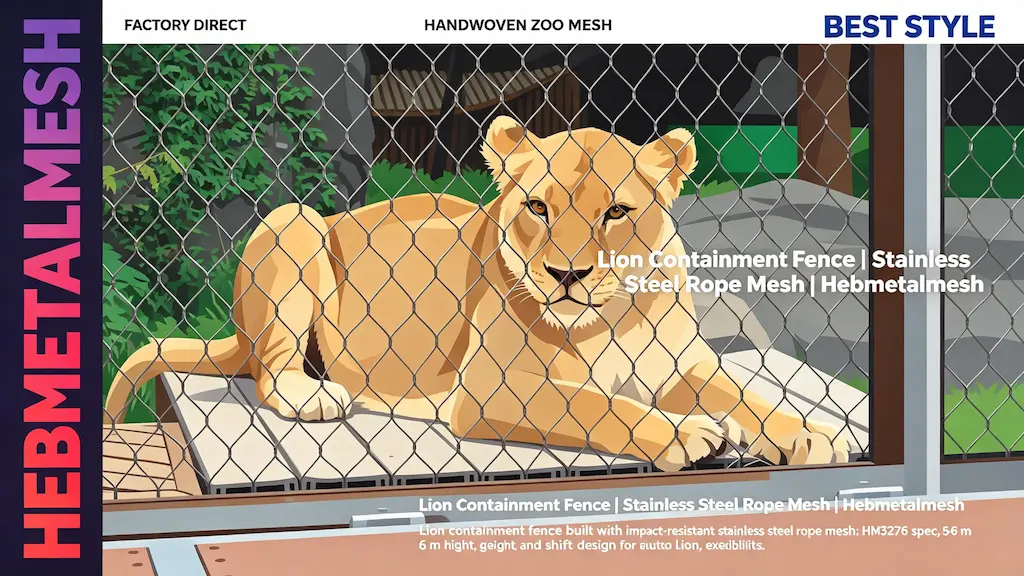
A lion containment fence is only ever as strong as its weakest detail. The mesh can hold seven kilonewtons per rope and still fail if a tension clamp slips, a gate frame racks, or a foundation is undersized. That is why a modern lion barrier is specified as one system — perimeter mesh, frame, gates and foundations — rather than bought as a roll of netting. This guide explains how zoos specify a stainless steel rope-mesh lion containment fence, what aperture and cable diameter a lion needs, how high the perimeter should stand, and how to buy a custom lion containment fence factory-direct.
Executive Summary
For a lion exhibit the reference barrier is hand-woven stainless steel rope mesh at 3.2 mm rope with a 76 mm aperture (model HM3276), stretched on a galvanized or stainless steel frame to a finished height of 5-6 m, with an inward overhang and a double gate shift route. The same material works as a lion viewing barrier at visitor level because the open weave keeps sightlines clear while the rope absorbs impact instead of shattering like glass or tearing like chain-link. Every lion containment fence specification should fix five numbers before ordering: rope diameter, aperture, panel split, fence height and anchor spacing. The reference specification is the lion enclosure netting product page.
Need a lion containment fence for a new or retrofit exhibit? Send your perimeter dimensions, target fence height and gate positions for a panel-by-panel specification and price.
Quick Answer:
Quick Answer: A lion containment fence is an impact-resistant perimeter barrier built from stainless steel rope mesh on a rigid frame. For lions, specify 3.2 mm rope and a 76 mm aperture (HM3276), set 5-6 m high with an inward overhang, and pair it with a double gate and a holding yard. Stainless steel outperforms chain-link, welded wire and nylon because it will not corrode, will not be chewed through, and keeps the exhibit visually open.
Key Takeaways
- A lion containment fence for zoo use is normally 3.2 mm / 76 mm rope mesh (HM3276); smaller carnivores sharing the same run can be held on 3.2/51 (HM3250).
- Height is driven by the animal’s climbing ability and its jump, not by fashion: a 5-6 m perimeter with an inward overhang defeats a standing leap of roughly 3.6 m.
- The failure points are gates, frame corners and foundations, never the middle of a panel. Spend the engineering budget there.
- Rope mesh weighs about 2 kg/m², so a lion structure mesh assembly is light enough to retrofit onto existing steelwork without re-designing the whole roof.
- Zoo lion safety fencing is a whole-system standard: mesh, frame, gates, plinth and the keeper gate all take part in transferring load.
Exhibit standards are written by the zoo community, not by suppliers. The World Association of Zoos and Aquariums publishes welfare and enclosure guidance that most regional associations follow, and a lion escape barrier that satisfies those documents is one where every component — not only the mesh — is sized for the animal behind it.
Why a Lion Containment Fence Is a System, Not a Roll of Netting
Lions are ambush predators that test a barrier from the inside. A 190 kg male can put a short, heavy load into a panel by running into it, and a female will hang on the mesh by her claws and work a seam. Neither behaviour breaks a 3.2 mm rope; both attack the connections. The honest way to think about lion containment fence design is to follow the load: the animal pushes the mesh, the mesh pulls the rope clamp, the clamp loads the cable, the cable loads the frame, and the frame loads the concrete plinth. If any link in that chain is weaker than the rope, that link becomes the real barrier strength.
A welded-wire or chain-link barrier produces a rigid grid. When an animal hits it, the barrier strikes back with the same force, which is why big-cat keepers see bent frames, torn fabric and repeated repairs. Rope mesh bends under load and returns to shape, dissipating energy across several metres of weave instead of concentrating it at one weld. The galvanised vs stainless cable mesh comparison explains why the alloy, not only the weave, decides how long that survives.
Choosing Rope Diameter and Aperture
Two numbers do most of the work in any lion containment fence specification: the lion containment fence cable diameter and the lion containment fence aperture. Aperture sets what a paw can pass through and how far the mesh can flex; cable diameter sets the breaking load of each strand. For lions the industry default is 3.2 mm rope at 76 mm pitch, the same construction documented on our lion enclosure netting core page. Narrowing to 51 mm stiffens the field and suits exhibits where small cats share the run; opening to 102 mm suits large, low-contact perimeter sections and hoofstock yards.
| Parameter | Lion perimeter (standard) | Shared small-cat run | Large perimeter / hoofstock |
| Model | HM3276 | HM3250 | HM32102 |
| Rope diameter | 3.2 mm | 3.2 mm | 3.2 mm |
| Aperture | 76 mm | 51 mm | 102 mm |
| Rope construction | 7×7 (49 wires) | 7×7 | 7×7 |
| Breaking load per rope | about 7 kN | about 7 kN | about 7 kN |
| Panel size | up to 9 x 18 m | up to 9 x 18 m | up to 9 x 18 m |
| Weight | about 2 kg/m² | about 2.2 kg/m² | about 1.9 kg/m² |
Because the field is hand-woven and then secured to its own rope edge, an impact resistant lion mesh panel spreads a strike across many strands. The lion containment fence weight is only about 2 kg/m² at 3.2/76, roughly a third of an equivalent masonry or steel-plate barrier, which is why zoos can upgrade an old exhibit in place rather than rebuild the structure. Alloy choice follows the site: 304 vs 316 cable mesh decides whether a coastal or chlorinated exhibit resists salt indefinitely.
Height, Loads and Escape Climbing Behaviour
Two separate questions decide fence height: how low can the animal climb, and how far can it jump. Climbing ability is the one keepers underestimate. Give a lion a tensioned horizontal rail within reach of the mesh and it will use the mesh itself as a ladder, even at 76 mm pitch. That is why a climb proof lion containment fence is built with an unclimbable lower section — smooth cladding, a plinth, or a stand-off — and an inward-angled top. Designers rarely use escape velocity in the physics sense, but they do account for a standing jump of about 3.6 m and a horizontal leap that can clear a 5 m moat.
The working figure for a lion containment fence for zoo exhibits is therefore 5-6 m of vertical mesh with 0.5-1 m of inward overhang, or 5 m of mesh above a 4-5 m dry moat. Add a jump margin of at least 1 m above the animal’s measured leap and treat the overhang as a second line of defence. The lion escape barrier is complete only when the mesh, the overhang and the moat are all present; removing any one of them turns a secure perimeter into a climbable wall.
Gates, Shifting and the Holding Yard
Most real-world incidents happen at the doors, not the walls. A lion perimeter needs a double gate: an outer door for vehicles or keepers and an inner door into the display, never opened at the same time. The holding yard behind the exhibit is where animals wait during cleaning and veterinary work, and it must be built to the same standard as the display perimeter, because a stressed animal tests the mesh as hard there as it does in a run. The shift gate that moves animals from holding to display should be operated from a position with a clear view of both sides.
Any gate opening in rope mesh needs a rigid frame of its own, because the flexible field cannot carry the door load. Bolt the gate frame back to the main structure and cast a concrete plinth under each post so the door stays square through frost and settlement. This is the detail that keeps zoo lion safety fencing working after the first decade, and it is the one most often value-engineered out of a tender. Moat-edge and debris-prone runs follow the same principles covered in zoo enclosure barriers.
Practical Buying Notes
A zoo buying a perimeter is usually comparing a general fabricator with a specialist lion containment fence manufacturer that weaves the mesh itself. Buying factory-direct keeps the rope, the edge finish and the tension hardware under one quality system, which matters because a compromised alloy will not show up until the mesh is already installed. The strongest protection is a mill certificate to EN 10204 3.1 that states the grade and the wire chemistry; a substitution toward a cheaper 201-grade stainless can otherwise only be caught by that document. Prices for the wider family of containment netting and fence mesh are published separately for planning.
As a lion containment fence supplier we quote by panel, not by the roll, so the price reflects the real seam count and the tension hardware you need. Custom lion containment fence orders — non-standard heights, L-shaped runs, curved viewing fronts and colour-matched black oxide finish — are woven to the panel schedule you supply. Planning guidance, always as a range because every exhibit differs:
| Scope | Indicative planning range |
| Stainless rope mesh panels (3.2/76) | $20-38 / m² |
| Tension hardware and rope edges | add roughly 8-15% |
| Full perimeter with frame, gates and plinth | engineering-led, quoted per project |
Lead time is typically 2-4 weeks for weaving plus 2-6 weeks for sea transit. Order the tension hardware with the mesh, never after it, or the installation crew will be waiting on clamps and turnbuckles.
Installation, Tension and Inspection
Rope mesh is a tensioned membrane. Panels are attached to a perimeter cable or a frame and tensioned with turnbuckles until the field is drum-tight but still able to flex under impact. A panelled lion containment fence design lets the installer replace one bay after storm damage instead of re-weaving the whole run, so the panel split matters at the drawing stage. Anchor points, frame bracing and rope clamps should all be accessible for a five-year inspection cycle, and any clamp that has moved should be re-tensioned before it is re-torqued.
Rope mesh also holds up better than the alternatives where the exhibit is washed down daily — the rope mesh vs plastic netting guide covers why flexible steel keeps its shape where polymer sags. Where the mesh meets grass or a planting bed, run a concrete kerb to control burrowing and to protect the bottom rope from soil contact.
Frequently Asked Questions
A lion containment fence is a perimeter barrier made from stainless steel rope mesh on a steel frame, sized so a lion cannot bite, climb or push through it. It replaces rigid chain-link or welded wire with a flexible, see-through membrane rated at about 7 kN per rope at 3.2 mm. The fence is only complete with its gates, frame and foundations.
For most exhibits, 5-6 m of vertical mesh with an inward overhang, or 5 m of mesh above a 4-5 m dry moat. The figure follows the animal’s standing jump of roughly 3.6 m plus a safety margin. Always add an unclimbable lower section so the mesh cannot be used as a ladder.
Use 3.2 mm rope at 76 mm aperture (HM3276) as the standard lion specification. A 51 mm aperture stiffens the field for mixed small-cat exhibits; 102 mm suits large, low-contact perimeter sections. All three share a 7×7 rope construction and roughly 7 kN breaking load.
Yes for big-cat exhibits. Chain-link is a rigid grid that rebounds force and needs frequent repair, while rope mesh flexes and returns to shape. Stainless steel also resists corrosion, so a coastal or chlorinated exhibit does not slowly rust through the way galvanised wire does.
Mesh panels run about $20-38 / m² as a planning range, with tension hardware adding roughly 8-15%. A full perimeter including frame, gates and plinth is engineering-led and quoted per project. Always treat these as planning ranges, not fixed prices.
Use SS304 (18% chromium / 8% nickel) for inland exhibits with normal humidity. Choose SS316, which adds molybdenum, for coastal sites, salt-spray zones or any enclosure washed with chlorinated water. Both carry the same breaking load; the difference is long-term corrosion resistance.
Still comparing suppliers? Send your panel schedule and gate positions to our export team for a factory-direct lion containment fence quote.
Written by the Hebmetalmesh stainless steel mesh export team. Shijiazhuang Netting Trading Co., Ltd, No.386 Zhaiying Street, Shijiazhuang, Hebei, China. Contact: info@hebmetalmesh.com. Rope mesh is manufactured in 13 rope/aperture combinations from 1.2 mm / 20 mm to 3.2 mm / 102 mm, with SS304 and SS316 alloys and a black oxide finish option for low-glare exhibit design.