
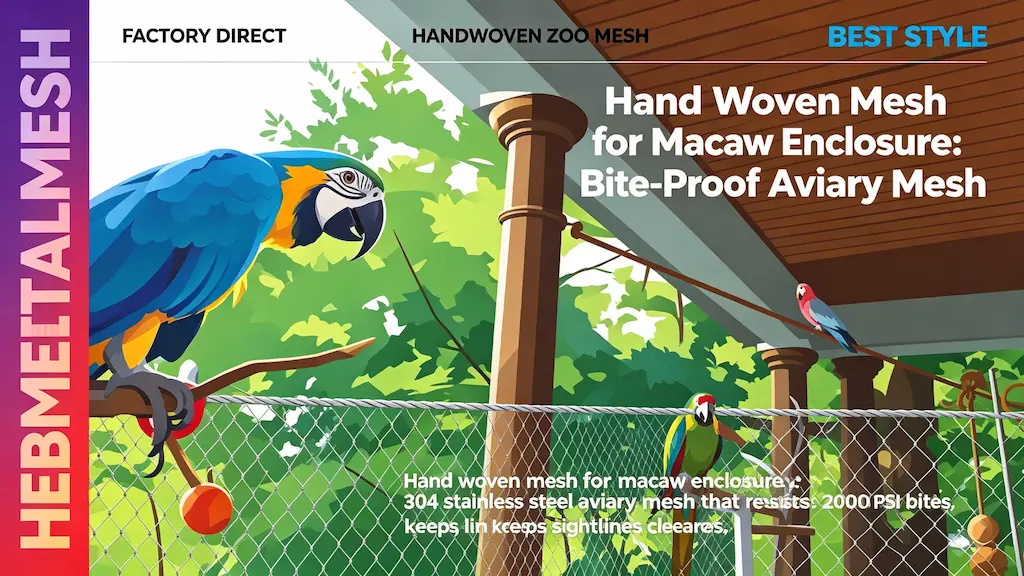
Macaw fencing fails for one reason: it gets chosen as netting when it should be chosen as a containment system. A macaw does not peck at a fence, it works on it — returning to the same point hundreds of times with a beak that generates roughly 2,000 psi at the tip. That behaviour decides the aperture, the rope, the way panels are joined and the way they are anchored, which is why the specification below starts with beak loading rather than with price.
Executive Summary
A macaw proof fence is a system of four parts: a woven stainless panel, a tensioned perimeter cable, a post line that carries the load, and a set of terminations that transfer that load without a weak point. Buyers who price only the panel usually pay twice, because a cheap skin on an under-built frame is the classic failure mode on a large parrot aviary. The mesh matters, but the structure decides whether the mesh survives. The reference specification is the macaw enclosure netting product page product page.
Buying Macaw Fencing Factory-Direct?
Send the enclosure drawing, the macaw species and the site climate. We return an aperture, rope diameter, panel schedule and a custom price within 24 hours.
Request My Free Quote →Quick Answer:
Macaw fencing should be specified at 38 mm aperture in 3.2 mm stainless rope (HM3238) for the main enclosure, and 50 mm in 3.2 mm (HM3250) for very large macaws and long outdoor flights where a bird never gets its beak between wires. Woven stainless rope mesh carries roughly 7 kN breaking load in 7×7 construction, so the panel is almost never the weak point — the frame, the terminations and the ground line are. Specify SS304 for inland sites and SS316 for coastal or wash-down enclosures, and buy the panel and the frame as one design rather than two purchases.
Key Takeaways
- Rate the mesh for beaks, not for birds. A macaw’s bite is measured in thousands of psi, so welded wire gradually deforms at the same points.
- Woven panels beat welded grids. There is no weld point to fatigue, and a ferrule join in stainless will not galvanically corrode against the wire.
- Aperture is a species decision. 38 mm suits most macaws, 50 mm suits hyacinth and long flights, 25 mm suits small parrots sharing the building.
- Never use zinc-coated wire around parrots. Ingestion of zinc from galvanised mesh is a known toxicity route in psittacines.
- Buy panel, cable, post and termination together. Split supply is where projects lose alignment between the mesh schedule and the frame drawing.
The parrot husbandry and enclosure guidance most zoos work to is published by the World Association of Zoos and Aquariums, which treats enclosure integrity as part of animal welfare rather than as a maintenance item.
What Macaw Containment Fencing Has to Survive
A macaw enclosure is a destructive environment by design. Chewing is not a defect in the bird, it is how the animal maintains its beak, so any containment material has to survive decades of controlled abrasion at predictable points — the corners it can reach, the feeding station, the perch it sleeps beside, and the gate it waits at.
Three loads act on a macaw fence, and only one of them is the beak. The first is beak force: a large macaw generates enough pressure at the tip to deform soft wire and to open a split in a welded join. The second is dynamic load — a bird landing hard, or climbing and swinging off a panel — which travels into the frame, not into the mesh. The third is weather: wind acting on a large sail area, and salt or wash-down chemistry working on whatever is not stainless. Design for the first and the second two become details; ignore the first and the panel becomes a consumable, replaced on a cycle set by the birds rather than by the owner.
Matching Aperture and Rope to the Species
A macaw fencing specification is built from two numbers, and both follow from the bird list rather than from the budget.
| Macaw group | Aperture | Rope | Typical fit |
| Large macaws (hyacinth, green-winged) | 50 mm | 3.2 mm | Long outdoor flights, zoo exhibits |
| Most macaws (blue and gold, scarlet) | 38 mm | 3.2 mm | Breeding and general holdings |
| Small parrots sharing the building | 25 mm | 1.6 mm | Mixed parrot aviaries |
| Holding, transfer and hospital cages | 38 mm | 2.4 mm | Close-contact panels |
| Very large perimeter runs | 76 mm | 3.2 mm | Zoo structures, walk-through sections |
Rope diameter carries the load and aperture sets the barrier. In 7×7 construction a 3.2 mm rope breaks at roughly 7 kN, so the mesh itself reaches well beyond what a bird can impose; the practical strength question is always the weld point in a welded product, or the termination in a woven one. That is why stainless macaw fencing in a woven format is the default for a serious collection: there is no weld to work loose and no coating to open once the surface is scored.
The Macaw Containment Structure: Posts, Cables and Panel Layout
A macaw containment structure is a tensioned membrane, not a wall. The panel spans between perimeter cables, the cables pull against corner posts, and the posts put the whole load into the ground. Change any one of those and the other two have to change with it.
Set post spacing at 3 m or less on a loaded panel line, and shorter where a panel turns a corner, because a corner concentrates more force than a straight run. Specify footings for soil type rather than for habit. Where a panel span crosses more than about 6 m without intermediate support, expect the panel to move in wind — support long spans with an intermediate post line or a cabled ridge rather than with a heavier weave.
The aviary footprint then decides the layout. Long, narrow flights suit long-winged psittacines; square enclosures suit pairs and small colonies. Allow for a service route on the outside of the perimeter so a keeper can inspect the panel line without entering the enclosure, and draw the gate interlock — a double-door entrance — into that route from the start. Retrofitting an interlock into a finished fence means cutting a panel that is already tensioned.
Flight Enclosures, Breeding Enclosures and Holding Cages
Different jobs inside one facility call for different containment, and using one specification everywhere wastes money at both ends.
A macaw flight enclosure is the long outdoor run where the bird actually flies. It needs length before height, a clear corridor along its axis, and a skin that lands softly rather than a rigid grid a wing can strike. Flight length matters more than vertical flight for macaws — the bird travels along the enclosure far more than it climbs it — so the panel schedule on the macaw enclosure netting page is usually cut for a long low wing rather than a tall one. Height still earns its place, because it lets a bird climb away from a keeper.
A macaw breeding enclosure adds two requirements. Each breeding pair has to be separated from the next without moving through shared airspace, so the building needs divisibility designed in at ground level. It also needs nest access from outside the enclosure — a service hatch behind each nest log — so a keeper never has to open the flight to check a nest.
A macaw holding cage and transfer crate are the most under-specified part of most projects and the part where birds get hurt. Close-contact panels take a finer weave at a smaller aperture, and every edge inside the bird’s reach should be smooth. Keep perch diameter generous on a large macaw — an undersized perch is hard on the feet over a lifetime — and set night perches high, sheltered and away from the public edge.
Factory-Direct Supply: Ordering, Lead Time and Price Drivers
Buying from a macaw fencing factory rather than through a reseller keeps the panel schedule on one specification. That matters as soon as a project mixes apertures and grades on one site, because a split supply chain produces panels that do not carry the same documentation.
A macaw fencing supplier that weaves and terminates in one plant can deliver the whole set — panels, perimeter cables, swages and tensioners — cut to the drawing. That makes macaw fencing installation mostly a tensioning job. Panels are woven to size, hung between cables, and adjusted with turnbuckles; custom macaw fencing simply means the panel schedule is cut to the enclosure rather than trimmed on site.
As a planning range rather than a quotation, aviary-grade stainless rope mesh typically lands between $10 and $22 per square metre before frames and installation, and the frame commonly costs as much again. On macaw fencing price, three things move the number: the rope diameter, the number of separate panel lines, and the grade. A coastal facility that specifies 304 to save money usually pays it back in replacements. Cost drivers across fencing formats are set out in our overview of animal fence and containment netting prices, and the material comparison behind the grade decision is covered in the guide to galvanised versus stainless mesh. Lead time is typically two to four weeks from order, plus two to six weeks of transit depending on destination.
Macaw Safety Fencing, Predator Detail and Inspectability
Macaw safety fencing is judged by what it prevents, not by how it looks. Three failure modes cause most incidents, and all three are design decisions rather than accidents.
The first is the ground line. A fence is only as good as where it meets the earth, so bury the panel into a concrete toe or a buried apron, and inspect that line twice a year. The second is the roof. Aviaries are opened from above by owls and raptors and entered from below by rats and snakes, so macaw proof fencing means deciding the aperture for the smallest animal that must be excluded, not the largest bird that must be contained. The third is the pinch point: gates, cable anchors and any join where a bird can trap a toe.
Professional practice is to specify for the facility rather than the individual bird. A macaw sanctuary fencing project usually holds several species at different sizes, and a zoo macaw structures programme has to satisfy inspection criteria as well as the birds, so the specification should be written to the smallest species in the collection and documented with mill certificates for the grade supplied. Our overview of better zoo enclosure barriers explains how that choice affects both welfare and the visitor’s line of sight.
Frequently asked questions
38 mm aperture in 3.2 mm stainless rope for most macaws, and 50 mm in 3.2 mm for hyacinth macaws and long outdoor flights. Use 25 mm where small parrots share the building.
For parrots, yes. Woven stainless has no weld points to fatigue and no zinc coating to be ingested, both of which are real risks with galvanised welded wire around psittacines.
A large macaw generates roughly 2,000 psi at the beak tip. That is why the mesh has to be rated for repeated abrasion at the same point, not just for a single impact.
Height helps, but length matters more. Plan the longest clear flight line the site allows and build height from there — a long low flight serves macaws better than a tall short one.
As a planning range, aviary-grade stainless rope mesh runs about $10 to $22 per square metre before frames and installation. Rope diameter, grade and the number of panel lines move the figure.
304 for inland, dry or humid sites. Specify 316 within about five miles of salt water and for enclosures that are washed down regularly, because molybdenum resists chloride attack.
Ordering macaw fencing from the factory
Send the enclosure drawing, the species list, the climate and the panel schedule. That is enough to recommend the aperture, the rope diameter and the layout for each zone, and to weave custom macaw fencing that arrives sized, tensioned to the drawing and documented — the grade question is settled in our guide to 304 versus 316 stainless cable mesh, and the alternative materials in the notes on rope mesh versus plastic netting.
Request a macaw fencing quotation from Hebmetalmesh and the panels ship cut to size, with the whole system on one specification.
Hebmetalmesh — Shijiazhuang Netting Trading Co., Ltd, No.386 Zhaiying Street, Shijiazhuang, Hebei, China. info@hebmetalmesh.com