1. Introduction: The Art of Brachiation and Containment
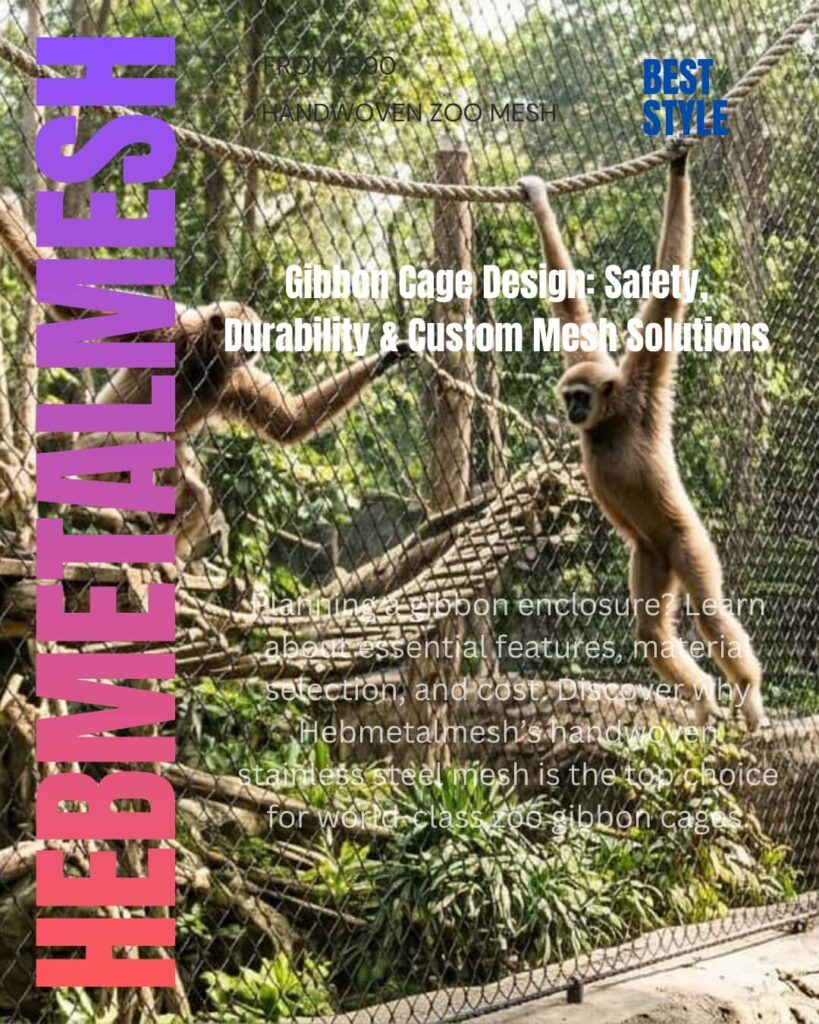
Gibbons are widely celebrated as the “acrobats of the primate world.” Unlike many other primates, these small apes move primarily through brachiation—a specialized form of arboreal locomotion where they swing from branch to branch using only their arms. In the wild, this allows them to reach speeds of up to 34 mph and leap gaps as wide as 50 feet.
For zoo architects and private sanctuary owners, this presents a unique engineering challenge: How do you build a gibbon cage that supports such high-speed, high-impact movement while ensuring maximum safety? A standard cage isn’t enough; gibbons require a high-volume “flight path” that can withstand the constant tension and kinetic energy of a swinging 20-pound primate. Traditional rigid fencing or heavy chain link often falls short, either obstructing the view of visitors or posing a risk of injury to the animals’ delicate hands and joints.
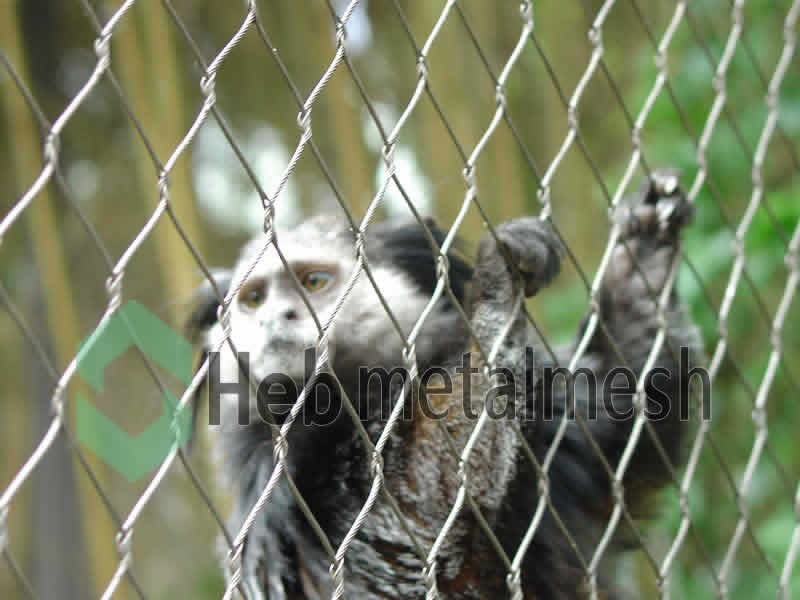
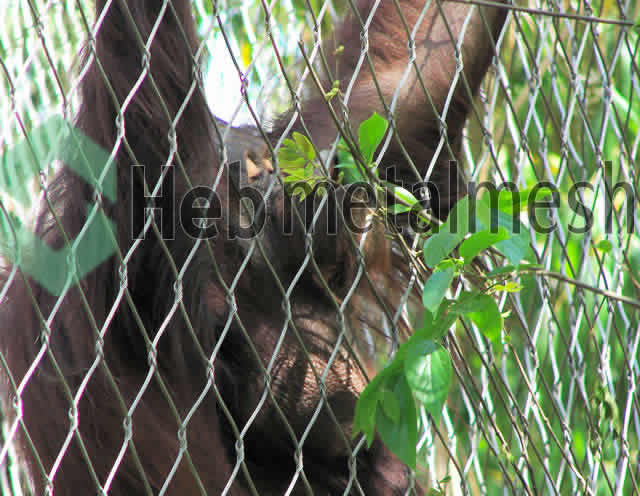
The Hebmetalmesh solution addresses these challenges head-on. By specializing in custom handwoven stainless steel mesh, we provide a flexible, “spring-like” containment system. Our seamless, large-scale panels allow for expansive enclosures that mimic a natural forest canopy, giving these incredible athletes the room they need to soar without the restrictive feel of a traditional cage.
2. Key Takeaways
For those planning a primate exhibit or looking for the best materials for a gibbon cage, here are the essential facts to consider for safety, cost-effectiveness, and durability:
- Prioritize Verticality: Gibbons are arboreal; their enclosures must emphasize vertical height over floor space to allow for natural brachiating behavior.
- High Tensile Strength is Mandatory: Only high-grade stainless steel (AISI 304 or 316) provides the necessary strength-to-weight ratio to secure active primates for decades.
- Optimal Visibility with Black Oxide: Choosing a Black Oxide finish significantly reduces sunlight reflection and “glare,” making the mesh nearly invisible to the human eye and providing a better guest experience.
- Seamless Large Panels: Hebmetalmesh produces panels up to 30′ x 60′. Larger panels mean fewer joins, which reduces installation labor costs and eliminates potential weak points in the structure.
- Customization Without Cost: Ordering customized roll sizes directly from the manufacturer ensures you pay only for the material you need, with no additional “custom-cut” fees.
- Longevity & Maintenance: Stainless steel handwoven mesh is virtually maintenance-free, resisting corrosion even in humid tropical zoo environments or coastal regions.
3. What are the Essential Features of a Gibbon Enclosure?
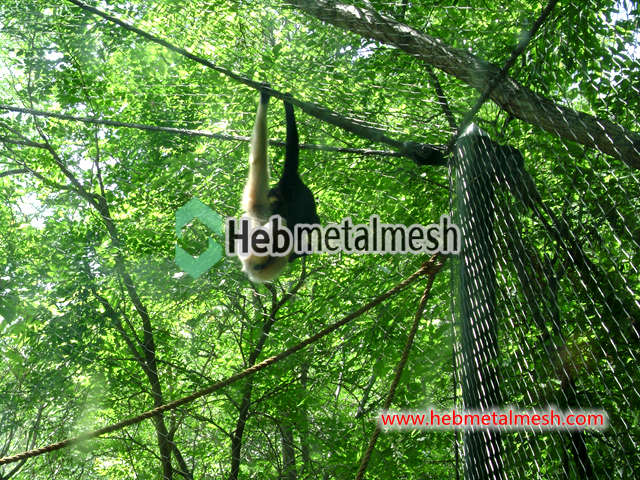
Designing a gibbon cage is not about creating a box; it is about recreating a three-dimensional forest canopy. To keep these primates healthy and engaged, several non-negotiable features must be integrated into the architecture.
Height & Volume: The Vertical Advantage
In the wild, gibbons rarely descend to the forest floor. Therefore, vertical space is significantly more important than ground-level square footage. A professional gibbon enclosure must provide enough height to allow for long, downward swings and upward leaps. Experts recommend a minimum height of 15 to 20 feet, though world-class zoo exhibits often exceed 30 feet. This “airspace” allows for the installation of multi-level climbing structures, ropes, and feeding platforms that mimic their natural habitat.
Flexibility vs. Rigidity: Protecting Primate Joints
One of the most overlooked aspects of primate containment is the “recoil” of the material. Rigid steel bars or heavy, stiff fencing provide no “give” when a fast-moving gibbon lands on them. Over time, the repeated impact on hard surfaces can lead to joint stress or hand injuries.
Handwoven stainless steel mesh acts like a high-tensile fabric. It is flexible enough to absorb the kinetic energy of a leaping gibbon, acting as a safety net that protects their limbs while remaining impossible to break or chew through.
Aesthetics: The “Invisible” Barrier
Modern zoo design focuses on immersion. A successful enclosure should allow visitors to feel as though they are looking into a forest, not a prison. This is achieved by using thin-gauge, high-strength wire that doesn’t obstruct the view. By integrating the mesh with natural elements like live trees, bamboo, and rockwork, the gibbon cage becomes a seamless part of the landscape.
4. Material Selection: Why Stainless Steel Mesh?
When choosing materials for a long-term investment like a gibbon exhibit, the choice usually comes down to three options. However, when performance is measured against cost over time, one stands above the rest.
Comparing Containment Materials
| Feature | Chain Link | Welded Wire | Hebmetalmesh (Handwoven) |
|---|---|---|---|
| Durability | Low (Rusts quickly) | Medium (Breaks at welds) | High (30+ Years) |
| Safety | Sharp edges/Burrs | Rigid/Impact risk | Smooth & Flexible |
| Visibility | Poor (Thick wires) | Moderate | Excellent (Thin & Strong) |
| Customization | Standard rolls only | Rigid panels | Any size (up to 30’x60′) |
| Animal Comfort | Abrasive surface | Hard impact | Impact absorbing |
The Superiority of 316-Grade Stainless Steel
While 304-grade is excellent for most environments, we highly recommend 316 stainless steel for zoo enclosures. It contains molybdenum, which provides superior resistance to “pitting” and corrosion. This is especially vital in humid tropical climates or coastal “bird park” environments where salt air and moisture can degrade lesser metals in just a few years. With Hebmetalmesh, your enclosure remains structurally sound and visually clean for decades.
The Black Oxide Advantage: Enhanced Viewing
Traditional silver stainless steel can reflect sunlight, creating a “glare” that makes it difficult for guests to see the animals or take photos. Our Black Oxide finish is a chemical treatment that turns the steel a deep, matte black.
- The Optical Illusion: Because the black mesh does not reflect light, the human eye focuses past the wire and onto the gibbons and greenery.
- Natural Integration: The black color mimics the shadows of the forest, making the gibbon cage virtually disappear into the background.
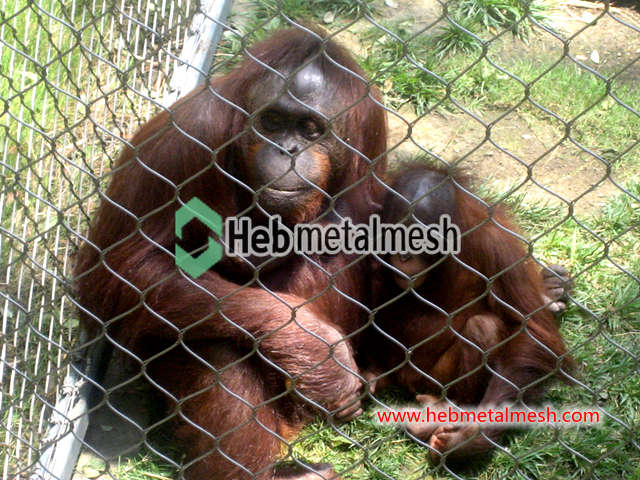
5. Customization: The Hebmetalmesh Advantage
When designing a world-class gibbon cage, “standard sizes” often lead to compromises in safety and design. At Hebmetalmesh, we understand that every zoo exhibit and garden sanctuary has unique dimensions. This is why our customization process is built into our core service model.
Customized Roll Sizes at No Additional Cost
Unlike many local hardware suppliers who charge “cutting fees” or force you to buy excess material, we offer customized roll sizes tailored specifically to your blueprints. Whether you need a narrow strip for a specialized primate tunnel or an expansive overhead section for an aviary-style enclosure, we produce the exact dimensions you require. This “order-to-fit” approach minimizes waste and ensures your budget goes directly into the quality of the material.
The Power of Large Panels: 30′ x 60′
One of the most significant advantages of working with Hebmetalmesh is our ability to manufacture massive, seamless panels—up to 30 feet by 60 feet (approximately 9m x 18m).
- Reduced Labor: Installing one large panel is significantly faster than seaming together ten smaller ones.
- Eliminating Weak Points: In a gibbon enclosure, the seams are often where structural integrity is tested most. By using large, continuous handwoven panels, you eliminate the need for excessive hardware and clips, creating a much stronger and more visually “clean” containment system.
Internal Link: Want to see how we maintain this level of precision? Learn more about Our Production Process and our commitment to handwoven quality.
6. Cost Analysis: How Much Does a Professional Gibbon Cage Cost?
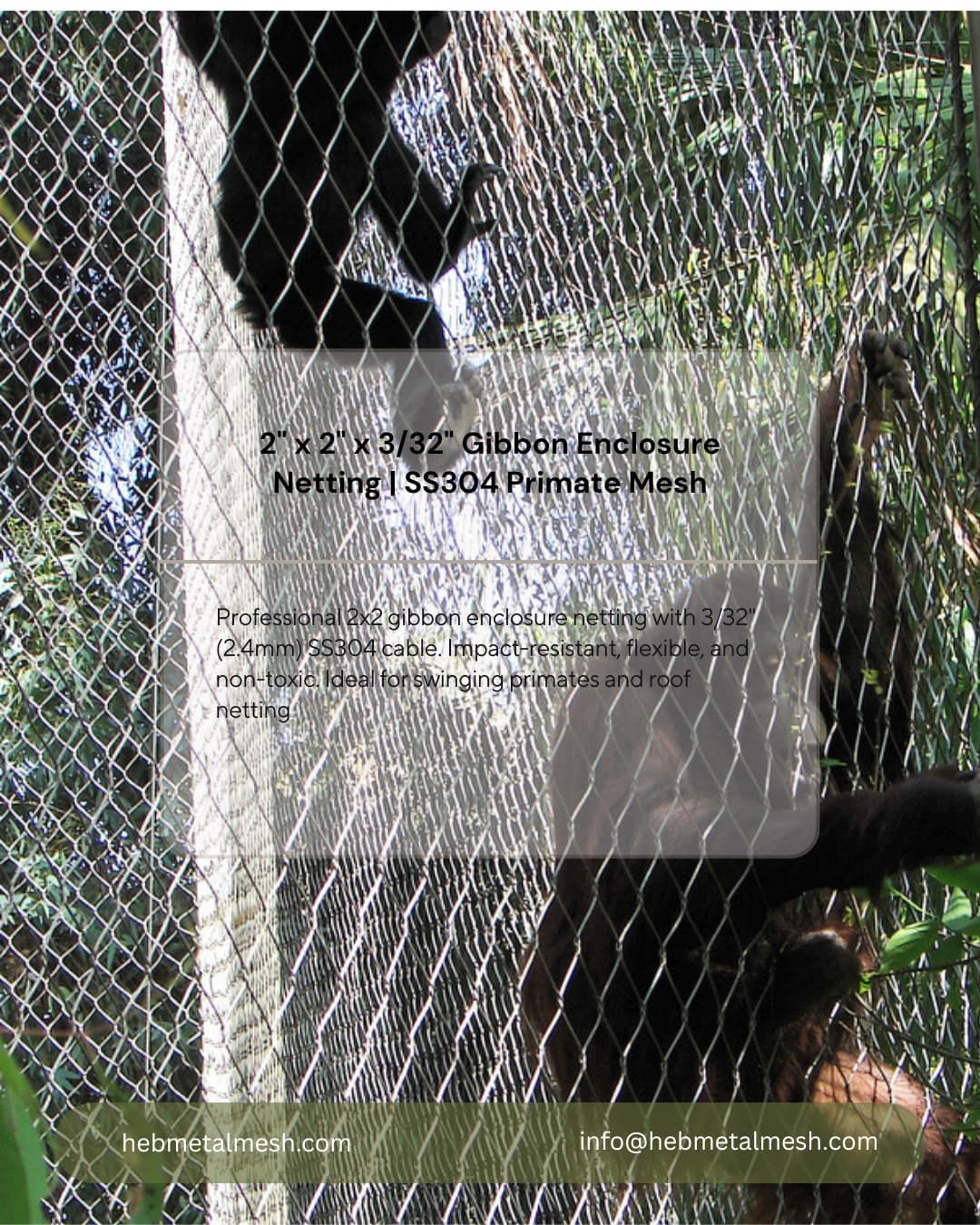
Budgeting for a professional-grade gibbon cage requires looking beyond the initial price tag. To find the true cost, you must consider the longevity of the materials and the complexity of the installation.
Key Factors Influencing Price
- Total Square Footage: Naturally, the larger the enclosure, the higher the material cost. However, larger orders often benefit from better shipping rates per square foot.
- Mesh Diameter (Cable Thickness): For active primates like gibbons, we typically recommend a $2.0\text{mm}$ to $3.2\text{mm}$ cable. Thicker cables provide more security but increase the weight and cost of the mesh.
- Shipping & Logistics: Because stainless steel mesh is heavy, shipping can be a factor. However, because our mesh is flexible, it can be rolled tightly, significantly reducing the volume and shipping costs compared to rigid panels.
DIY vs. Professional Zoo Grade
While “DIY” fencing like chain link or plastic netting may seem cheaper initially (often costing $1–$3 per square foot), these materials fail quickly under the stress of primate use and outdoor elements. A professional gibbon enclosure using 316-grade stainless steel is a long-term investment. While the upfront cost is higher, the lifespan of 30+ years means the “cost per year” is actually much lower than cheaper alternatives that require replacement every 3–5 years.
The Direct Manufacturer Advantage: Save 30-40%
The most effective way to manage the cost of a high-end gibbon cage is to eliminate the middleman. When you buy from Hebmetalmesh, you are ordering directly from the factory.
- By bypassing distributors and retail markups, our clients typically save between 30% and 40% on their total material costs.
- These savings allow zoo directors and private owners to reallocate funds toward better enrichment features, like climbing structures and specialized feeding systems.
7. Installation and Safety Standards
Installing a gibbon cage requires more than just hanging a fence; it requires structural tension. Because gibbons exert high kinetic energy during brachiation, the mesh must be installed using a perimeter cable system.
- Proper Tensioning: The handwoven mesh should be tensioned until it is taut but maintains its natural flexibility. This “spring” action is what prevents injury during high-impact landings.
- Smooth Transitions: Ensure all attachment points—whether using stainless steel ferrules or tie wires—are tucked away or smoothed down. Gibbons are incredibly tactile and will find any sharp edge or loose wire end.
- Load Distribution: By using our large custom fence panels, you distribute the weight of the animal across thousands of interwoven diamond nodes, rather than putting stress on a single weld or bolt.
8. Case Studies: Hebmetalmesh in Action
Over the years, Hebmetalmesh has become a trusted partner for wildlife conservationists and zoo architects globally.
- The Tropical Aviary Project: A major bird park required a 40-foot high enclosure that could house both large hornbills and small primates. Our Black Oxide mesh provided the perfect “invisible” barrier, allowing the lush vegetation to take center stage while keeping the inhabitants secure.
- The Primate Sanctuary Upgrade: A rescue center replaced aging chain-link cages with our 316-grade stainless steel mesh. Not only did the animal health improve due to the softer landing surface of the mesh, but the facility saved thousands in annual maintenance and rust-prevention costs.
9. Conclusion: A Long-Term Investment in Primate Welfare
Building a gibbon cage is a balance of engineering and empathy. You need a material strong enough to contain a powerful athlete, yet delicate enough to protect their hands and provide a clear view for education and conservation.
With a lifespan exceeding 30 years, resistance to the harshest weather, and a finish that disappears into the landscape, Hebmetalmesh offers the ultimate solution for modern primate enclosures. By choosing our handwoven stainless steel mesh, you are investing in a product that prioritizes animal welfare, visitor experience, and long-term financial sense.
Build a Safer, Durable Gibbon Enclosure
Get professional-grade Handwoven Stainless Steel Mesh customized to your exact specifications. No extra cost for custom roll sizes.
- ✔ Premium 304/316 Stainless Steel
- ✔ Seamless Panels up to 30′ x 60′
- ✔ Nature & Black Oxide Finishes
- ✔ Factory Direct Pricing (Save 30-40%)
10. Q&A: Frequently Asked Questions
A cable diameter of 2.0mm to 3.2mm with a mesh aperture (opening) of 2″ x 2″ or 3″ x 3″ is typically recommended to prevent entrapment while ensuring maximum strength.
You can purchase customized, professional-grade panels directly from the Hebmetalmesh Online Store, which ships worldwide.
Yes. The black oxide process is a structural coloration that does not peel or flake, offering the same 30+ year durability as natural steel.
Absolutely. At Hebmetalmesh, we manufacture to your specific length and width requirements at no additional cost.
We can produce seamless handwoven panels up to 30′ x 60′, allowing for massive, one-piece enclosure sections.
Hebmetalmesh is a specialized manufacturer that has supplied stainless steel mesh to zoos, wild parks, and bird sanctuaries for years.
Yes. Unlike welded wire or chain link, our handwoven mesh has no sharp burrs or jagged edges, making it the safest option for tactile primates.
Total cost is determined by the square footage, the grade of steel (304 vs 316), and the cable diameter. Contact us for a direct factory quote to save on middleman markups.
Yes, it is widely used for orangutans, chimpanzees, lemurs, and macaques due to its high tensile strength and flexibility.
Yes. Because we provide custom-sized rolls, the mesh is much easier to lace onto a frame than rigid, heavy panels that require specialized cutting tools.