
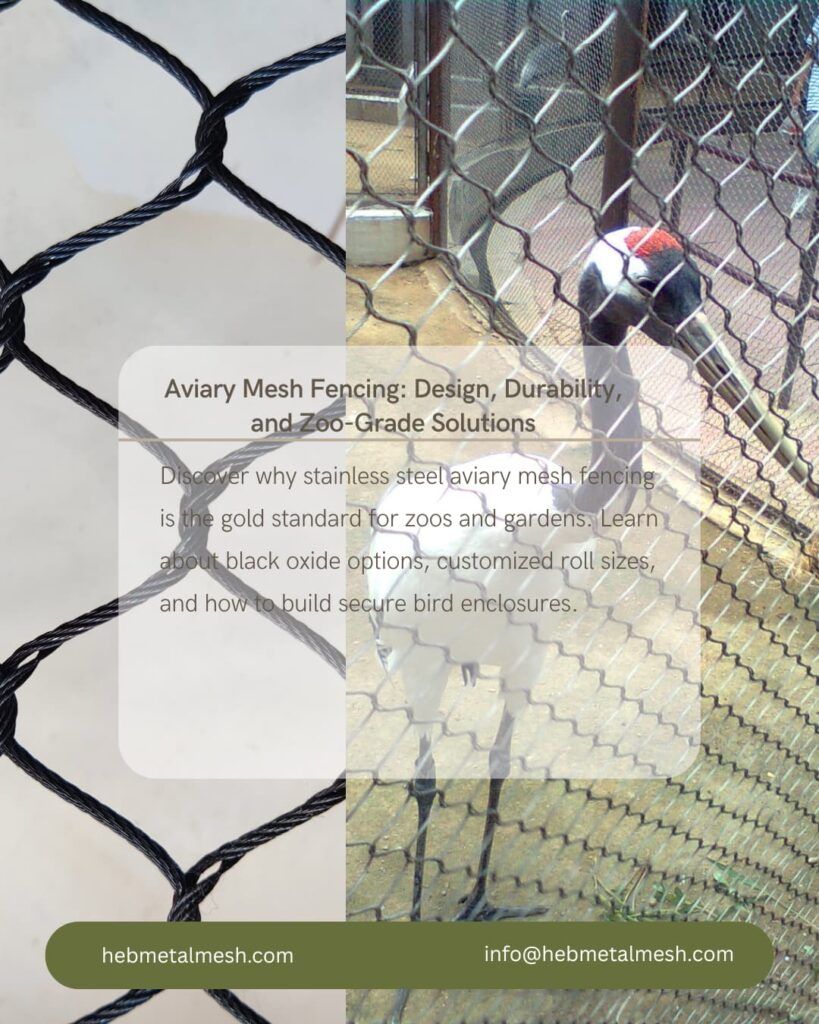
Most cable mesh in a bird park is chosen by its aperture, and the aperture is usually chosen from a bird the park already owns. That is half the calculation. The opening has to be small enough that nothing in the collection can pass a head through it, and small enough that nothing outside the collection can pass a head through it either. Between those two figures sits a band of openings that admit a head and refuse a body, and a bird caught that way hangs. Aperture selection is not a search for the right number; it is a search for the two that bracket it.
Executive Summary
A bird park specification can fail in two directions, and the catalogue only warns about one. The obvious direction is containment: the opening has to be narrower than the head of the smallest bird in the collection, measured on the smallest individual rather than the largest. The direction nobody prices is ingress. A park roof is also a barrier against free-living birds and rodents, and an opening sized for an eagle admits a starling’s head while refusing its body, which produces a hung bird, a welfare incident and — if the species carries avian influenza — a biosecurity event with a public-health dimension. The answer is not to guess a mid-range opening but to state both limits and treat everything between them as forbidden. Because hand woven wire mesh is woven rather than welded, a designer can choose aperture and cable diameter independently, which is what makes that possible. The reference specification is the stainless steel rope mesh product page.
Specifying mesh for a bird park? Send us the species list, the free-living birds the site has to exclude and the span, and we will return the aperture, the cable diameter and the frame loads that follow from them.
Quick Answer: What aperture should a bird park use?
Size the opening from whichever bird is smaller — the smallest head in your collection, or the smallest head that has to be kept out of it — then test that answer against the entrapment band. If the aperture is narrower than both heads it is safe; if it is wider than the whole body of either bird it is also safe; if it sits between a head and a body it is the wrong aperture, however open it looks from the path. Cable diameter, span, alloy and ferrule termination are chosen afterwards, around that number.
Key Takeaways
- An aperture is bounded by two birds: the smallest one you must contain and the smallest one you must exclude.
- The dangerous opening is neither the tight one nor the wide one, but the band that admits a head and refuses a body.
- Bird head entrapment is a welfare failure and a biosecurity failure at once, because a hanging wild bird is a disease vector.
- Aperture and cable diameter are independent in woven mesh, and their ratio decides how solid the barrier looks.
- Rodent entry and wild bird entry are governed by the same figure as containment, so specifying them together costs nothing extra.
Two Birds Decide the Aperture, Not One
Most mesh sizing for birds begins and ends with the resident species, and the standard advice — measure the head, go one size below — is correct as far as it goes. It stops where the interesting part starts, because a park enclosure is two barriers sharing one skin. Facing inward it contains a collection whose smallest member fixes the maximum aperture you may use; facing outward it excludes a free-living population whose smallest member fixes the same figure independently. Both are ceilings, and a specification has to satisfy the lower of the two.
The second figure gets missed on timing. The collection is a written list, the wild birds are not, and the roof is usually detailed before anyone has asked what lives in the hedge outside it. For the wider layout question — flight volumes, service routes, visitor flow — the full brief sits in our notes on aviary netting for bird parks; this page is only about the opening.
The Entrapment Band
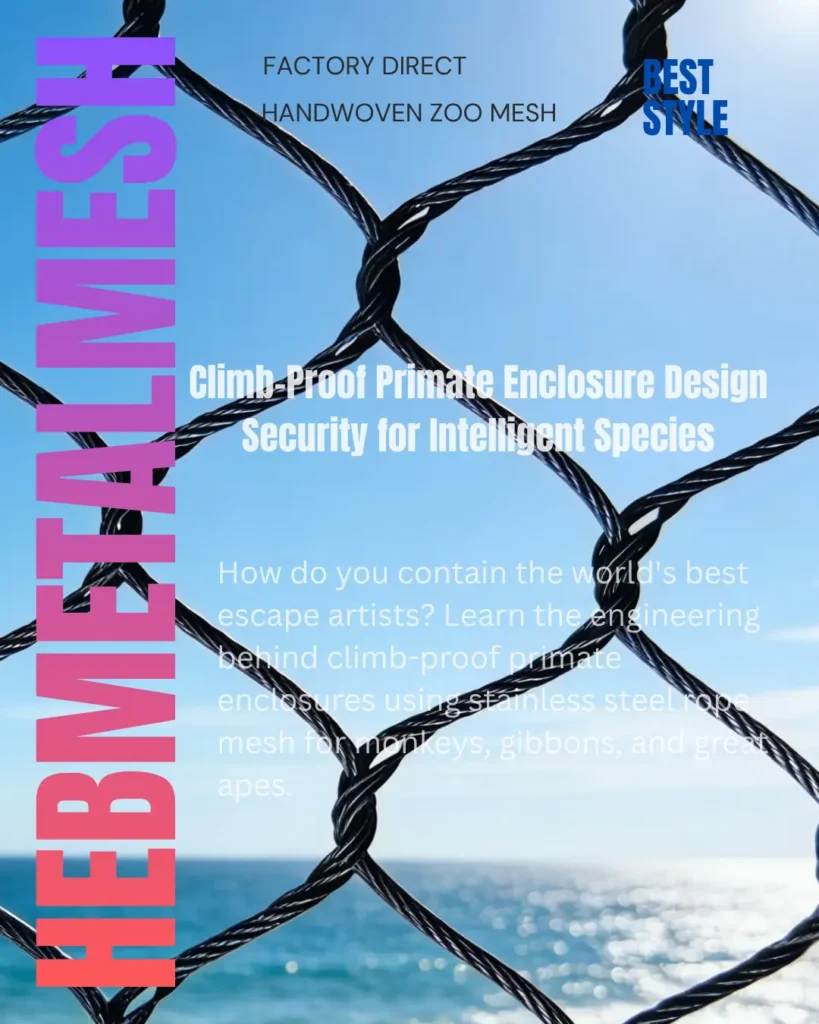
An opening behaves in one of three ways. Narrower than the head, and the head never enters, so the bird is contained. Wider than the body, and the bird passes through or withdraws freely, which is a containment failure but not a trap. Between the two, a bird puts its head and neck through and stops at the shoulders, and the harder it pulls the less it achieves. That middle range is the entrapment band, and aperture entrapment is the only failure a mesh specification can cause by itself. It is also where a sketch of anatomy stops being enough: a bird reaching through compresses its neck and rotates its skull, so head entrapment is decided by a head measured in motion and a body that does not deform at all. The British Trust for Ornithology publishes the field method for measuring head and bill in the hand, which is the measurement the rule depends on.
The band has two edges. At the lower one is a minimum aperture, the first width that admits a head. At the upper one is a maximum aperture, the last width that still refuses a body. Every width between them should be treated as forbidden. Those two figures are the aperture limits worth writing down, because a supplier quoting inside them cannot be argued with after the fact.
The band matters most at the top of a park. Roof mesh is habitually chosen coarse, because roof spans are wide and a heavier cable is easier to justify there, and a coarse roof is exactly where small birds arrive from above and hang. Where a coarse roof is unavoidable, the opening still has to be justified against the bird most likely to land in it.
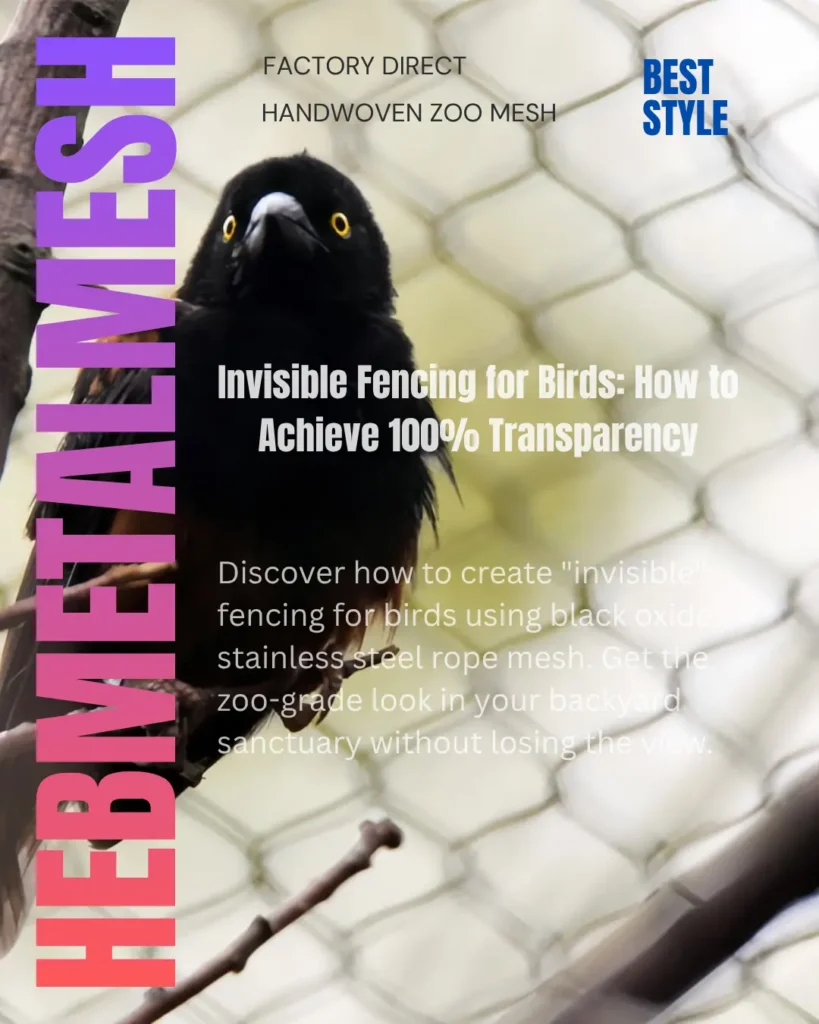
The Smallest Bird in a Park Is Rarely Yours
The smallest head that constrains the design is usually not in the collection. It belongs to whatever lives on the site, and a park housing medium birds can still be defeated by a sparrow-scale head at the eaves. Wild bird entry is not an aesthetic concern; it is the entry route for disease into a collection that is otherwise closed, which is why biosecurity and aperture size are the same conversation, covered in more depth in our aviary biosecurity notes.
One consequence should be stated openly. A 20 mm aperture is close to the finest opening a woven cage mesh is normally made in, and it is already marginal against a small passerine head. For a park that genuinely must exclude small wild birds, the honest options are a designated fine over-roof, a second finer layer, or an accepted residual risk with the season for it written down. Pretending one 20 mm aperture achieves both containment and exclusion is how a specification looks clean on paper and fails in service.
Rodent entry follows the same arithmetic with a different body plan, because a rodent’s limit is its skull rather than its head furniture. It is why a park’s floor detail and its roof detail are usually specified at different apertures, and why a penetration left for a drainage pipe quietly becomes an opening nobody sized.

What the Cable Is There For
Once the opening is fixed, the cable has one job: absorb whatever the largest occupant delivers and hold the plane of the mesh while it does it. That is a function of diameter and span together, never of diameter alone. A long unsupported span with a fine cable behaves like a drum; the same cable over a shorter span behaves like a barrier. Mesh sizing for birds therefore ends with a structural question — how far between supports, and how heavy the animal — rather than with a species list.
Because cable netting is woven rather than welded, a wire rope mesh keeps the two variables separate. The aperture can be tightened for containment without forcing a heavier cable, and the cable can be thickened for the breaking load a long span demands without altering what can pass through. A welded grid locks the two together, which is one of the traps set out in our aviary mesh comparison.
eading the Numbers: 20 mm, 38 mm and Between
The useful quantity on a specification sheet is not the aperture size and not the diameter, but their ratio. Square the clear distance, divide by the pitch, and you have the open fraction; the remainder is the solidity ratio, the share of the barrier that is metal. It moves fast at fine apertures and slowly at coarse ones, which is why a park can feel open through one mesh and closed through another with a similar mesh count.
| Aperture | Cable | Open | Typical use |
| 20 mm | 1.2 mm | 88% | fine, and the cable choice costs most here |
| 38 mm | 1.2 mm | 94% | the small-bird compromise |
| 38 mm | 3.2 mm | 84% | strong and open, for medium birds |
| 102 mm | 3.2 mm | 94% | maximum mesh openness, large collection only |
The 20 mm aperture loses sixteen points of mesh openness when the cable goes from 1.2 mm to 3.2 mm; the same change costs about ten points at a 38 mm aperture and four at 102 mm. That trade has to be made consciously. Where transparency matters — a walk-through flight, a display frontage — a lighter cable at a moderate aperture buys more view than a tight aperture does.
Alloy, Terminations and the Frame
Grade selection is short. An uncoated stainless mesh has no coating to lose, so its corrosion resistance is a property of the alloy rather than of a surface treatment, and 304 covers inland park sites while 316 is the answer wherever salt or heavy cleaning is in the air. A coastal walk-through aviary is the case that decides it.
Terminations deserve more thought than they get. A ferrule termination gives a clean, repeatable crimp at every intersection and a mesh that holds a flat plane, which is what a display frontage usually wants. A knotted weave tolerates slack and repairs locally, which is worth more on a roof than on a wall. Neither is stronger in the abstract; they fail differently, and the failure mode is what a maintainer lives with. Panels are made to 9 m by 18 m, and above roughly that size the frame rather than the mesh becomes the project, because a mesh that spans further hands its load to steel somebody has to pay for. Span, panel size and diameter are walked through from the enclosure side in our mesh size notes.
Writing the Aperture Specification
Five lines are enough, and none of them is a mesh count. First, the head width of the smallest bird in the collection, on the smallest individual, since next season’s juvenile is smaller than anything on site today. Second, the head width of the smallest free-living bird the site must exclude — and whether excluding it is realistic at all. Third, the two aperture limits, written down so no supplier can quote inside them. Fourth, the cable diameter and the design span, chosen together. Fifth, the alloy and the termination. Add a sixth if the site is coastal, because grade and span interact there in ways inland sites never see.
What that buys is a mesh which cannot be quietly substituted: a cheaper panel with a different opening falls outside the stated limits and can be rejected on the drawing rather than after a bird is found hanging. Our stainless steel rope mesh range is supplied against exactly those lines, aperture and diameter quoted separately so the pair can be checked. Parks that also care how the finished barrier reads should see our net fouling notes, because droppings gradually bridge an opening and effectively tighten it over a season.
FAQ
No, and the assumption causes most incidents. Anything tighter than the head is safe; between the head and the body it is not. If a call has to go one way, tighter is usually the right direction, but the reason for sizing the aperture that way should be the head measurement rather than a general preference for fine mesh.
Because they carry what a closed collection has no resistance to. A free-living bird that enters through a roof opening, or hangs in it, is an infection route as well as a welfare problem, which is why avian influenza planning and aperture selection belong on the same drawing.
Only if the finest available opening is narrow enough for the smaller bird, and 20 mm often is not. Where the requirement is genuine, a second finer layer over the roof is the usual answer, and it should be written into the specification rather than assumed.
We will size the aperture from your species list — and from the birds you do not own. Send us the collection, the free-living species the site has to exclude and the span, and we will return the opening, the cable diameter and the support loads together.