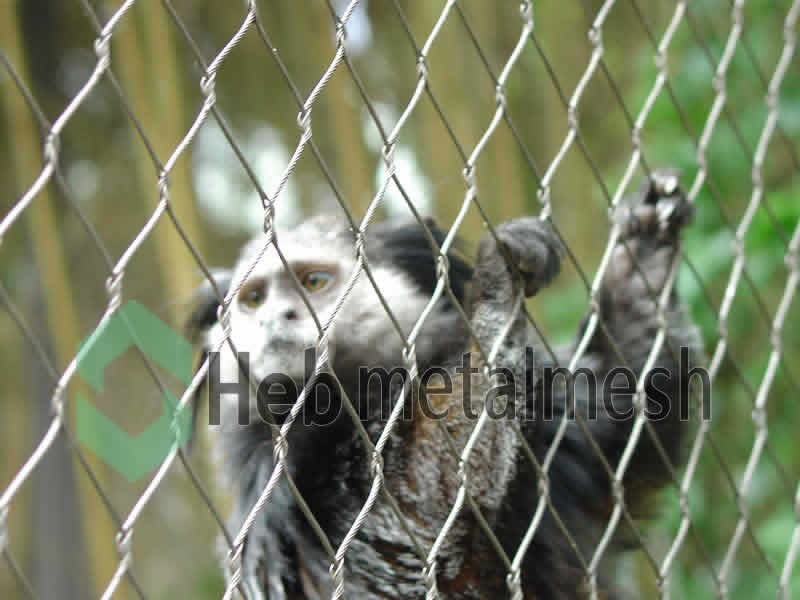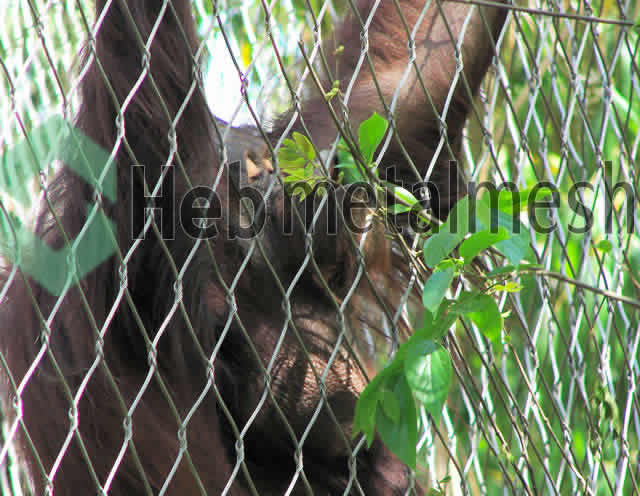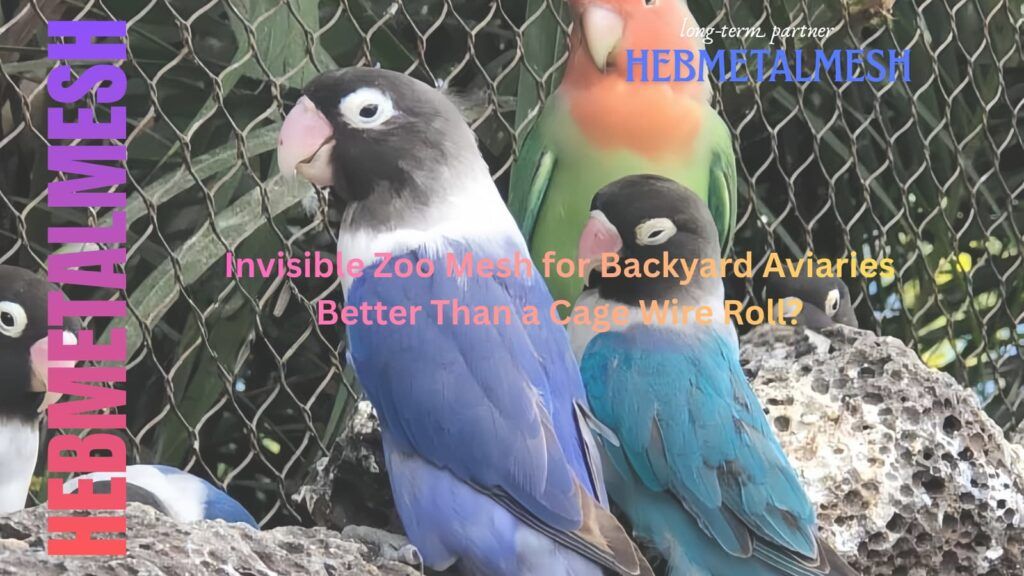
Why settle for a cage when you can have a view? Traditional cage wire rolls often create a visual barrier that distracts from the beauty of your birds. Invisible zoo mesh (stainless steel rope mesh) offers a high-tensile, 90% transparent alternative used by world-class zoological parks. It’s hand-woven, rust-proof, and flexible enough to wrap around complex architectural shapes, providing a premium, “vanishing” aesthetic for home aviary projects that standard welded wire simply cannot match. If you are looking for the best invisible zoo mesh for backyard aviaries, you’ve likely realized that a standard cage wire roll just won’t cut it.
1. Introduction: The “Aha!” Moment
You’ve done everything right. You spent months researching the perfect avian species, thousands on rare breeding pairs or exotic rescues, and even more on a lush, tropical landscape that would make a botanical garden jealous. But then came the enclosure phase. You went to the local hardware store, grabbed a standard cage wire roll, and spent a weekend stapling galvanized grids to a wooden frame.
You stepped back to admire your work, and your heart sank.
Instead of a breathtaking sanctuary, you’re looking at a silver-grey wall of industrial “noise.” The birds are there, but they’re obscured by a heavy, reflective grid. The plants are there, but they look like they’re behind bars. This is the “Hardware Store Trap”—the moment you realize that while a cage wire roll is functional for a chicken coop or a compost bin, it’s a visual catastrophe for a high-end backyard aviary.
The “Zoo-Grade” Pivot
Here is the secret professional curators at the San Diego Zoo or the Smithsonian haven’t told you: They stopped using standard cage wire rolls decades ago. Walk through any modern, world-class bird house, and you’ll notice something unsettling—you can barely see the enclosure. You see the flight patterns, the vibrant plumage, and the natural behavior. This isn’t a trick of the light; it’s a deliberate shift in materials. Professional zoologists moved away from rigid, welded grids and toward a high-tensile, hand-woven solution that prioritizes the viewer’s experience as much as the animal’s safety.
The Hook: It’s Not Magic, It’s Engineering
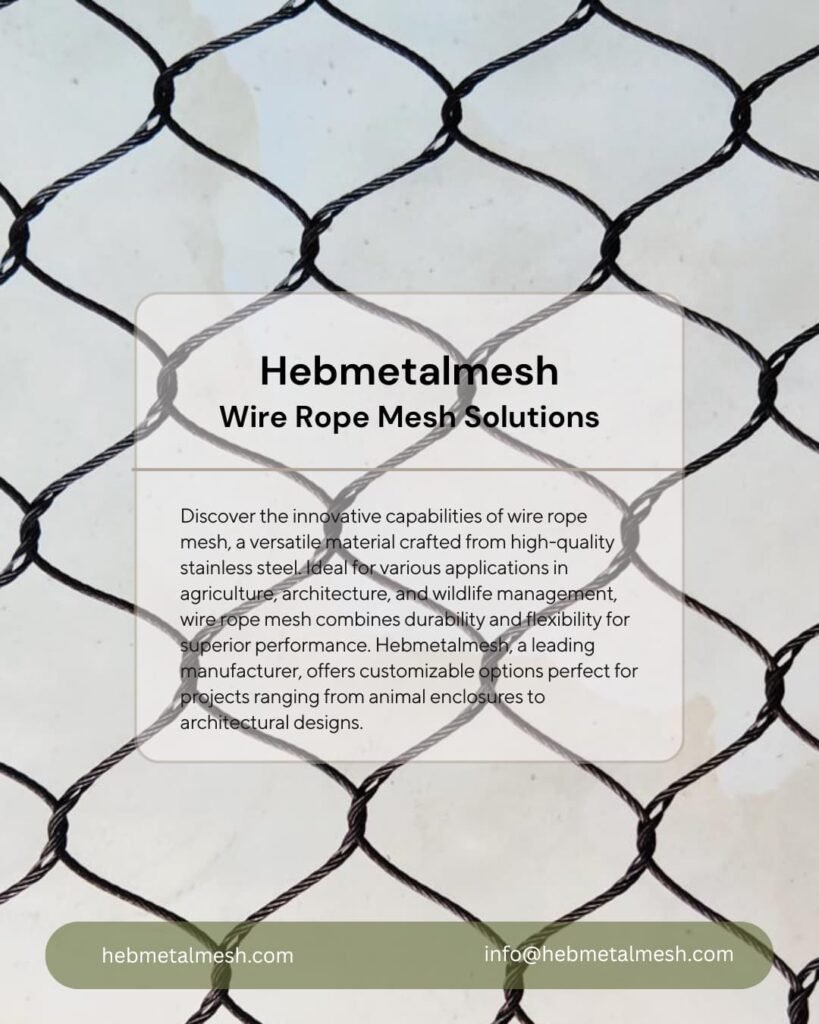
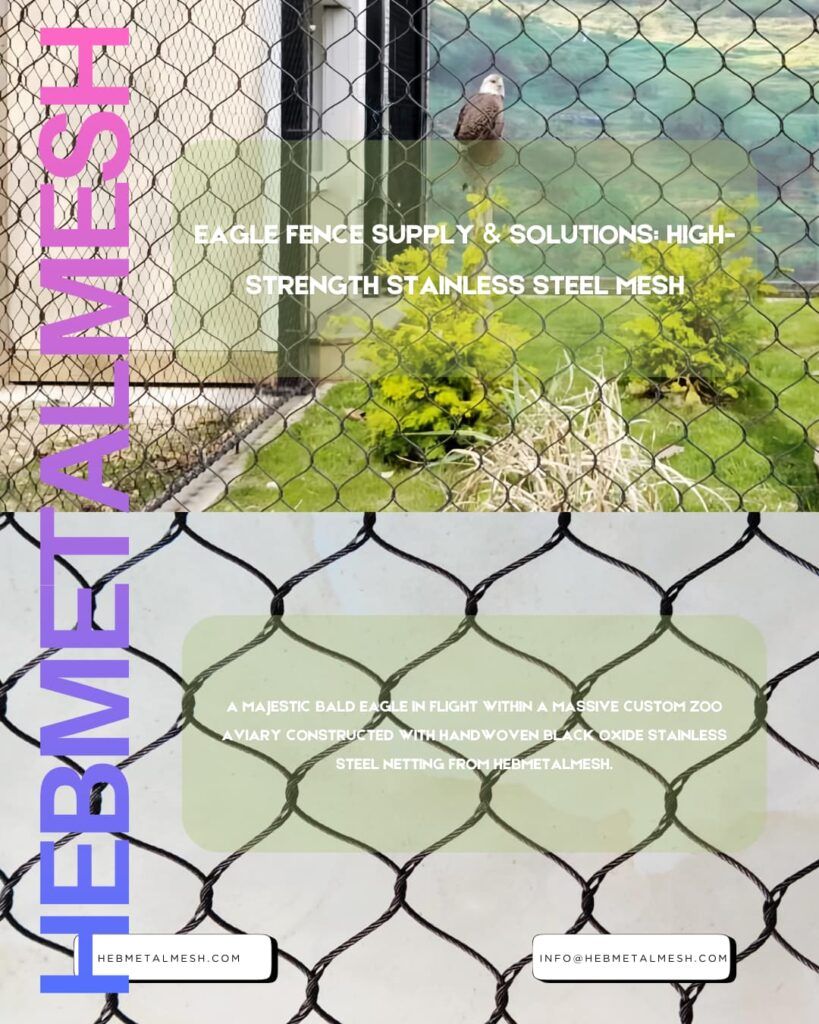
This is what we call Invisible Zoo Mesh. It isn’t some experimental cloaking technology; it is the pinnacle of 316 stainless steel engineering. By utilizing a “rope mesh” structure—where incredibly thin cables are woven into a flexible diamond pattern—you achieve a physical barrier that is actually stronger than a traditional cage wire roll, yet boasts a transparency rate of over 90%.
In the next 1,800 words, we’re going to show you how to stop building “cages” and start creating “invisible” sanctuaries. It’s time to let the light in and make the wire disappear.
2. The Science Behind Invisible Zoo Mesh for Backyard Aviaries
Have you ever wondered why some bird enclosures feel like a “black box” while others seem to disappear into the landscape? It’s not about the birds; it’s about aperture and light refraction. When you use a standard cage wire roll, you are typically dealing with thick, galvanized wires that reflect sunlight directly into your retinas. This creates “visual noise”—a bright, metallic grid that forces your eye to focus on the fence rather than the life inside it.
The “Vanishing” Diameter
The secret to invisible zoo mesh lies in its ultra-slim profile. By utilizing marine-grade 316 stainless steel, we can achieve incredible tensile strength with a wire diameter as small as 1.2mm to 2.0mm. Because the wire is so thin, it occupies less of your field of vision. More importantly, the hand-woven diamond structure doesn’t have the bulky “welding spots” found on a typical cage wire roll, which act like tiny mirrors catching the sun. Instead, the mesh absorbs and scatters light, allowing the human eye to naturally “focus past” the barrier.
The Math of Transparency
To truly understand why your old cage wire roll is blocking your view, you have to look at the Open Area Ratio. This formula determines exactly how much unobstructed light reaches your eyes:
While a heavy-duty cage wire roll might have a transparency rate as low as 60-70% due to thick wires and small openings, our specialized zoo mesh regularly hits 90% or higher. You aren’t just buying a fence; you’re buying 20% to 30% more “view” that you previously didn’t even know you were missing.
3. Comparing the Contenders: Zoo Mesh vs. Cage Wire Roll
When you’re standing in the aisle of a home improvement center staring at a $50$ cage wire roll, it’s easy to think, “Wire is wire, right?” Wrong. That’s like saying a tricycle and a Ducati are the same because they both have wheels. When we move from basic hardware to professional-grade invisible zoo mesh, we aren’t just changing the brand—we’re changing the molecular structure of your enclosure.
Durability: Zinc-Plated vs. Marine-Grade Stainless Steel
Most standard cage wire rolls are made of galvanized steel. This means a base layer of cheap carbon steel is dipped in a thin coating of zinc. The moment you cut that wire, the “seal” is broken, and the core begins to rust from the inside out. Within three to five years, you’re looking at unsightly orange streaks.
In contrast, our zoo mesh is forged from $316$ Marine-Grade Stainless Steel. This isn’t a coating; the entire wire is an alloy designed to withstand salt spray and acid rain. While a cage wire roll is a “temporary” solution you’ll be replacing in five years, stainless steel rope mesh is a legacy product with a $30$-year lifespan.
Flexibility: The “Fabric” Factor
If you’ve ever tried to wrap a cage wire roll around a curved frame or a corner, you know the struggle. It fights back. It kinks, it bubbles, and it leaves sharp “fishhooks” that catch on clothes and wings. It’s rigid, linear, and unforgiving.
Invisible zoo mesh behaves more like a high-tech fabric. Because it is hand-woven from flexible cables, it can be stretched, draped, and contoured to any architectural shape. Whether you want a geodesic dome or a flowing, organic canopy that weaves through trees, this mesh follows your lead—it doesn’t dictate your design.
Safety: The “Zinc Toxicity” Talk
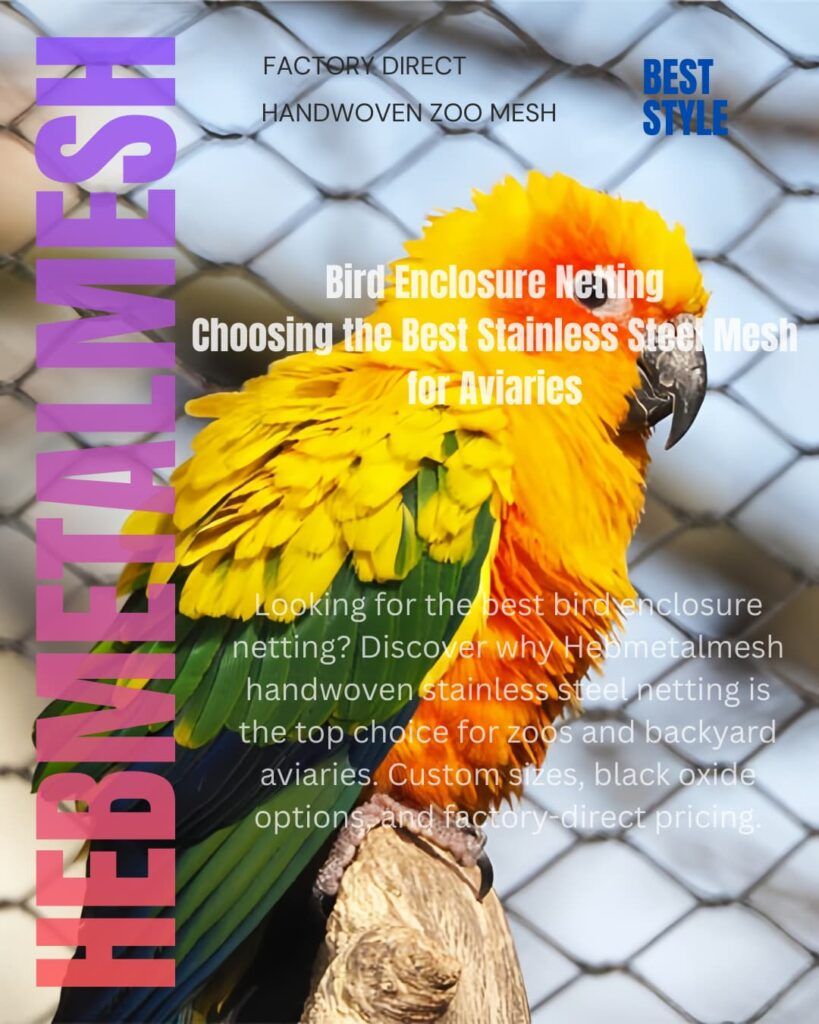
For parrot owners, this is the most critical point. Many birds in the psittacine family are “hookbills”—they use their beaks to climb. A standard galvanized cage wire roll is coated in zinc, which is highly toxic to birds if ingested. “New Cage Syndrome” is a real medical emergency where birds slowly succumb to heavy metal poisoning from chewing on their wire walls. By switching to inert stainless steel, you eliminate the risk of zinc toxicity entirely. You aren’t just buying a better view; you’re buying a health insurance policy for your flock.
The “Kink” Factor
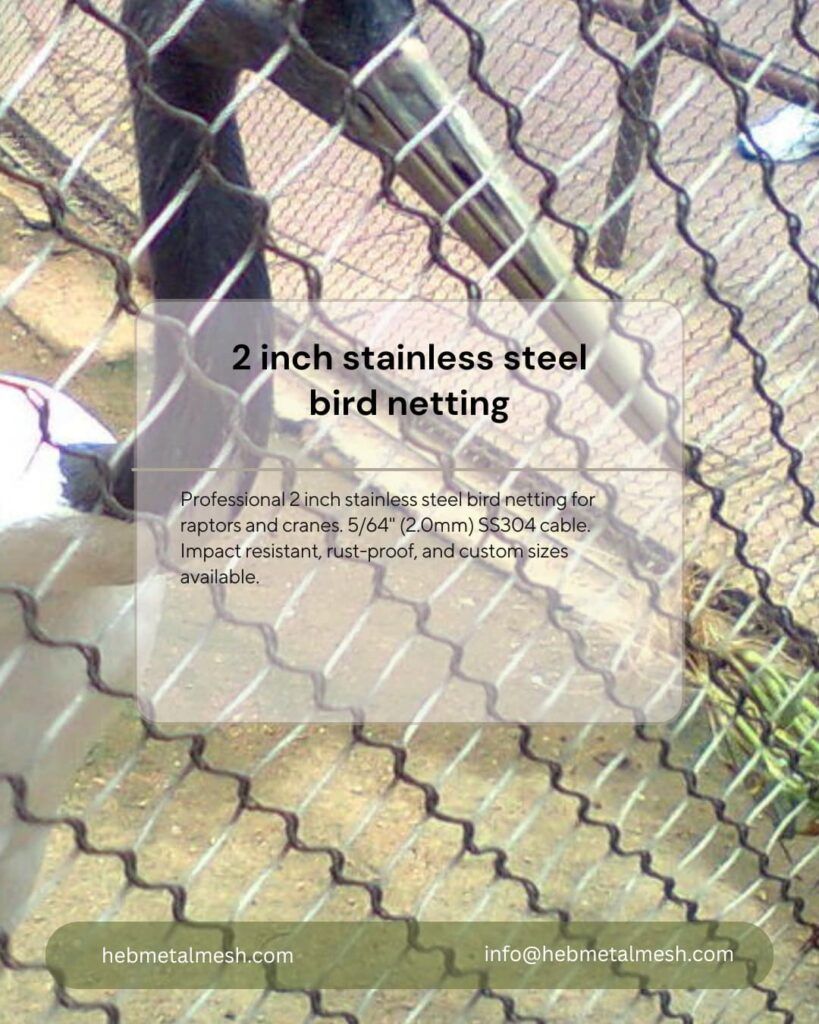
Finally, let’s talk about structural memory. If a tree branch falls on a welded cage wire roll, the metal kinks and the welds snap. Once it’s bent, it stays bent. It looks “trashed” instantly. Our rope mesh, however, is crush-proof. Its diamond-weave structure acts like a spring, absorbing impacts and snapping back into its original shape. It handles the weight of heavy snow or falling debris without losing its tension or its beauty.
4. Design Inspirations: From Backyard to Sanctuary
Forget the rectangular “box” in the corner of the yard. When you stop thinking in terms of a rigid cage wire roll, the architectural geometry of your property completely changes. You aren’t just building an enclosure; you are curating an ecosystem.
The “Walk-In” Experience
The most transformative shift from “hobbyist” to “professional” is the creation of a walk-in sanctuary. Traditional cage wire rolls are often limited by their structural stiffness, forcing you into small, cramped designs that feel like… well, cages. By contrast, invisible zoo mesh allows for massive spans without the need for heavy internal support beams. Imagine walking through a door into a lush, planted habitat where the barrier between you and the birds feels non-existent. Because the mesh is 90% open, the airflow and natural light keep the interior smelling fresh and the plants thriving—avoiding the “musty coop” smell associated with tighter, darker wire grids.
The Contoured Roof: Domes and Dreams
Standard welded wire is flat-earth tech. If you try to bend a cage wire roll into a dome or a hyperbolic curve, it kinks, buckles, and eventually snaps at the welds. Invisible zoo mesh is the “Spandex” of the architectural world. Because it is a hand-woven diamond pattern, it possesses “four-way stretch” capabilities. You can pull it over a circular frame to create a stunning geodesic dome or drape it over natural tree limbs to create an organic, flowing canopy. This flexibility allows your aviary to blend into the existing landscape rather than clashing with it.
Seamless Integration
The “Aha!” moment truly hits when you see the finishing. A cage wire roll usually requires ugly wooden batten strips or heavy-duty staples to stay in place. With stainless steel rope mesh, the integration is surgical. You can lace the mesh directly onto a perimeter cable or “sew” it onto steel frames using high-tensile stainless wire. Whether you are attaching it to reclaimed oak beams for a rustic look or sleek black steel for a modern aesthetic, the connection points are clean, minimal, and—most importantly—safe for inquisitive beaks.

5. Installation Secrets for the DIY Perfectionist
If you’ve ever unrolled a standard cage wire roll, you know the drill: it springs back, cuts your knuckles, and refuses to lay flat. Installing invisible zoo mesh is a completely different experience—it’s more like tailoring a suit than building a fence. It requires a shift in mindset from “stapling” to “tensioning.”
Tensioning is Key: The Perimeter Secret
Unlike a rigid cage wire roll that relies on its own stiffness to stay upright, stainless steel rope mesh thrives under tension. The secret to that professional “vanishing” look is a structural perimeter cable. By threading a 1/8″ or 3/16″ stainless steel cable through the edge diamonds of the mesh and anchoring it to your frame, you create a “drum-tight” surface. This doesn’t just look better; it actually reinforces your entire structure. The mesh and the frame work together as a single, high-tensile unit that can withstand high winds and heavy snow loads that would collapse a flimsy welded wire cage.
The Tool Upgrade: Precision vs. Brute Force
Forget the rusty wire snips and manual staplers you’d use for a cheap cage wire roll. To achieve a zoo-grade finish, you’ll want to trade up to a swaging tool and stainless steel ferrules. Swaging allows you to create permanent, rock-solid loops in your perimeter cables. While it sounds technical, it’s a remarkably satisfying DIY process. Instead of thousands of sharp, protruding wire ends, you end up with a smooth, snag-free enclosure that is safe for both your birds’ feathers and your own hands.
The “One and Done” Investment
Let’s be real: installing any enclosure is a weekend-killer. Do you really want to do it again in three years when your cage wire roll starts to sag and rust? Stainless steel rope mesh is the “last fence you’ll ever buy.” Because it is chemically inert and physically flexible, it doesn’t fatigue over time. You install it once, tension it perfectly, and then spend the next thirty years enjoying the view instead of patching holes.
6. The Verdict: Is it Worth the Investment?
Now we get to the bottom line. You’re looking at the price difference between a $50 cage wire roll from the local depot and a custom-woven order of invisible zoo mesh. At first glance, the hardware store option looks like a bargain. But is it?
The ROI of “Invisible” Engineering
When you factor in the “Life Cycle Cost,” the math shifts dramatically. A standard cage wire roll is a consumable; it’s a product designed to be replaced. Between the inevitable rust, the sagging welds, and the risk of zinc toxicity, you aren’t just buying wire—you’re buying a maintenance schedule.
On the other hand, $316$ stainless steel rope mesh is an architectural asset. It increases the property value of your home by turning a functional necessity into a design feature. If you plan on enjoying your aviary for more than five years, the “cost per year of service” for zoo mesh actually drops below that of cheap galvanized wire.
The Ultimate “Aha!” Moment
The real value, however, isn’t found in a spreadsheet. It’s found on a quiet Saturday morning when you’re sitting by your aviary with a cup of coffee. With a cage wire roll, you are looking at a fence. With invisible zoo mesh, you are looking at your birds. You see the iridescent shimmer of a wing, the delicate texture of a leaf, and the true depth of your landscape.
The “Aha!” moment happens when you realize that the barrier has effectively disappeared. You’ve successfully brought a piece of the wild into your backyard, and for the first time, there’s nothing standing in the way of the view.
Ready to Make Your Aviary “Invisible”?
Don’t let a standard cage wire roll ruin your view. Upgrade to the same hand-woven stainless steel mesh used by the world’s leading zoos.
- Unmatched Transparency: 90% open area for the best view.
- Lifetime Durability: 304/316 Stainless Steel that never rusts.
- Custom Sizes: We weave to your specific project dimensions.
Worldwide Shipping | Factory Direct Pricing | Expert Support
🙋♂️ Frequently Asked Questions: Invisible Zoo Mesh vs. Cage Wire
Absolutely. While a standard cage wire roll relies on rigid welds that can “pop” under pressure, our stainless steel rope mesh is hand-woven. This means the load is distributed across the entire panel. Even a thin $1.2$mm cable has a breaking strength that far exceeds traditional chicken wire or hardware cloth. It’s the same material used to contain large primates and big cats in professional zoos.
Unlike a cage wire roll, which you can snip with basic pliers, stainless steel rope mesh is a bit tougher. You will need a high-quality wire rope cutter to ensure a clean snip without fraying the cable. Because we provide custom-sized panels at hebmetalmesh, we recommend measuring twice so we can weave it to your exact dimensions, saving you the labor of trimming.
ou can, but you shouldn’t. Using staples is the “cage wire roll” way of thinking. For a professional, invisible look, you should install a perimeter cable using eye-bolts and then “lace” the mesh to the cable. This allows the mesh to stay perfectly tensioned and prevents the wood from splintering under the high-tensile pull of the steel.
No. One of the biggest headaches with a cage wire roll is that the metal has “structural memory”—once it stretches or gets hit, it stays saggy. Because our zoo mesh is a flexible weave of 316 stainless steel cables, it acts like a spring. As long as your frame is solid and your perimeter cables are tight, the mesh will remain drum-tight for decades.
Yes. The primary concern with metal enclosures is Zinc Toxicity (Heavy Metal Poisoning). Standard galvanized cage wire rolls are coated in zinc. Our mesh is solid 304 or 316 Stainless Steel, which is chemically inert and contains no toxic coatings. It is the gold standard for sensitive or expensive species like Macaws, Cockatoos, and soft-billed birds.