
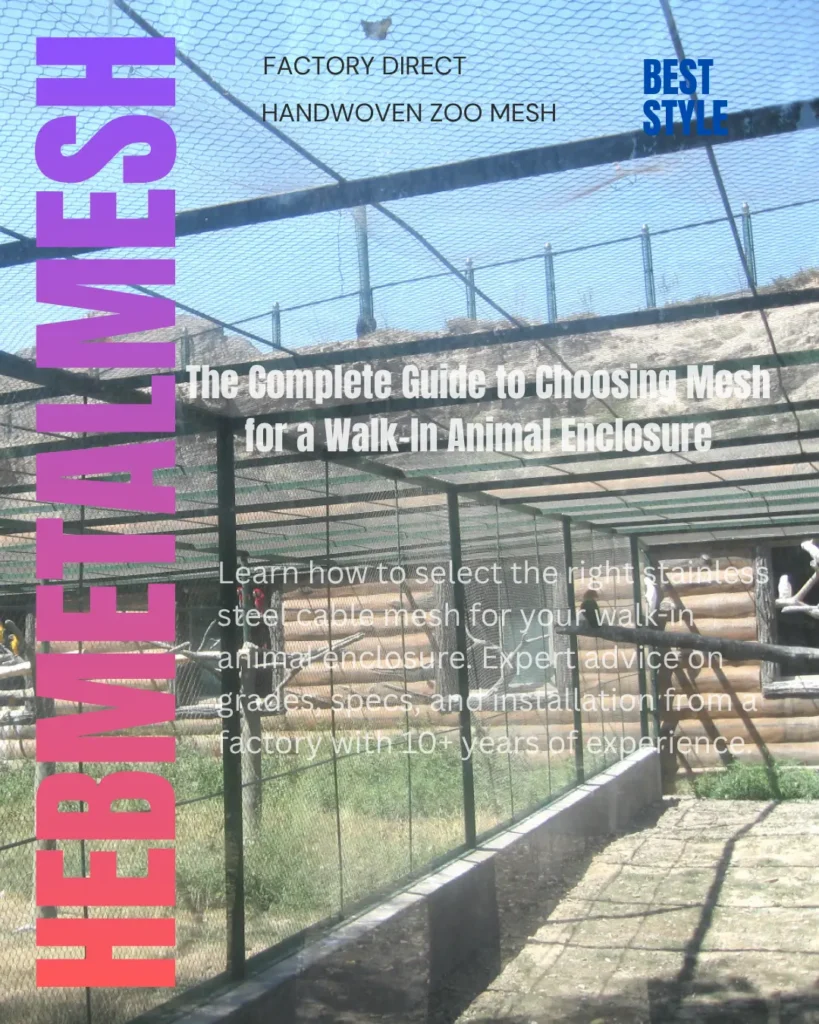
Every other barrier on a zoo, sanctuary or wildlife park site is looked at from the outside. A walk in enclosure is the one you go into, and the animal is already inside. That single fact separates it from the rest of the fence catalogue. The containment duty has not changed — the aperture still has to deny the smallest body that must not pass, and the cable still has to take the strongest contact in the collection — but the volume now has two occupants, and the half of the specification that decides whether the animal stays in is the door rather than the panel.
Executive Summary
A walk in enclosure is a sealed volume that people and animals share, so its mesh has to satisfy two briefs at once. For the animal the governing numbers are aperture and cable diameter. For the person they are the entry, the headroom, the wall at shoulder height and the ability to work from inside. Those two briefs meet at three places: the enclosure entry, the roof, and the door leaf. Most walk-in enclosures that fail are not breached through the panel; they are walked out of through the entry, because an open leaf is a hole the size of a person. The reference specification is the Animal Fence Mesh product page.
Planning a walk-through exhibit or a walk-in holding enclosure? Send the species, the counts, the site exposure and a sketch of how a keeper gets in and out. We will return the mesh numbers with the entry arrangement and the door schedule.
Quick Answer:
Quick Answer: A walk in enclosure is specified like any other mesh volume, plus one thing no ordinary barrier needs: an enclosure entry the animal cannot use. Size the mesh first — aperture from the smallest body that must not pass, cable from the strongest contact — then design the entrance as a two stage arrangement, so a person is never standing in front of an open hole. An enclosure airlock with two leaves and a short lobby between them is the detail that separates a safe walk-in enclosure from a walk-through gamble.
Key Takeaways
- A walk in enclosure is the only barrier a person occupies with the animal, so the walk in enclosure specification has two occupants and two duty sets.
- The panel is rarely what fails. The entry is, because a leaf opens, and an open leaf is a hole.
- An enclosure airlock — a two door entry with a lobby between the leaves — is the single most valuable detail on the drawing.
- The volume has to be sized for a person as well as for the collection, which makes walk in enclosure size and walk in enclosure height different questions from an ordinary barrier’s.
- Mesh for walk in enclosure work is a standard product; the door schedule is the part that is usually missing from the enquiry.
For the husbandry and exhibit-design reasoning behind shared visitor and keeper space, the material published by WAZA is a sensible starting point.
Two Occupants, One Volume
Ordinary containment mesh separates two worlds. A walk-in enclosure merges them, and that changes what the specification is for. The animal has to be held; the person has to enter, stand, work, and leave without becoming part of the containment problem. Once a keeper or a visitor is inside the same air, the mesh is no longer only a barrier — it is the interior surface of a room. That is the whole difference between this page and the zoo containment barrier question of what stops an animal.
The practical consequence is that the specification splits. One brief is written from the animal outward: which opening denies the smallest body, which cable resists the strongest beak, jaw or hand. The other is written from the person outward: how wide the door is, how high the lintel sits, whether the inside face is smooth at eye and shoulder level, and where a ladder goes when a panel has to be re-tensioned. A walk-in enclosure that fails is usually not a mesh failure. It is a failure to write the second brief.
Three Surfaces and One Entry
A walk-in enclosure is a sealed volume, and a volume is three surfaces plus its openings. Every surface is a mesh decision, but they are not the same decision.
The walls do the containment work, and they are where the aperture is set. The roof is a ceiling rather than a barrier, which means it carries a load — rain, leaf litter, wet snow — and it is also the surface a person looks at from underneath all day. A roof detail that drains onto the visitor path will be resented long after the panel is forgotten. The floor line is the third surface, and on an indoor walk-in it is the one that decides whether the room can be cleaned. The openings are the fourth element, and there is normally only one that matters. Treat the roof as a covering and not a boundary: the overhead netting guide on this site sets out the span, support and drainage logic.
The Entry Is Where It Fails
Doors are the only parts of an enclosure designed to be opened, so they are the parts with a hole in them. A walk in enclosure door is therefore the highest-risk item on the whole drawing, and it deserves more thought than any panel.
The fix is architectural rather than mechanical. An enclosure entry should be two leaves in series with a lobby between them: an outer door off the visitor path, a short enclosure airlock, and an inner door into the volume. With that arrangement no leaf ever opens directly onto the animal’s world, because the second door cannot open until the first has closed. It costs one extra frame, one extra mesh door leaf and about a square metre of floor, and it converts the most likely escape route into a compartment. Where space allows, a three stage entry is better still on a mixed collection.
The enclosure entry sequence has three more requirements. The gap between leaf and post must be no wider than the mesh aperture, or a small animal leaves through the door line rather than the panel. The leaf must meet the ground through a threshold detail rather than standing above a clearance, because most walk-in escapes use the strip under the gate. And the operating face of the latch belongs on the safe side of each leaf, which on the inner door is the lobby side, never the animal’s side.
The leaf itself deserves its own line in the schedule. An entry door mesh panel is a small panel carrying a full frame load and being handled every day, so it needs stiffening along its leading edge and hinges rated for daily use rather than the light hinges that suit a fixed panel.
The Four Numbers a Walk-In Enclosure Needs
| Element | What sets it | Working range |
| Aperture | Smallest body that must not pass, infant included | 20 – 102 mm by species |
| Cable diameter | Strongest beak, jaw, hand or horn in contact | 1.2 – 3.2 mm |
| Height | Animal’s standing and jump reach, plus person headroom | 3.0 – 6.0 m clear |
| Entry | A person carrying a bag or a stretcher | 0.9 – 1.2 m clear leaf |
The first two numbers are the ordinary mesh brief and are covered elsewhere. The second two are what make a walk in enclosure different. Headroom is not a mesh figure — it is what the frame has to give a person — but it drives the panel heights and the number of horizontal joints, and therefore the walk in enclosure cost. Interior clear width matters for the same reason: a walk in enclosure size that fits the collection may still be too narrow to walk a stretcher into.
What the Mesh Does at Body Height
From the inside, the mesh is furniture. Hands run along it, shoulders brush it, and a child at a walkthrough exhibit will reach for it. That makes the finish of the inside face a specification item rather than a detail.
Two things belong in the schedule. The first is edge treatment. A panel terminated on an edge cable held by a swage ferrule leaves a fitting; a panel cut and left raw leaves a burr on one face. State which face is outboard, so the raw edge never ends up at hand height. The second is the frame joint. Any bolt head within arm’s reach of a path is a snag, so the inside face of a walk-in enclosure should be flush or shrouded, with the working end of every fixing on the outside.
There is a metals question here too. Where stained stainless steel rope mesh meets a galvanised frame, the contact is a galvanic corrosion cell, and rust streaks on a surface people stand against is a maintenance complaint as much as a structural one. Either both metals are stainless, or the contacts are isolated.
Servicing From Inside
An enclosure you can walk into is an enclosure you can inspect properly, and that is most of its value. A keeper inside can see the bottom of every panel, reach the groundline, and find the abrasion at a crossing before it becomes a broken strand — work that is guesswork from outside.
Two items should be scheduled from day one. The first is cable tensioning. Panels settle through their first season, so a re-tensioning visit belongs in the service plan, and every tensioning point and ferrule should be reachable from inside or from a safe standing position. The second is load path inspection: check the edge cables, the anchor plates and the point where the mesh frame takes the roof load. A hand-woven panel is forgiving — one broken wire costs roughly 2% of that strand’s breaking load and the panel stays tight — but a fixing has no such reserve.
For a collection in a sealed volume, comfort and airflow matter as well. The animal-side brief is set out on the species appropriate enclosure page, and the bird case, which is the most common walk-in arrangement on a smaller site, is covered by the walk-in aviary material.
Writing the Order
A workable brief for a walk in enclosure supplier carries eight lines: species with counts and breeding status; the smallest body that must not pass; aperture and cable diameter as two numbers; clear height and interior width for a person; grade and finish by exposure; panel or roll format with a take-off; the door schedule with leaf sizes, latch faces and the airlock arrangement; and the inspection and re-tensioning interval. The fixing groups — edge cable, ferrules, tensioning hardware and anchors — add 10 to 20 percent to a mesh-only figure, and the entry is the item most often left out of it.
The reference document for the mesh side of that brief is the Animal Fence Mesh product page.
Frequently Asked Questions
A walkthrough exhibit is designed for visitors and usually keeps people on a defined path with a keeper present. A walk-in enclosure is working space, entered by staff. The mesh numbers are similar; the door discipline is not, because a working enclosure is entered many times a day.
One leaf is a hole for as long as it is open, and a person’s body blocks it only while they are in it. Two leaves with a lobby between them mean the animal never faces an open way out. Where the collection is small or flighty, that is the difference between routine and risk.
High enough for the tallest animal’s standing reach plus a margin, and high enough for a person to work under the roof comfortably — 3.0 to 6.0 m clear covers most collections. Add height where the species jumps; add headroom where staff carry anything.
You can, but the entry is the part that should drive the frame. Work out the leaf widths, the lobby depth and the latch faces first, then divide the remaining surface into panels that fit around them.
Where to Go From Here
Write the mesh numbers, then write the entry. Send the collection, the smallest animal that must not pass, the site exposure and a plan of how a keeper gets in and out, and the aperture, cable, grade, panel format and door schedule follow from it. The entry is the part an escape will test, and it is the part most specifications leave blank.
Specify the volume and the way in. Send the species, the counts, the smallest animal that must not pass and a sketch of the entry route, and we will return the mesh numbers with a door schedule. Start the conversation.