Introduction: What is a Rope Netting Fence?
A rope netting fence is a highly versatile barrier defined by its interwoven rope structure, designed to provide safety, enclosure, and architectural aesthetics across a vast range of applications. From a simple decorative trellis in a backyard garden to essential fall protection on a construction site, this type of fencing offers flexibility and clear visibility that solid walls cannot match.
When most people first search for rope netting, they encounter products made from natural fibers like jute or hemp, or mass-produced synthetic materials such as polypropylene and polyester, often found on major retail sites. While these options serve certain temporary or low-stakes needs, they quickly reveal significant limitations when faced with the demands of harsh weather, high security, or active animal containment.
For permanent, high-stakes, and aesthetically demanding applications—where failure is not an option—a new standard has been established: Handwoven Stainless Steel Rope Mesh. This is a permanent, industrial-grade solution that transforms the concept of a “rope fence” into an engineered, durable barrier.
At Hebmetalmesh, we specialize exclusively in this industrial-grade solution. Trusted by world-class zoos, wildlife parks, and large-scale agricultural operations globally, our product is the pinnacle of the rope netting fence category. This guide will compare all available types of rope netting fence, delve into their specific commercial and architectural applications, and explain in detail why stainless steel rope mesh is the ultimate long-term investment for professional and commercial projects.
Section 1: The Many Faces of Rope Netting Fence – Understanding Your Options
Choosing the right rope netting fence material is the difference between a temporary solution and a permanent investment. The market presents a spectrum of choices, each suited to varying levels of demand and durability. Understanding these differences is crucial before committing to a project.
Natural Fiber Nets (Jute/Hemp)
Natural fiber nets, typically made from jute, hemp, or cotton, are widely available and appeal to users looking for a rustic, organic look.
- Pros: They are highly aesthetic, eco-friendly, and offer a very low initial cost, making them attractive for temporary use. They are easily knotted and cut to size.
- Cons: These materials are inherently biodegradable. They weaken rapidly when exposed to moisture, mold, or UV radiation. Their tensile strength is low, meaning they offer zero security and are entirely unsuitable for containing anything larger than a small, non-destructive pet or simply holding up a vine. They require constant replacement, making their long-term cost surprisingly high.
- Best for: Decorative balcony nets, temporary garden accents, photography backdrops, or indoor architectural features where weather is not a factor.
Synthetic Polymer Nets (Polypropylene, Polyester, Nylon)
Synthetic nets are the most common alternative found in construction and safety industries. They offer better resilience than natural fibers but come with a major hidden weakness: UV degradation.
- Pros: These nets are lightweight, relatively weather-resistant, and significantly more affordable than metal, offering a decent tensile strength initially. They are excellent for specific use cases like safety fall protection, debris netting, or sports barriers.
- Cons: Over time, all polymer materials suffer from UV degradation, which causes the material to become brittle, lose color, and critically, lose its strength. They can be easily chewed through or cut by animals, making them a poor choice for animal fencing mesh. They also tend to stretch significantly under load, requiring re-tensioning, and have a definite, limited lifespan before they must be replaced. This makes them unsuitable for long-term durable fence netting.
- Best for: Playground safety enclosures, construction debris netting, temporary crowd control barriers, or light-duty sports containment.
Metal Wire Mesh (Chicken Wire, Welded Mesh)
While not a “rope netting fence,” traditional metal wire mesh is often considered a fencing option. It is rigid and strong but falls short in flexibility and aesthetics.
- Pros: Offers rigid strength and is inexpensive for small areas.
- Cons: Most cheap options, like chicken wire or simple welded mesh, are prone to rust and corrosion. They often have sharp edges that pose a direct safety hazard to both humans and animals, and they are inflexible, making installation on curves or slopes cumbersome. They also create a visually heavy, institutional barrier that detracts from the view.
Industrial-Grade Handwoven Stainless Steel Rope Mesh
This is the premium, industrial-grade category of the rope netting fence. Unlike the woven or knotted fibers, this solution is constructed from flexible, high-tensile wire rope (cables) that are handwoven into a seamless, rhombus-patterned mesh.
- Pros:
- Exceptional Durability: Crafted from premium 304 (or 316) stainless steel rope mesh, it is completely weatherproof, highly corrosion-resistant, and maintains its strength indefinitely.
- Unmatched Safety: The handwoven design creates a soft, yet incredibly strong, barrier with no sharp edges, eliminating injury risk for animals and people.
- Aesthetically Elegant: Its subtle, transparent structure virtually disappears, offering maximum visibility and meeting the highest architectural standards.
- Vandal-Resistant & Maintenance-Free: It is nearly impossible to cut with standard tools and requires zero maintenance or replacement for decades.
- Chew-Proof: The only reliable solution for high-value animal fencing mesh.
- Cons: Higher initial investment than synthetic or natural options, but this is overwhelmingly offset by zero replacement, maintenance, or failure costs over a 20+ year lifespan.
- Best for: Any permanent, demanding application where safety, durability, and aesthetics are non-negotiable.
Section 2: Where is Rope Netting Fence Used? Applications Decoded
The intended application is the single most important factor in determining the required material. While light-duty nets serve well for decoration, the needs of a zoo or a large farm demand the engineered strength of stainless steel rope mesh.
Residential & Light Commercial (Suitable for Natural/Synthetic Nets)
These applications prioritize aesthetics or temporary safety, and can usually be handled by synthetic or natural fiber nets:
- Garden Plant Protection: Light nets protect crops from birds or small pests.
- Balcony Safety Nets: Used to prevent small children or indoor pets from falling from low-rise balconies (requires frequent checks for wear).
- Decorative Trellises: Jute or thin polymer ropes used to support climbing plants.
- Playgrounds: Synthetic nets are excellent for climbing frames or ensuring a safety fall perimeter.
Commercial, Agricultural & Institutional (Requires Stainless Steel)
These environments necessitate a failsafe, permanent solution due to the risk, investment, and forces involved. This is where the Hebmetalmesh standard of durable fence netting becomes mandatory.
Zoo Enclosures & Animal Fencing Mesh
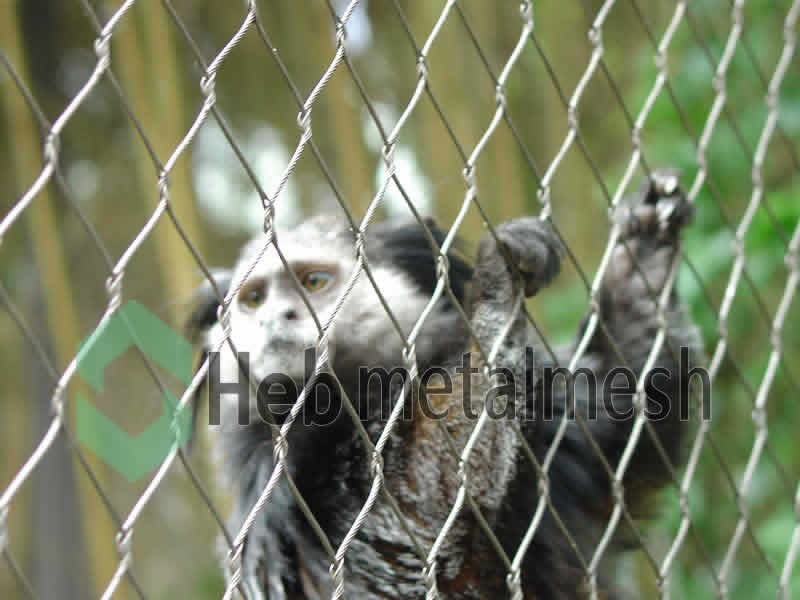
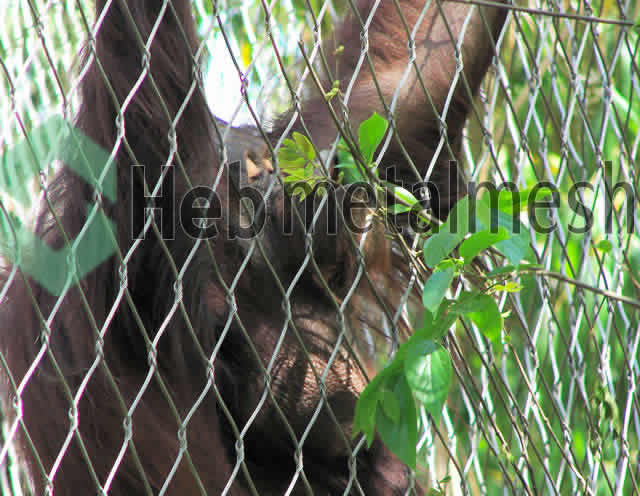
This is the proving ground for stainless steel rope mesh. Zoos require a containment barrier that is both supremely strong and virtually invisible to visitors, creating a naturalistic viewing experience.
- Containment Strength: Our rope mesh can be engineered to withstand the significant forces of large, powerful animals (felines, primates, ungulates) without fail. The mesh absorbs kinetic energy by stretching slightly, rather than breaking, providing a level of safety unmatched by rigid barriers.
- Animal Safety: The smooth, flexible structure ensures there are no sharp points, burrs, or toxic chemicals (unlike treated wood or rusting wire), keeping the inhabitants safe from injury. It is completely chew-proof, solving the primary failure point of synthetic animal fencing mesh.
- Clear Visibility: Zoo design relies on maximum visitor viewing. The transparency of the mesh allows guests to feel closer to the animals, enhancing the experience while maintaining absolute security.
Aviary & Bird Park Fencing Netting
Avian habitats require mesh sizes precise enough to contain species as small as hummingbirds while being high enough and strong enough to resist predators and weather.
- Predator Prevention: The highly tensioned, custom-sized mesh prevents external predators (like raccoons or foxes) from gaining entry.
- Custom Mesh Size: One of our key USPs is that the mesh opening size can be precisely customized to meet the specific requirements of the species being contained, preventing escapes while preserving the aesthetic open-air feel of the park. This adaptability is essential for successful aviary fence netting projects.
- Longevity: Bird enclosures are large, complex, and expensive to replace. Using 304 stainless steel guarantees that the infrastructure remains intact and maintenance-free for decades.
Farm Fencing & Livestock Pens
While traditional wire fencing is common, stainless steel rope mesh offers a superior, long-term alternative for high-value livestock or specialized agricultural applications.
- Durability Against Elements and Animals: Unlike standard wire that sags, breaks, and rusts, or wood that rots and requires constant repair, stainless steel netting resists weather, UV exposure, and the wear and tear of contact with animals.
- Pest Exclusion: Finer mesh sizes can be used around valuable feed storage or specific growing areas to exclude pests like rodents and birds without the need for toxic chemicals.
Security & Architectural Features (Commercial Rope Netting)
The unique combination of strength and beauty makes the stainless steel rope mesh a top choice for modern architectural and high-security projects, qualifying it as true commercial rope netting.
- Balcony and Staircase Infill: Used as a sophisticated railing replacement or infill panel in high-rises, stadiums, and museums, providing code-compliant safety without blocking light or sightlines.
- Decorative Facades: Employed as a dynamic architectural facade material that can support climbing plants or simply add an element of engineered elegance to a building’s exterior.
- Safety Barriers: Used on bridges, highway overpasses, and steep terrain for anti-climb and rockfall protection.
Section 3: The Hebmetalmesh Advantage: Why Our Stainless Steel Rope Netting is Different
When you move from purchasing a temporary net to specifying a permanent, high-performance barrier, you need to partner with a specialist. Hebmetalmesh offers significant advantages over general suppliers, rooted in our focus on material science, construction method, and dedication to custom rope netting fence solutions.
Material Science: 304 vs. 316 Stainless Steel
We build our reputation on the quality of our core material: 304 stainless steel.
- The Power of 304: This alloy is the global standard for corrosion resistance, strength, and hygiene. It provides outstanding performance in 99% of environments, including heavy rain, snow, and extreme temperature cycling, making it the perfect choice for durable fence netting. It is cost-effective while delivering a lifetime of performance.
- 316 Option for Extremes: For projects in extreme coastal environments (i.e., immediately adjacent to salt spray) or industrial areas with high chemical exposure, we offer the 316 grade. While slightly more expensive, 316 contains molybdenum, which grants superior resistance to pitting corrosion from chlorides. We consult with clients to determine if the additional investment in 316 is necessary.
Construction: Handwoven vs. Knotted/Knitted
The method of construction is what gives our product its strength, elasticity, and uniform appearance—a critical distinction from synthetic nets.
- The Flaw of Knotted Nets: Synthetic nets are often knotted or knitted, meaning the strength of the net relies entirely on the strength and integrity of thousands of individual knots. If a knot loosens, or if the rope stretches unevenly, the entire barrier’s load-bearing capacity is compromised.
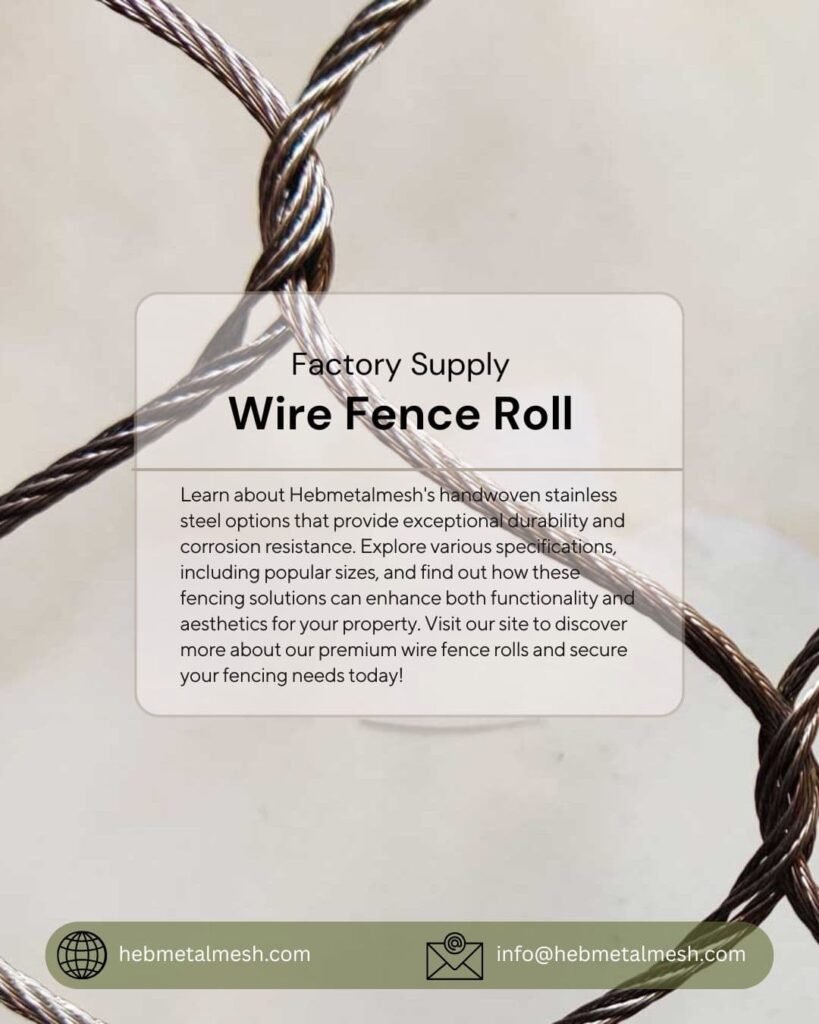
- The Handwoven Superiority: Our stainless steel rope mesh is meticulously handwoven using flexible wire cable. The cables pass through each other, creating a uniform, seamless rhombus pattern. This design ensures uniform load distribution across the entire mesh surface. There are no weak knots to loosen or break. The result is a robust, highly flexible fabric that is vandal-resistant and maintains an elegant, consistent appearance that synthetic nets simply cannot replicate.
Customization: Your Project, Your Specifications
As a direct factory supplier, our greatest USP is our ability to provide complete customization, bypassing the limitations of fixed-size products from retailers. We directly address the need for custom rope netting fence solutions.
We understand that every project—whether it’s an aviary fence netting system for a national park or an architectural facade—is unique. We can tailor every essential parameter:
- Cable Diameter: From thin 1.2mm for delicate architectural features to robust 2.4mm or 3.2mm for large animal fencing mesh projects containing big cats or primates.
- Mesh Size (Aperture): The size of the diamond opening can be customized from tiny (25mm x 25mm) to very wide (up to 300mm x 300mm), guaranteeing the perfect containment or safety barrier for any species or application.
- Roll Size: Unlike fixed-size netting, we supply bespoke rolls. Our standard large roll sizes go up to 30’ x 60’, and we provide bespoke sizes beyond that at no extra engineering cost. This dramatically simplifies installation for large commercial projects, minimizing seams and wasted material.
Total Cost of Ownership: An Investment, Not Just a Purchase
While the initial cost of stainless steel rope mesh is higher than polymer or jute options, the long-term economic argument is overwhelmingly in favor of the durable metal solution. To truly understand the investment, you must consider the Total Cost of Ownership (TCO).
TCO Comparison for Rope Netting Fences
| Feature | Natural Fiber (Jute) | Synthetic Polymer (PP/Nylon) | Hebmetalmesh Stainless Steel |
|---|---|---|---|
| Best For | Decoration, temp use | Playgrounds, light safety | Zoos, Aviaries, Farms, Security |
| Strength | Low | Medium | Extremely High |
| Weather Resistance | Poor (rots) | Good (UV degrades over time) | Excellent (304 Stainless) |
| Lifespan | < 2 years | 3-7 years | 20+ years |
| Safety | Can fray | Can stretch/tear | No sharp edges, failsafe |
| Custom Sizes | Rare | Limited | Yes, up to 30’x60′ + bespoke |
| Cost Over Time | High (replacement cycle) | Moderate (replacement cycle) | Low (one-time investment) |
The price is calculated per square foot based on the specifications (cable diameter and mesh aperture). While simple nets cost a few dollars per linear foot, our commercial-grade stainless steel rope mesh is priced by the square foot (starting from $0.43/sq.ft.). When you factor in the labor and materials required to replace a synthetic net every 5 years, the stainless steel option becomes the most economical choice within a decade. It’s a one-time purchase built to last for the life of your facility.
Section 4: Key Considerations Before You Buy (The Decision Framework)
Before you purchase any rope netting fence, use this checklist to guide your decision-making process. The results will quickly point you toward the necessity of stainless steel rope mesh for any serious containment or safety project.
Buyer’s Checklist: 5 Questions to Ask Before Purchasing Rope Netting
- What is my primary goal? (Containment, Safety, Decoration, Privacy?)
- If the answer is Decoration or temporary Privacy, a cheap net may suffice.
- If the answer is Containment or Safety, you require stainless steel.
- What forces will it face? (Animal strength, wind load, human impact?)
- If you are containing determined animals or need anti-vandal protection, only the tensile strength and durability of our wire cable can guarantee security.
- What is the environment? (Coastal salt air, rain, UV exposure?)
- If the environment is harsh, wet, or sunny, all non-metal fibers will quickly degrade, making 304 stainless steel rope mesh the only long-term viable option.
- What is the expected lifespan? (2 years vs. 20+ years?)
- A 2-year lifespan is costly. An expected lifespan of 20+ years, guaranteed by stainless steel, is a fixed asset.
- Do I need standard or custom sizes?
- Large-scale commercial rope netting projects rarely fit stock sizes. As a direct factory, we ensure you get the exact specifications and dimensions needed for seamless installation, avoiding unsightly joints and material waste.
If your answers to questions 2, 3, and 4 point toward “high force,” “harsh environment,” and “long lifespan,” then stainless steel rope mesh is not just an option—it is the only viable choice for a professional, code-compliant, and durable rope netting fence.
Section 5: Installation & Maintenance Insights
The simplicity of installation and the near-zero maintenance required for stainless steel rope mesh are often overlooked benefits that further drive down the long-term TCO.
Installing & Caring for Your Rope Netting Fence
Synthetic and natural fiber nets require constant vigilance, checking for tears, sags, and UV damage. They must be replaced periodically, requiring new labor and materials every few years.
In contrast, our stainless steel mesh is designed for robust, permanent installation. General principles involve creating a strong outer frame (posts, tubes, or wire cables) to which the mesh is secured and tensioned. Due to the inherent flexibility and strength of the handwoven design, it conforms beautifully to complex shapes—like curved aviary roofs or irregular hillside animal fencing mesh—with minimal effort. Specialized ferrules and tensioning tools make the connection points secure and professional.
For Hebmetalmesh Stainless Steel Rope Mesh:
Once correctly installed, the mesh is virtually maintenance-free. The 304 stainless steel alloy is non-corrosive and does not degrade under UV light. Occasional rinsing with water, perhaps annually, is all that is needed to clean off surface dirt and restore its natural, elegant shine. There are no ropes to re-tie, no knots to check, and no tears to mend, ensuring your durable fence netting performs flawlessly year after year.
Conclusion & Call to Action
The journey of choosing a barrier starts with the simple idea of a rope netting fence. It quickly diverges: on one path lies the temporary, aesthetic, and ultimately costly realm of natural and synthetic nets; on the other lies the permanent, failsafe, and architecturally stunning solution of stainless steel rope mesh.
The “best” rope netting fence depends entirely on the demands of your application. If your project is commercial, agricultural, institutional, or involves high-stakes containment (like a zoo or high-security building), the choice is clear.
Hebmetalmesh is your expert partner for permanent, commercial, and demanding projects. As a direct factory with unparalleled experience in creating custom animal fencing mesh and aviary fence netting for facilities worldwide, we provide superior quality, customization (including large roll sizes up to 30’ x 60’), and the peace of mind that comes with using genuine 304 stainless steel.
Ready to discuss your project with a specialist? We can help you specify the perfect custom rope netting fence solution tailored to your exact needs.
- Browse our standard products and see our material quality firsthand.
- Contact us for a custom quote and expert advice on your unique project specifications.
- View our project gallery to see Hebmetalmesh in action worldwide in zoos, parks, and architectural installations.
Frequently Asked Questions About Rope Netting Fences
A: For permanent installations and high-security containment, handwoven stainless steel rope mesh is the strongest option. It is constructed from high-tensile wire cable and offers superior strength, elasticity, and corrosion resistance compared to natural or synthetic ropes. This material is essential for durable fence netting.
A: Price varies dramatically by material and aperture. Decorative jute nets cost a few dollars per foot, while commercial-grade stainless steel rope mesh is priced by the square foot (starting from $0.43/sq.ft.). For an accurate linear foot cost, you must have the height specification and mesh size. Contact us with your project details for a detailed quote based on your exact specifications.
A: Light-duty, fixed-size nets are available on Amazon, Walmart, and Home Depot. For durable, commercial-grade stainless steel rope netting, specialty direct factory manufacturers like Hebmetalmesh are the best source. We specialize in providing custom rope netting fence solutions and expert support for large, complex projects.
A: Yes, but material is critical. Synthetic nets can be easily chewed or torn through by determined animals. For containing strong, dangerous, or high-value animals (like zoo animals, large dogs, or agricultural livestock), only stainless steel rope mesh provides the necessary combination of strength, safety, and chew resistance required for effective animal fencing mesh.
A: Yes, at Hebmetalmesh, we specialize in customizations. We supply massive rolls up to 30 feet by 60 feet and can create bespoke sizes and specifications (cable diameter, mesh size) at no extra engineering cost. This ensures a perfect fit for complex architectural or aviary fence netting projects.