
Most pet-bird cages are sized for the owner’s convenience rather than the bird’s body. A backyard aviary reverses that. It is the smallest structure in which a companion bird can fly a straight line, turn under its own power, choose sun or shade, and stay permanently out of reach of everything that hunts it. Choose the mesh carelessly and you own an expensive frame; choose it well and the structure disappears into the background of a bird’s daily life for twenty years or more.
Executive Summary
A backyard aviary is a permanent outdoor flight for companion birds — budgerigars, cockatiels, conures, finches, canaries and the small parrots most households keep — built from stainless steel rope mesh on a rigid frame. Three specifications decide whether it works: the ruling mesh aperture, matched to the smallest bird in the flight; the cable diameter, matched to the largest predator that can reach the mesh; and roof loading, matched to the worst wind or snow your region delivers. Small birds work at 1.2–1.6 mm cable and 20–25 mm aperture; medium parrots at 2.0 mm and 38 mm; a mixed flight or a coastal site calls for 2.4 mm in stainless steel 316. Material plans at roughly $10–22 per square metre as a planning range, a factory-direct lead time of two to four weeks plus two to six weeks of transit, and an EN 10204 3.1 mill certificate on every order. The reference specification is the aviary netting and bird enclosure mesh product page.
Quick Answer:
What matters most when you build a backyard aviary? The mesh aperture comes first. It has to be small enough that the smallest bird in the flight cannot push a shoulder through, and every other decision follows from that number. Predator-rated cable comes second, roof loading third. Settle those three figures before you buy a post and the rest of the project is ordinary carpentry.
Key Takeaways
- Aperture is set by the smallest bird, not the largest. One finch in a flight of cockatiels decides the ruling mesh size for the whole structure.
- Cable diameter is set by the largest predator, not by the birds. A 1.2 mm weave holds a budgerigar; it does not stop a raccoon.
- Grade follows exposure rather than budget: SS304 inland, stainless steel 316 within reach of salt water.
- The roof is the structural part. Top panels meet uplift and snow that wall panels never see.
- A backyard aviary is a weekend of frame work and one afternoon of hanging mesh — provided the panels arrive cut to size.
Avian enclosure design is a welfare question before it is a materials question. The Association of Zoos and Aquariums publishes the care standards that professional bird collections work to, and the same logic — flight space, shelter, substrate and escape-proof containment — scales down to a garden flight.
Building a Backyard Aviary Starts With the Bird, Not the Frame
Building a backyard aviary usually begins with a photograph of a finished structure and a budget. Begin instead with the resident list, because the smallest body in the flight governs everything downstream. A cockatiel needs a straight, unobstructed run to build lift; a finch needs length rather than height; a conure needs something to destroy.
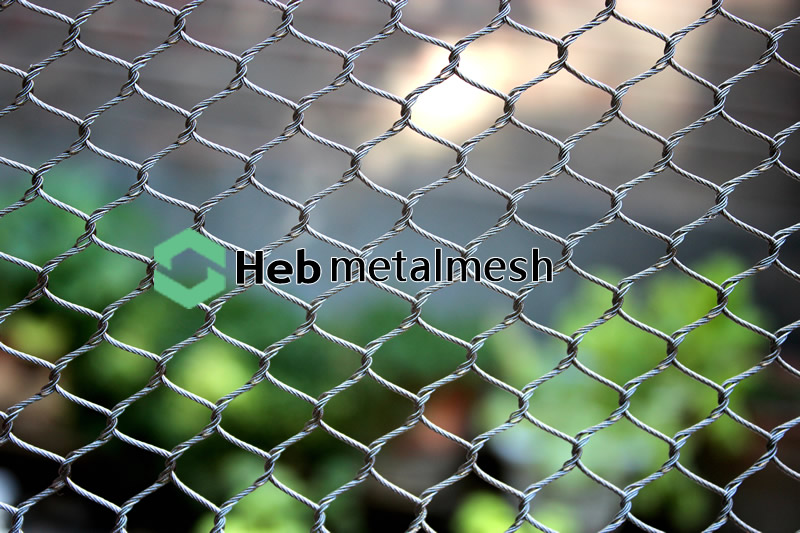
Anyone searching for how to build a backyard aviary hits the same fork within an hour: welded wire or woven rope mesh. Woven mesh wins on three counts. It is almost entirely void — a stainless rope panel is roughly 88% open area — so the bird sees the garden and the garden sees the bird. It deflects on impact instead of resisting it, which matters when a bird misjudges a turn at speed. And it does not corrode at a joint, because there are no joints to corrode.
The structure then has three jobs: flight, light and safety. Owners reliably underestimate the third.
Sizing the Flight: Floor Area, Length and Headroom
Work from the bird, then the garden. Allow a flight length of at least 3–4 m for small parrots and 6 m or more for a mixed collection, with a width no less than a third of the length so birds can bank without clipping a wall. Headroom matters less than footprint for perching species, but keep it above 1.8 m or you will not enjoy cleaning it.
Site the flight on level, well-drained ground with a hard edge — paving or a concrete strip — beneath the walls. This is where most backyard aviary setup fails. A flight standing on bare soil wicks damp into the base rail, and the birds spend the winter on wet ground. Leave at least a metre of clearance on the service side for a wheelbarrow and a person, and put the door on the sheltered face so the flight does not empty every time it is opened.
The Number That Decides Everything: Aperture
Aperture — the clear opening between adjacent cables, best measured as the ruling diagonal — is the only dimension that can let a bird out. Size it to the smallest head in the flight, then confirm the same mesh is strong enough for the largest body it must exclude.
| Resident birds | Ruling aperture | Cable diameter | Typical code |
| Finches, canaries, small waxbills | 20 mm | 1.2 mm | HM1220 |
| Budgerigars, lovebirds | 25 mm | 1.6 mm | HM1625 |
| Cockatiels, conures, small Amazons | 38 mm | 2.0 mm | HM2038 |
| Mixed flight, larger parrots | 38 mm | 2.4 mm | HM2438 |
| Coastal or exposed sites | 38–51 mm | 2.4–3.2 mm | HM2438 / HM3250 |
The common error is oversizing the mesh aperture to save money on a large flight. The saving is small and the risk is not: a finch that can pass its shoulders through a 38 mm opening will keep testing until it finds the weakest point in the weave. Where a mixed collection forces a compromise, run the tighter mesh across the lower 1.5 m where the birds actually perch and forage, and a wider aperture above head height.
Cable Diameter and the Predator Outside the Mesh
Holding birds in is half the duty; keeping things out is the other half, and that is decided by cable diameter rather than aperture. An aviary for pet birds is a compromise structure — open enough to be a flight, sealed enough to be a vault. A raccoon can work a paw through a 25 mm opening and pull. A hawk strikes the panel at speed. A domestic cat climbs and hangs its full weight on the top edge.
For that reason a residential flight should not drop below 1.6 mm cable, even for finches — the birds do not need the strength, the predator does. Where large dogs, foxes or bears are a genuine possibility, move to 2.4 mm and specify a breaking load above 4 kN per cable. A backyard aviary build specified by bird size alone is only half-specified, and the failure shows up at a corner, where the load concentrates and the weave has least room to move.
Why Rope Mesh Outlasts the Alternatives
Galvanised welded wire is cheap and it works, for a while. It corrodes at the weld, it is stiff enough to injure a bird that flies into it, and it rusts from the inside out, so the failure is invisible until a panel gives way. Plastic netting degrades under UV; a knotted nylon mesh that survives two summers in direct sun is doing well.
Hand-woven stainless steel rope mesh behaves differently. The 7×7 strand construction gives each cable 49 individual wires, so one broken wire does not become a torn panel. In SS304 or stainless steel 316 it will outlast the frame it hangs on. Add black oxide when the flight sits against a hedge or a dark fence: the finish kills the glare without affecting uv resistance.
Two grades cover almost every garden, and it is worth comparing 304 against 316 cable mesh before you commit. SS304 is stable in an ordinary inland setting; stainless steel 316 adds molybdenum and is the defensible choice within a few kilometres of the coast, or where the flight sits under trees that drop acidic litter.
The Roof, the Weather and the Load Case
Aviary roof netting is where the loads become real. A flat or lightly pitched roof collects snow — a dead load of 20–40 kg per square metre in a heavy winter — and a slope below about 15° will not shed it. Wind uplift acts on the same panel from below, and is worst at the upwind corner, so the perimeter cable and its anchor plates carry the design load rather than the weave.
Two practical rules. Give the roof a true fall, and never rely on the tension of the mesh to hold a top panel down; a cabled perimeter with a swage ferrule at each corner is the only detail that survives ten winters. Where the flight spans more than roughly 3.5 m, add an intermediate purlin and let the mesh hang in bays, so a single failure never frees a whole side. A home aviary in a coastal garden also has to assume salt-laden wind on every face, which is a second argument for 316.
Frame, Foundations and Screening
The frame does two jobs: it holds the mesh in tension and it resists wind. Posts at 2.5–3.5 m centres with a structural ridge over the flight will carry a domestic-scale build; anything longer deserves an engineer’s eye on the wind case. Set posts in concrete footings below the frost line and cap every timber end — a bird will find the one gap you leave.
Good aviary structure design and careful aviary framework design matter more than ornament, because the mesh needs a straight, rigid edge to tension against and any deflection in the frame shows up as a slack panel. Where you want to screen the flight visually — a windbreak on the weather side, or privacy from a neighbouring window — aviary screening panels fixed clear of the mesh do the job without loading the enclosure itself. The installation sequence is the same one used on zoo panels, at a smaller scale.
Cost, Sourcing and the Upkeep Calendar
Backyard aviary cost splits into frame, mesh and groundworks, and the mesh is rarely the largest line. Budget materials at $10–22 per square metre as a planning range for aviary-grade rope mesh; frame and footings usually exceed the netting on a domestic build. Buy in roll or panel format and the arithmetic changes — a backyard aviary kit of pre-cut panels saves a weekend of site cutting and removes the most common source of ragged edges.
Choose a backyard aviary supplier who will quote panels against your drawing rather than sell you a roll and wish you luck. A residential aviary is a small, awkward order that a general fencing merchant will not understand; a mesh manufacturer will. Work the supplier vetting checklist and ask for the mill certificate, the panel schedule and the tensioning detail with the quotation.
Then diarise the upkeep. Walk the flight monthly, checking cable tensioning at the corners and looking for bright marks where a wire has begun to fail. Do the deep inspection annually and budget a full re-tension every five years, at the same time you treat the timber. Read enough aviary installation reviews before you buy and a pattern emerges: almost every complaint traces back to a slack panel, not to a failed material.
FAQ
Match it to the smallest bird you keep — around 20 mm for finches and canaries, 25 mm for budgerigars and lovebirds, 38 mm for cockatiels and conures. A mixed flight always takes the tightest aperture its smallest resident requires.
Only if you build to the smaller bird. A single ruling aperture governs the whole flight, so a finch-safe 20 mm mesh is correct even though budgerigars would be content at 25 mm. Check temperamental compatibility before mixing species, not after.
Plan on $10–22 per square metre for aviary-grade stainless mesh as a planning range, with frame and footings usually exceeding the netting on a domestic build. Full project figures vary far more with groundworks and site access than with the mesh.
SS304 is stable in a normal inland garden; stainless steel 316 adds molybdenum and is the right grade near salt water. Either will outlast a timber or steel frame, and a 7×7 strand construction tolerates the occasional broken wire without losing the panel.
Send us the species, the flight dimensions and the site exposure. We will return a panel layout, an aperture and cable schedule, the fixing detail and an indicative material budget — start with the quote request.