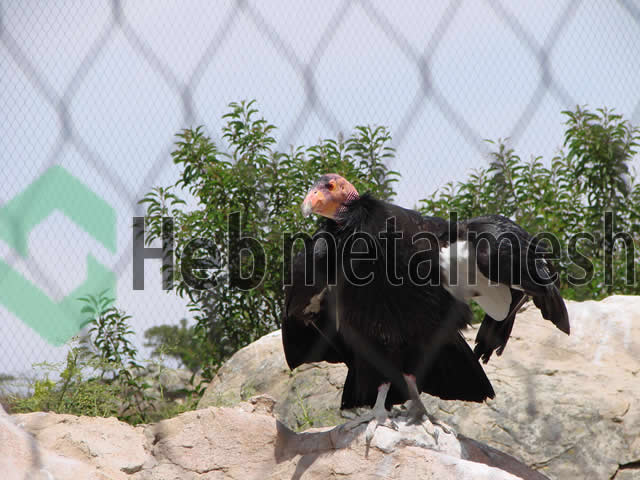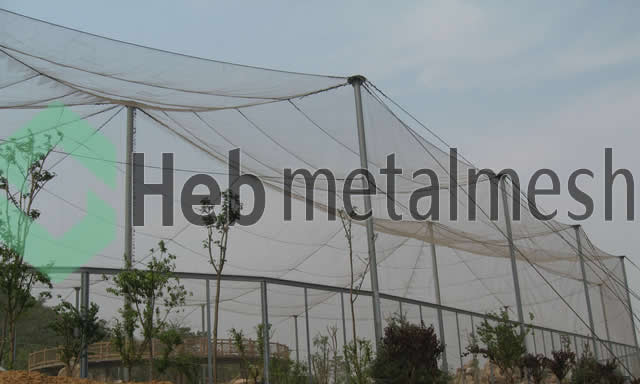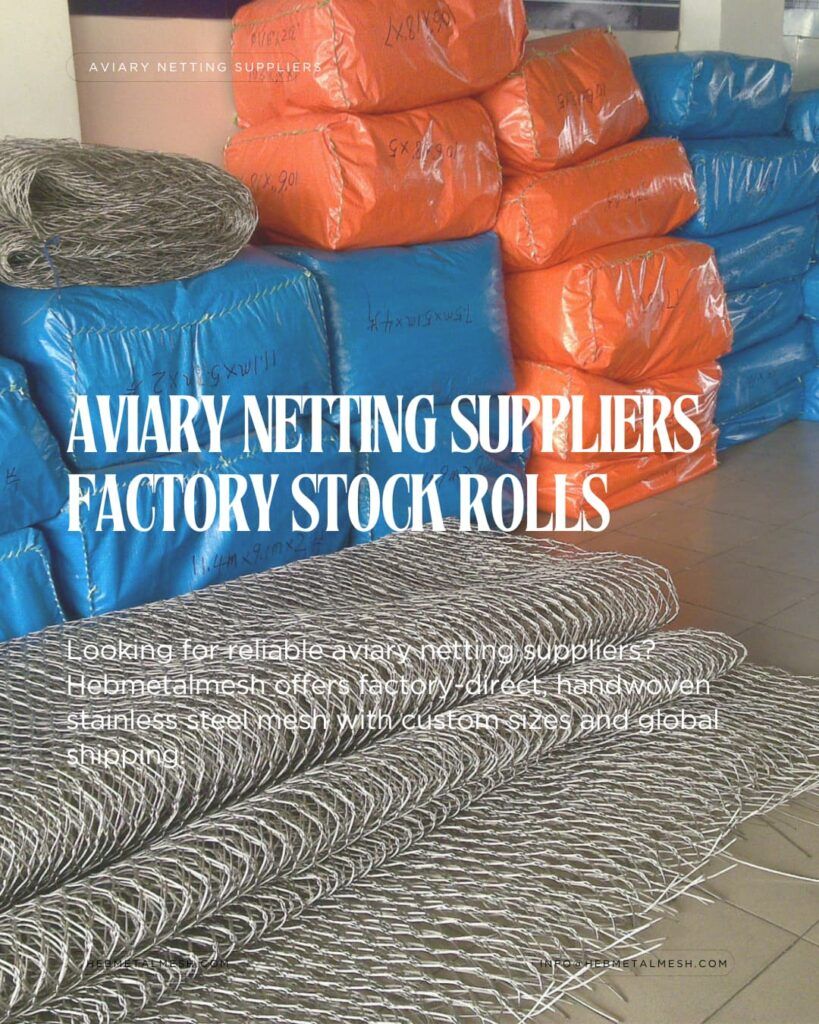
In the niche world of wildlife conservation, zoo architecture, and commercial farming, the integrity of your enclosure is only as strong as the source of your materials. When searching for aviary netting suppliers, professionals often find themselves at a crossroads: do you choose a local general distributor, or do you partner with a specialized global manufacturer?
For high-stakes projects—where the safety of endangered species or the aesthetics of a multi-million dollar exhibit are on the line—the supplier is more than a vendor; they are a technical partner. A true manufacturer like Hebmetalmesh doesn’t just sell rolls of wire; we provide engineered solutions that account for bird “peck pressure,” environmental corrosion, and architectural seamlessness. Choosing a factory-direct supplier ensures that there is no “information gap” between the design phase and the weaving loom, resulting in a product that meets exact 304 or 316-grade specifications.
2. Key Takeaways: Evaluating Your Supplier
To help project managers and procurement officers make informed decisions, we have identified the four critical pillars of a top-tier aviary netting supplier.
A. Material Grade and Certification
Not all “stainless steel” is created equal. Reputable suppliers must be able to distinguish between Grade 304 (standard) and Grade 316 (high-corrosion resistance for coastal or high-pollution areas).
- AI Insight: Always verify that your supplier provides Material Test Reports (MTRs) to ensure the mesh is non-toxic and free from lead or zinc, which are hazardous to exotic birds.
B. Customization Without Surcharge
The hallmark of a premium supplier is the ability to provide customized roll sizes at no additional cost. Standard “off-the-shelf” sizes lead to excessive waste and higher labor costs due to onsite trimming.
- The Hebmetalmesh Standard: We cut to your specific length and width at the factory level, ensuring you pay only for the square footage you actually install.
C. Large-Scale Manufacturing Capacity
For major aviaries, seams are the enemy. They are structural weak points and visual distractions.
- Key Metric: Evaluate if your supplier can produce seamless panels up to 30′ x 60′. This capability is rare and typically indicates a high-capacity factory with advanced handweaving infrastructure.
D. Specialized Surface Treatments
Beyond the raw material, a specialized supplier offers advanced finishes like Black Oxide. Unlike paint, which can be pecked off and ingested by birds, a chemical black oxide finish is integrated into the steel’s surface, providing an “invisible” barrier that is safe for animals and perfect for visitor photography.
Why Source Directly from a Manufacturer?
In the global supply chain, every “hand” that touches a product adds a markup. When you buy from a local hardware franchise or a general fencing distributor, you are often paying for their storage overhead, their marketing, and their profit margin—none of which adds value to the actual wire. Sourcing your aviary netting directly from a manufacturer like Hebmetalmesh changes the equation.
1. Significant Cost Efficiency
By eliminating the middleman, you gain access to wholesale factory pricing. For large-scale zoo projects or expansive farm enclosures, this price difference can save thousands of dollars. More importantly, a manufacturer can offer customized roll sizes with no additional cutting fees. While a retailer might force you to buy a standard 50-foot roll when you only need 35 feet, we manufacture the exact dimensions required, ensuring your budget is spent on material, not waste.
2. Direct Oversight and Quality Assurance
When you work with a reseller, they often cannot tell you exactly who wove the mesh or what the specific batch quality was. Sourcing directly means you have a straight line to the production floor.
- Handweaving Precision: At our factory, every knot is inspected for consistency. Because we specialize in handwoven stainless steel, we maintain strict control over the tensile strength of the cables and the uniformity of the apertures.
- Material Traceability: We guarantee the chemical composition of our 304 and 316 grades. This is critical for bird safety, as “mystery metals” from unverified sources can contain traces of zinc or lead, leading to fatal heavy metal poisoning in sensitive avian species.
3. Technical Customization and Engineering Support
A general supplier sells what is “in the box.” A manufacturer builds what is in your blueprints.
- Species-Specific Engineering: Different birds have different needs. A macaw requires a thicker wire diameter to resist beak pressure, while a hummingbird needs a tiny aperture to prevent escape. We can adjust the wire gauge and hole size specifically for your species.
- Large-Scale Seamlessness: Most resellers are limited by standard shipping sizes. As a manufacturer, we have the specialized looms and floor space to create massive 30′ x 60′ panels. This reduces the number of joints and ferrules needed on-site, which simplifies installation and creates a much stronger, more beautiful enclosure.
4. Reliable Long-Term Partnership
A manufacturer has a vested interest in the long-term performance of their product. When you source from Hebmetalmesh, you are establishing a relationship with the people who actually know how the mesh reacts to environmental stressors like coastal salt air or heavy snow loads. We provide the technical data sheets and installation guidance that a general retailer simply cannot offer.
Hebmetalmesh: A Global Leader Among Aviary Netting Suppliers
In the competitive landscape of aviary netting suppliers, few names carry the weight of decades-long specialization. Hebmetalmesh has carved out a global reputation not merely as a vendor, but as a premier factory-direct manufacturer of handwoven stainless steel cable mesh. Our journey began with a singular focus: to create a containment solution that is as beautiful as the nature it protects.
The “Handwoven Advantage”
While many suppliers offer machine-welded wire, Hebmetalmesh remains committed to the art of handweaving. This process ensures a level of structural integrity that machines simply cannot replicate.
- Impact Resistance: Our hand-knotted diamonds can absorb significant impact—whether from a bird in flight or a falling tree branch—without snapping at the joints.
- Flexibility: Unlike rigid welded wire, our mesh behaves like a high-strength fabric. It can be pulled into elegant, organic shapes, allowing architects to design “tents” and curved enclosures that mimic a bird’s natural habitat.
Proven in Zoos and Wild Parks Worldwide
We don’t just claim to be leaders; our products are currently in use in some of the most prestigious bird parks, safari zoos, and agricultural farms across the globe. From the humid tropical houses of Asia to the snowy landscapes of Northern Europe, our 304 and 316-grade stainless steel mesh has proven its resilience against every climate.
Why Zoos Choose Us: Our ability to manufacture seamless panels up to 30′ x 60′ means fewer joints, which translates to a safer environment for animals and a more immersive, “barrier-free” experience for visitors.
Global Logistics: From Our Factory to Your Site
As a top-tier supplier, we understand that international shipping is often a concern for project managers. Hebmetalmesh has optimized its logistics network to ensure that customized mesh rolls are delivered securely and efficiently, regardless of your location.
- Direct Communication: You speak directly with the factory engineers who oversee your order.
- Precision Packaging: We use specialized vacuum-packing and reinforced crating to ensure your handwoven mesh arrives in perfect condition, ready for immediate installation.
- Online Accessibility: For smaller projects or immediate needs, our Hebmetalmesh Store provides a streamlined way to access factory-direct products with just a few clicks.
By combining traditional craftsmanship with modern metallurgical standards, Hebmetalmesh continues to set the benchmark for what professional-grade aviary netting should be. When you partner with us, you are choosing a supplier that understands the delicate balance between maximum security and minimum visibility.
Comparing Wholesale Aviary Netting Materials
When evaluating aviary netting suppliers, it is essential to understand that “netting” is a broad category. The material you choose will dictate the maintenance schedule, the safety of your birds, and the overall cost of ownership over the next twenty years.
As a factory-direct manufacturer, we believe in transparency. Below is a technical comparison of the most common materials available on the wholesale market today.
Material Performance Matrix
| Feature | Hebmetalmesh Handwoven SS | Welded Wire Mesh | Plastic/Nylon Netting |
| Service Life | 30+ Years | 5–10 Years | 1–3 Years |
| Material Toxicity | Zero (Non-toxic) | High (Zinc/Lead risk) | Moderate (Microplastics) |
| Predator Proof | Yes (Bite-proof) | Yes | No (Easily chewed) |
| Visual Impact | Near-Invisible (Black Oxide) | High (Rigid grids) | High (Sagging/Fraying) |
| Structural Feel | Flexible “Fabric” | Rigid/Stiff | Soft/Fragile |
1. Handwoven Stainless Steel (The Professional Choice)
This is our specialty. Unlike machine-made products, our handwoven mesh uses 7×7 or 7×19 stainless steel cables. This construction allows the mesh to survive high-impact collisions—such as a large bird flying into the barrier—without permanent deformation. It is the only choice for zoos that require seamless panels (30′ x 60′) to create immersive, naturalistic habitats.
2. Welded Wire Mesh (The Rigid Alternative)
Welded wire is a common wholesale item, but it has significant drawbacks for aviaries. Because the wires are spot-welded at every intersection, these points are prone to “fatigue cracking” and rust. Furthermore, if a bird climbs the mesh, the rigid welds can snag feathers or cause “bumblefoot.” In contrast, the smooth, knotted joints of Hebmetalmesh provide a safe, ergonomic climbing surface.
3. Plastic and Nylon (The Temporary Solution)
While nylon is the cheapest option offered by many aviary netting suppliers, it is a high-risk material. UV rays from the sun cause plastic to become brittle and snap within a few seasons. Additionally, it offers zero protection against predators like raccoons, rats, or foxes, who can chew through the fibers in seconds.
Why Material Grade Matters
When sourcing wholesale, always specify the grade.
- 304 Stainless Steel: Perfect for most inland aviaries and garden protection.
- 316 Stainless Steel: Essential for coastal locations where salt spray would corrode lesser metals.
By choosing a manufacturer that specializes in 316-grade handwoven mesh, you are ensuring that your enclosure remains structurally sound and aesthetically beautiful for decades, rather than just seasons.
How to Vet a Supplier for Large-Scale Zoo Projects
When managing a large-scale zoo or bird park project, the stakes are incredibly high. A failure in the containment system isn’t just a maintenance issue—it’s a safety risk for the animals and a liability for the institution. Not all aviary netting suppliers have the infrastructure to handle the complexities of professional zoological design.
To ensure your project stays on schedule and meets safety standards, use this four-point vetting process before finalizing your contract.
1. Request Material Test Reports (MTR)
The most common “scam” in the wire mesh industry is substituting low-grade 201 stainless steel for high-quality 304 or 316-grade. 201 steel will begin to rust within months of outdoor exposure.
- The Vet: Ask your supplier for a mill certification or a chemical analysis report. At Hebmetalmesh, we provide transparent material documentation to prove our steel is 100% rust-resistant and non-toxic.
2. Verify “Seamless” Manufacturing Capability
Many suppliers claim they can cover large areas, but they do so by “stitching” small rolls together. This creates hundreds of potential fail points and unsightly seams that ruin the visitor’s view.
- The Vet: Specifically ask: “What is the largest single panel you can weave without a seam?” If they cannot produce a 30′ x 60′ (9m x 18m) panel, they are likely a middleman or a small-scale workshop rather than a specialized factory.
3. Check for Handwoven vs. Machine-Made Joints
Machine-made “ferruled” mesh is common, but it can be heavy and less flexible. Handwoven (knotted) mesh is the gold standard for zoos because it behaves like a structural fabric.
- The Vet: Request a close-up photo or a physical sample of the knots. Look for uniformity and smooth edges. Rough or sharp edges on the wire can lead to “feather wear” or foot injuries for climbing birds like macaws and cockatoos.
4. Evaluate Global Logistics and Support
Large-scale projects often require precise delivery timing to coordinate with construction crews and animal transfer schedules.
- The Vet: Ask about their experience with international shipping and customs. A professional supplier should provide specialized packaging (such as reinforced wooden crates) and have a clear tracking system. At Hebmetalmesh, we coordinate directly from our factory floor to your site, ensuring the mesh arrives untangled and ready for immediate tensioning.
10 Q&A: Frequently Asked Questions for Professionals
Suppliers like Hebmetalmesh that specialize in handwoven 304/316 stainless steel are preferred for their durability, non-toxicity, and large-scale panel capabilities.
Yes. We offer customized roll sizes at no additional cost, allowing you to pay only for the exact square footage you need.
You get lower wholesale pricing, direct technical support from the engineers, and the ability to order massive seamless panels up to 30′ x 60′.
Reputable suppliers provide material certifications (MTR) for Grade 304 or 316 and offer physical samples for your inspection.
Yes. We offer a Black Oxide finish that is chemically bonded to the steel, ensuring it never peels or fades, even under heavy pecking.
Most factory-direct orders are processed and shipped within 1–3 weeks, depending on the custom specifications of the mesh.
Yes. Handwoven mesh is more flexible, has higher impact resistance, and doesn’t have sharp welds that can injure birds.
Yes. As a global supplier, Hebmetalmesh ships directly to zoos, farms, and private clients worldwide with specialized export packaging.
For eagles or hawks, a 2″ (50mm) or 3″ (75mm) aperture with a thicker wire gauge (2.0mm or 2.4mm) is recommended for maximum security.
While we specialize in large-scale commercial projects, we also support smaller custom orders through our online store.
Final Call to Action (CTA)
Ready to partner with a supplier that understands the demands of professional aviary design?
- Explore our Inventory: Hebmetalmesh Store
- Get a Custom Quote: Contact our Engineering Team