
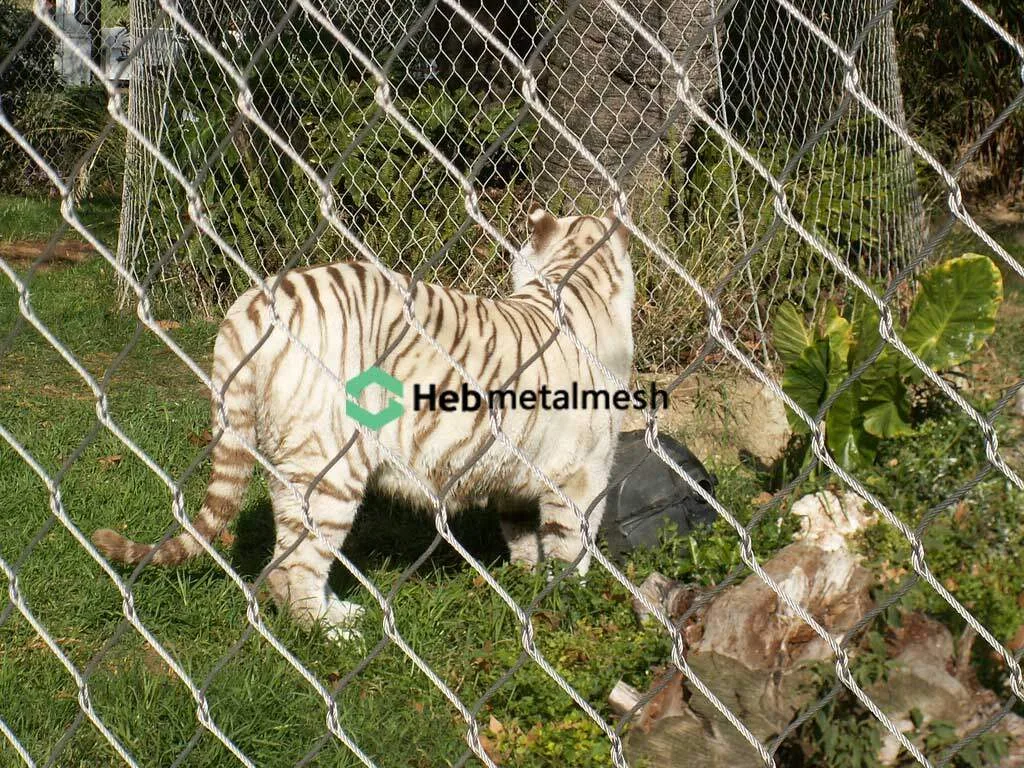
A tiger tests a fence with a claw, not a shoulder. It hooks a forepaw over a rope, pulls toward its chest, lets go, and comes back to the same few square metres tomorrow. The load that ends these panels is therefore not one dramatic impact but a small pull repeated in one place for years, and very little of a fence specification is written to answer it. What does answer it is the way the panel is built — whether a pull is carried outward along a continuous strand or delivered straight into a joint.
This page takes the animal’s behaviour as the brief and works out which parts of a tiger enclosure fence actually decide whether it holds.
Executive Summary
A tiger enclosure fence is normally specified as though the threat were a sudden impact, but the load that retires these panels is a hook-and-pull applied and reapplied at one aperture. At the same aperture size and the same rope diameter, handwoven construction and a ferruled grid behave differently under that load: a woven panel carries the pull along a continuous strand to its neighbours, while a ferruled grid delivers it to the ferrule joint at that crossing and stops. The two therefore differ in fatigue life, in how they fail, and in whether they warn anyone before a containment breach — so construction belongs in the specification, not only in the brochure. Woven mesh pays for that behaviour with longer fabrication and a tensioning regime that has to be done properly. The reference specification is the tiger enclosure fence product page.
Specifying a big-cat barrier and unsure which build to price? Send us the species, the barrier height, the panel span between supports and the exposure, and we will return the aperture, the rope diameter and the construction that match the load case.
Quick Answer: Does construction matter more than material?
At the same aperture size and the same rope diameter, yes. The material sets how much load a single strand can carry; the construction sets what the panel does with that load once it arrives. Because a tiger applies its load at one point, thousands of times, a panel that spreads the pull and a panel that concentrates it will diverge over a service life even though their catalogue numbers are identical.
Key Takeaways
- The design load on a big-cat barrier is a repeating point load, not a single impact.
- Handwoven construction is a load-path property: a continuous strand has no crossing to arrest a pull.
- A ferruled grid is not weak, but every ferrule joint is a place where a claw’s load stops moving.
- Fatigue, not impact, is what retires a tiger fence, and it stays invisible for years before it becomes visible.
- Woven mesh buys that behaviour with a longer lead time and a real tensioning discipline.
The Claw, Not the Shoulder
Most enclosure drawings imagine a charge. In a working tiger exhibit the first and most persistent contact is a forepaw: a claw hooked over a rope, a pull toward the body, a release, a repeat. That is a point load applied to one aperture, and the animal’s routine makes it a cyclic one — the same panel, the same height, often the same single opening.
This is an awkward load case to design against, because it is small enough that no single application threatens anything. It is also the only load case that is guaranteed to happen. A fence that is generously strong in a single pull test can still lose a panel to a load a fraction of that size, applied ten thousand times, if the pull is concentrated at one point rather than shared.
Why Handwoven Construction Is a Load-Path Word
There are two common ways to make a diamond mesh from stainless steel rope. One is to weave a single length back and forth so that it forms every diagonal of the sheet — this is what hand woven wire mesh means, and it is how a stainless steel rope mesh panel is produced in a factory rather than on site. The other is to lay cut lengths into a grid and lock every crossing with a pressed fitting.
The two can present the same aperture size and the same rope diameter and still not be the same barrier. A wire rope mesh is only as good as the path its load takes, and the difference between the two is where a pull goes when it arrives.
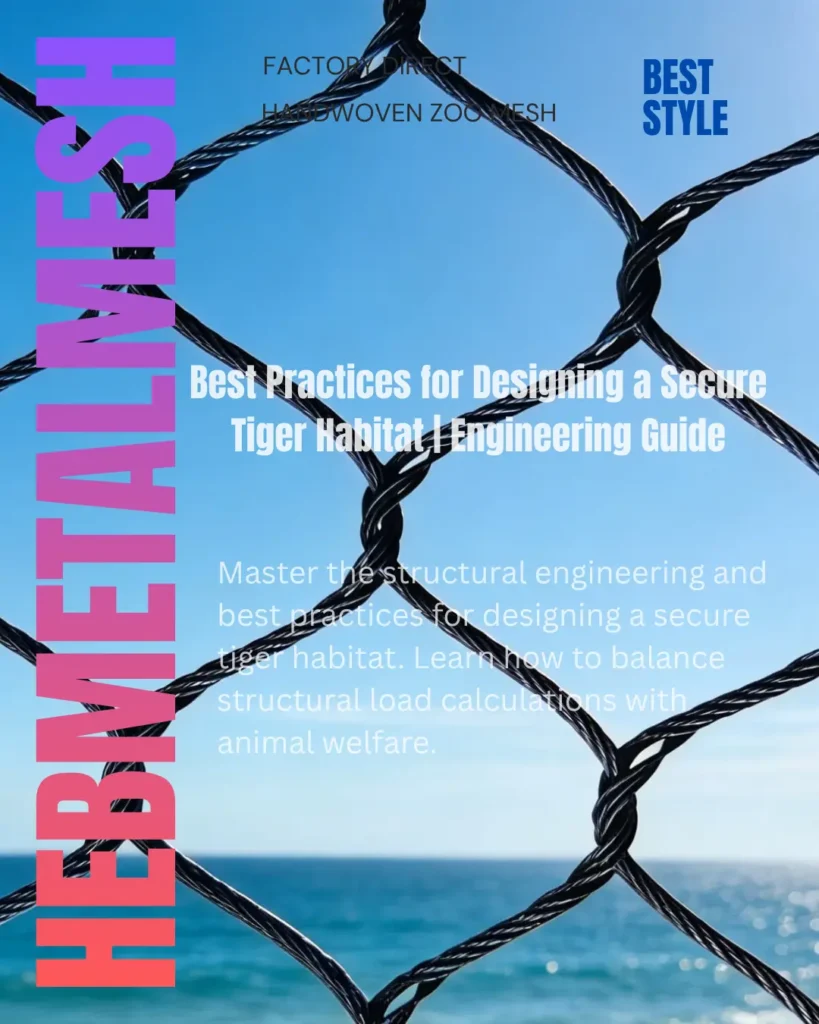
In a woven panel, a load applied at one aperture is resolved by the strand that passes through it and then by that strand’s neighbours, because the strand is continuous — a force has somewhere to travel. In a ferruled grid, the load travels until it reaches the nearest ferrule joint and is delivered there. Every ferrule joint is a deliberate discontinuity: a place where a moving load arrives with nothing to carry it onward, and where joint strength stops being a property of the strand and becomes a property of the fitting.
That is the whole meaning of handwoven vs ferruled. It also explains why woven vs ferruled is a structural question before it is a commercial one: the two products are not two prices for one thing, they are two answers to a load.
Where a Tiger Fence Actually Fails
Tiger fencing does not fail by tearing open. It fails by accumulating local damage at the points the animal favours, and by doing it quietly.
In a woven panel the first damage is usually wire breakage in one or two adjacent strands. Because the weave is continuous, a single broken wire does not release the panel: the surrounding strands continue to carry the load, and the panel holds its shape. That is a progressive failure rather than a sudden one, and it has real operational value — the enclosure keeps its containment while the defect is found and repaired.
A ferruled grid behaves differently at the same event. A wire break next to a ferrule joint unloads that connection and pushes its share into the neighbouring wires and the next joint along. The panel can look intact while the load path has already changed. In the worst case the sequence runs from a single wire to a loosened ferrule to a local opening, and only at that last step does it become visible as a containment breach.
The practical rule is not that one construction is safe and the other is not, but that the same animal produces two different failure sequences — and only one announces itself early.
Two Loads, Two Different Tests
A tiger exerts two loads on a barrier, and they are usually conflated.
The first is dynamic. An animal that charges, or lands on a panel from height, delivers energy in a fraction of a second, and the panel’s job is impact absorption — yielding far enough to take the energy out of the event and returning afterwards without permanent distortion.
The second is cyclic, and it is the one that decides the service life. A paw working the same aperture is a fatigue load: low amplitude, enormous repetition count. Steels do not have unlimited fatigue life at every stress level: a load well below the static strength of a wire can still start a crack at a stress concentration after enough cycles, which is exactly what a ferrule joint provides.
A meaningful pull test for a big-cat barrier therefore has two parts: one measures the response to a single large force, and the other asks whether the assembly contains any point where a small force, applied a great many times, has nowhere to go. Supplying only the first number is how a fence passes its acceptance test and still fails in year six.
Height, Climbing and Digging
Three behaviours set the geometry, and all three are about the frame rather than the mesh.
Tigers climb. A barrier is only a climbing barrier if the mesh is kept out of reach of any vertical surface the animal can brace against. A panel that a tiger can touch with a hind foot while gripping a post with a forepaw is a ladder. The fix is a clearance envelope: mesh set back from ledges, roofs and horizontal members, and an inward return at the top so that an animal which does reach the top line has nothing to pull itself over.
Tigers dig, and a dig proof detail is a buried apron or a concrete kerb carried below the mesh line rather than a heavier panel. A climbing mesh is a poor substitute for a footing detail, and no gauge of rope changes what happens under the sand.
Height is set by the leap height of the species with margin: a large tiger can clear several metres from a standing start and more from a raised feature, so the specification is driven by the highest platform inside the exhibit, not by the animal’s height. That calculation, and the rest of the welfare envelope, is set out by the zoological standards an accredited collection works to; the behavioural evidence on how a tiger investigates and leaves a barrier is documented by organisations such as Panthera, whose field work is the honest basis for assuming the animal will keep testing the same spot.
The Numbers, and the One That Is Not a Number
Five figures carry the containment argument.
Aperture size is the first, and it is the paw-safe decision. A stainless steel rope mesh for big cats is normally ordered in a fine aperture for the main envelope — 38 mm is the usual choice for the forepaw of an adult tiger — while a 51 mm aperture and larger are used where visibility or span matters more than paw exclusion. The rope diameter runs from 1.2 mm to 3.2 mm; the heavier end is used for main barriers because it carries more breaking load and resists fatigue. The alloy is 304 for inland sites and 316 where chlorides are present, and a corrosion resistant mesh in the right grade is what keeps the fatigue behaviour from being overtaken by pitting. The panel format runs to 9 m by 18 m, which decides how many frames, how many fixings and how many joints there are to inspect. The fifth figure is the expected service life.
The detail that is not a number is the termination. A panel has to be attached without creating the very concentration the construction is there to avoid, so the flexible cable netting at the frame edge is anchored through a ferrule termination that spreads load across many wires, rather than by a clamp that grips one bundle. The construction comparison sets this out against welded alternatives, and the fence’s height, clearance and footing belong with the safety standards that govern accredited exhibits. Where the design has to run many metres between posts, the span and support decisions follow from the same load case, and the tiger enclosure mesh range is supplied for this duty.
What Woven Construction Gives Up
An honest specification lists the costs as well as the benefits.
A hand woven panel is made to order, so lead time is measured in weeks and a mid-project change of aperture or rope diameter has to be planned for.
Tensioning is a real discipline rather than a formality. A woven stainless steel rope mesh only behaves as a membrane when it is pulled to the right tension and held there, and a panel that is left slack will move under the animal’s paw and work at its fixings instead of resisting.
Repair is a patch rather than a replacement. A local defect in a woven panel is repaired in place, which preserves the rest of the sheet, but it requires that the inspector noticed the wire breakage before it became an opening — and, as the section above sets out, the geometry that gives the panel its warning also hides the first broken wire inside the weave.
None of these argues against a woven panel for a tiger fence. They argue for choosing it deliberately rather than by the cheapest line on a supplier’s grid.
FAQ
Not in the sense of a single-pull figure. A heavier ferruled mesh can absorb a larger one-off load. The woven panel’s advantage is what it does with a small repeated load: the pull has a continuous path, so it is shared rather than concentrated, which is the load case a resident tiger actually produces.
Ask for the mesh count and the panel’s construction drawing. A continuous strand produces a fixed, countable diamond pitch across the full sheet and a defined strand path that cannot be replicated by joining cut lengths, so the two are distinguishable from the drawing before anything is delivered.
Because fatigue is a mechanical process, not a chemical one. Corrosion resistance stops the wire losing section to rust, but a repeat-loaded wire can still crack at a stress concentration after enough cycles. Choosing the alloy well removes one mechanism; choosing the construction well removes the other.
Send us the exhibit, not just the budget line. Tell us the species, the highest platform inside the barrier, the span between supports and the exposure, and we will return the aperture, rope diameter, alloy and construction that match how the animal will actually test the fence.